



Key Takeaways
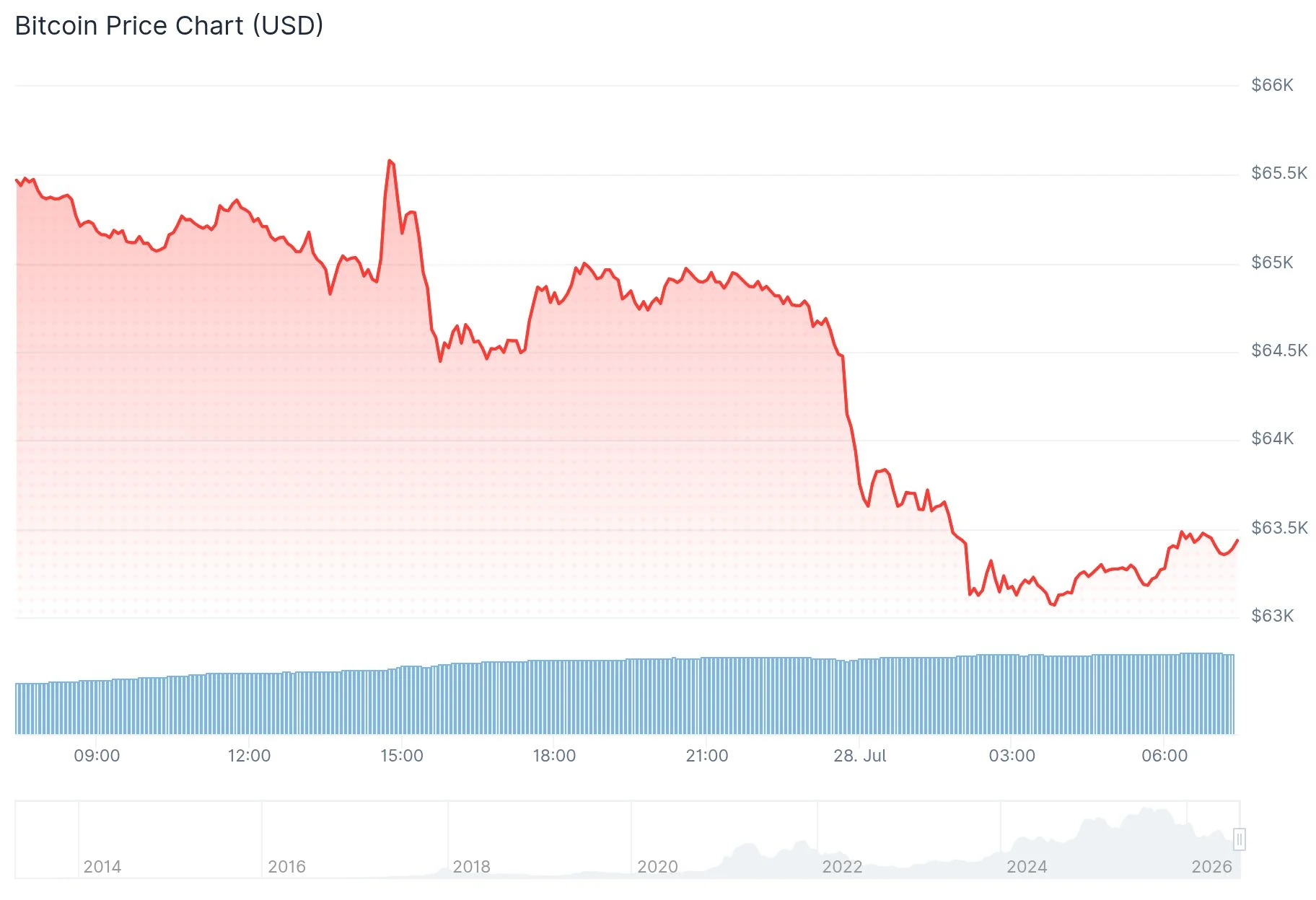
- BTC declined over 3% on Tuesday, reaching approximately $63,494 — marking its weakest performance since July 17
- Technology stocks tied to artificial intelligence experienced a brutal selloff, with South Korea’s KOSPI plunging more than 10%, creating ripple effects in cryptocurrency markets
- Market participants are assigning a 38% probability to an unexpected Federal Reserve rate increase this week, while September odds exceed 80%
- Technical analyst Michaël Van de Poppe identified critical moving average support zones at $64,289 and $63,261 for BTC
- Data from Santiment reveals whale addresses holding 10–10K BTC accumulated approximately 20,000 BTC within an 8-day window
The leading cryptocurrency experienced a decline exceeding 3% on Tuesday, touching $63,494 — representing a ten-day low. This downturn coincided with widespread selling pressure in artificial intelligence-focused technology equities that reverberated through global markets and digital asset spaces.
The Korean stock market witnessed significant turbulence as the KOSPI benchmark tumbled over 10%, driven by investor exits from AI semiconductor manufacturers. Major players Samsung Electronics and SK Hynix suffered substantial losses amid growing concerns regarding AI infrastructure investment levels and intensifying pressure from Chinese memory chip producers.
This bearish momentum extended into digital currency markets. Ethereum declined approximately 4.43%, Solana retreated 4.41%, and XRP fell 4.89% during the same trading period.
Federal Reserve Policy Weighs on Sentiment
Investor attention remains fixed on the Federal Reserve as its two-day policy meeting concludes Wednesday. Current market pricing suggests a 38% likelihood of an unexpected rate increase this week. Meanwhile, expectations for a September rate adjustment have surged beyond 80%, based on CME FedWatch Tool indicators.
Rising interest rate environments generally diminish the attractiveness of non-yield-bearing assets such as Bitcoin.

The cryptocurrency has faced challenges maintaining its recent bounce. Persistent capital outflows from US-based spot Bitcoin exchange-traded funds have created headwinds for price action over the preceding week.
During Sunday’s session, BTC successfully defended its 21-day and 50-day simple moving averages, positioned at $64,289 and $63,261 respectively. Digital asset analyst Michaël Van de Poppe characterized maintaining these thresholds as “a strong signal for the markets to be betting on the long side,” though he cautioned conditions remained “still a little fragile.” He indicated that observing a rally toward $66,000–$67,000 within the next one to three days would be necessary to validate strengthening bullish momentum.
Large Holders Continue Accumulating
Blockchain analytics from Santiment demonstrated that addresses containing between 10 and 10,000 BTC increased their holdings by 19,696 BTC across just eight days. Conversely, retail participation has shown signs of cooling — wallets holding less than 0.01 BTC exhibited reduced dip-buying behavior. Santiment characterized this dynamic as “usually constructive,” indicating supply concentration among higher-conviction holders.
Market analyst Ali Charts also highlighted that Bitcoin’s 3-day Bollinger Bands are beginning to compress. He observed that such low-volatility environments are “often followed by a major price expansion.”
During Monday’s session, BTC momentarily climbed toward $66,000 following reports that the United States and Iran had temporarily suspended military strikes. Both nations refrained from attacks since Sunday, with Iran’s foreign ministry confirming diplomatic discussions with Oman concerning the Strait of Hormuz reopening. This positive momentum dissipated by Tuesday’s trading.
Trading firm QCP Capital observed that Bitcoin and Ethereum maintained gains of roughly 11.6% and 24.6% respectively on a month-to-date basis, notwithstanding a difficult macroeconomic environment.
Bitcoin’s most recent price stood at $63,494, captured at 01:42 ET on July 28.
Get 3 Free Stock Ebooks
Discover top-performing stocks in AI, Crypto, and Technology with expert analysis.
- Top 10 AI Stocks - Leading AI companies
- Top 10 Crypto Stocks - Blockchain leaders
- Top 10 Tech Stocks - Tech giants


