



Key Takeaways
- Bitcoin declined to approximately $76,700, marking its lowest point in two weeks amid declining risk sentiment and increasing bond yields
- Liquidations exceeded $661 million within a 24-hour window, with 95% stemming from long positions using leverage
- On May 15, U.S. spot Bitcoin ETFs experienced $290.4 million in net withdrawals, preceded by a $630.4 million exodus on May 13
- Ethereum mirrored this downward trend with its own outflows and underperformed relative to Bitcoin
- The CLARITY Act progressed through the U.S. Senate Banking Committee with a 15-9 approval, marking regulatory advancement
[[LINK_START_1]]Bitcoin[[LINK_END_1]] tumbled to its lowest level in two weeks, touching $76,700 after retreating from the $80,000 threshold as Treasury yields surged and risk sentiment deteriorated. This decline has left market participants questioning whether this represents a temporary consolidation or signals the beginning of a more substantial downward trend.
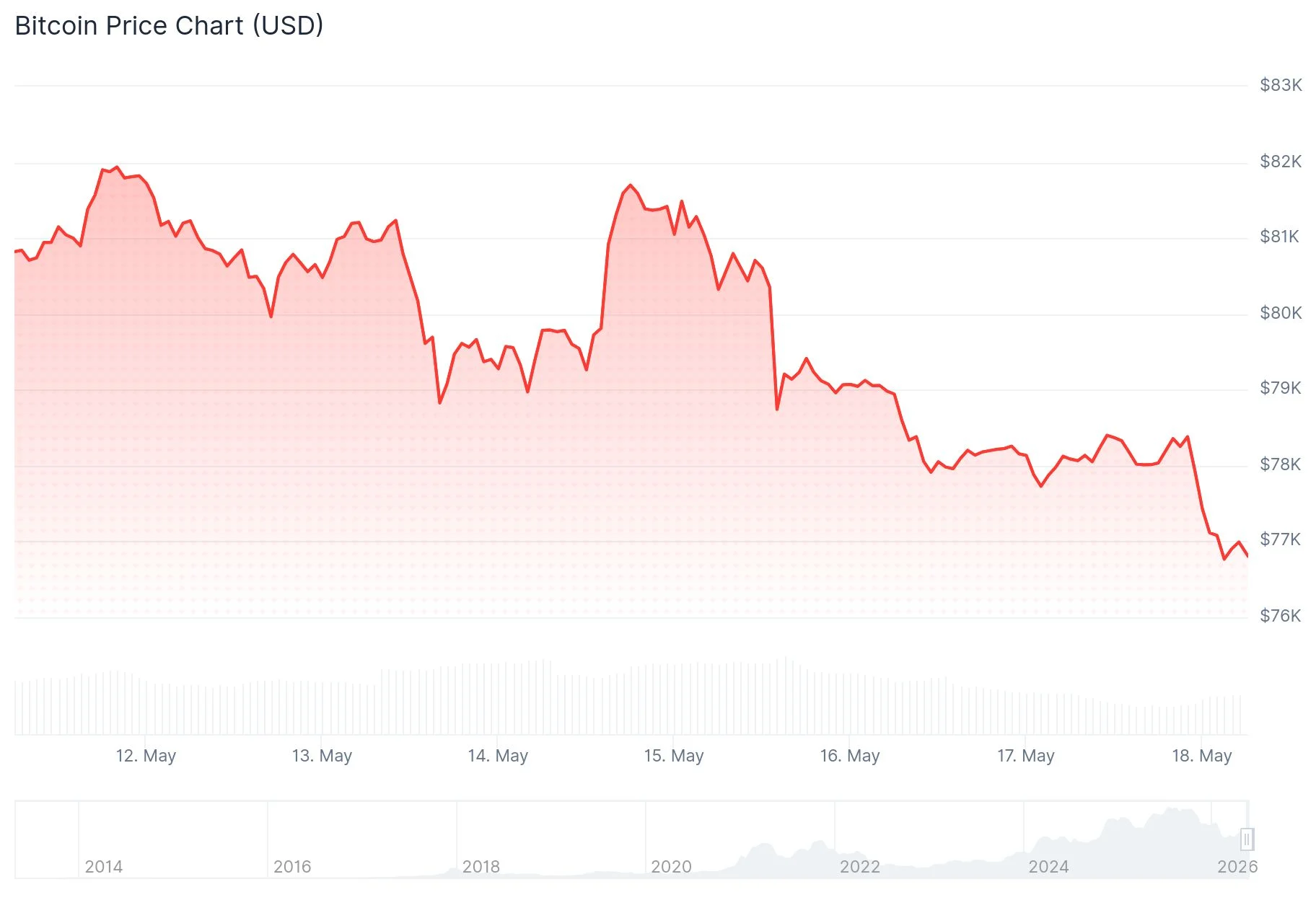
The downturn triggered substantial forced liquidations across the market. Approximately $661 million in cryptocurrency positions were eliminated during a 24-hour span. Remarkably, roughly 95% of these liquidations affected traders holding leveraged long positions. This concentration highlights how overleveraged bullish positioning can accelerate downward price movements through cascading liquidations.
Institutional Money Flows Turn Negative
The flow of capital into Bitcoin exchange-traded funds has emerged as a critical barometer for measuring institutional participation. Recent data suggests waning enthusiasm from larger investors.
On May 13, U.S. spot Bitcoin ETFs witnessed $630.4 million in net redemptions. Although May 14 brought a modest $131.3 million influx, May 15 saw another significant withdrawal of $290.4 million, based on Farside Investors tracking.
This choppy flow pattern indicates that institutional buyers are not providing consistent support. While it doesn’t signal a complete abandonment of crypto exposure, the reliable demand witnessed in previous months has clearly become more sporadic.

Broader Economic Forces Create Headwinds
Escalating bond yields represent a significant challenge for risk assets. As yields climb, fixed-income investments become more appealing, drawing capital away from speculative assets like cryptocurrencies. Bitcoin’s descent toward $78,000 coincided with a worldwide selloff in government bonds.
Market observers are closely monitoring Treasury yield movements, inflation metrics, and Federal Reserve communications. Sustained yield increases could suppress crypto valuations further. Conversely, easing yield pressure might create conditions for Bitcoin and alternative tokens to regain momentum.
Regulatory Development Offers Silver Lining
In a constructive development, the U.S. Senate Banking Committee approved the CLARITY Act with a 15-9 majority. This legislation seeks to establish clear frameworks for classifying digital assets — whether as securities, commodities, or distinct categories — while also addressing stablecoin regulation and oversight structures.
This represents meaningful progress for the cryptocurrency sector. Nevertheless, significant obstacles remain. Democratic committee members expressed reservations regarding anti-money laundering provisions and potential conflicts of interest. Committee approval represents just one stage in a lengthy legislative process.
For the present, Bitcoin maintains positioning above critical long-term support zones, and the regulatory environment shows gradual improvement. However, near-term dynamics — including persistent ETF outflows, liquidation pressure, and climbing yields — have created a precarious market environment requiring careful navigation.
Get 3 Free Stock Ebooks
Discover top-performing stocks in AI, Crypto, and Technology with expert analysis.
- Top 10 AI Stocks - Leading AI companies
- Top 10 Crypto Stocks - Blockchain leaders
- Top 10 Tech Stocks - Tech giants


