


Key Highlights
- Nvidia CEO Jensen Huang announced SK Hynix will supply DRAM for the company’s upcoming Vera data-center CPU
- The partnership between Nvidia and SK Hynix is projected to expand significantly through late 2026 and beyond into 2027
- A formal collaboration agreement between Nvidia and SK Group is scheduled for announcement on Monday
- The chip executive cautioned that memory supply constraints will continue for “quite a few years” driven by AI infrastructure demands
- During his Korean visit, Huang has scheduled meetings with executives from Samsung, Hyundai, and LG
During a weekend visit to South Korea, Nvidia’s Chief Executive Jensen Huang revealed that the company’s upcoming Vera data-center CPU will utilize DRAM from SK Hynix. The disclosure followed a casual meeting between Huang, SK Group’s Chairman Chey Tae-won, and SK Hynix’s CEO Kwak Noh-jung at a Seoul location on Sunday — notably held at Kkanbu Chicken restaurant over the popular Korean combination of fried chicken and beer, known locally as “chimaek.”
According to Huang, the collaboration between Nvidia and SK Hynix is anticipated to expand considerably throughout the latter half of 2026 and continue into 2027. Both organizations plan to present their official cooperation strategy to media representatives on Monday morning.
The Vera processor represents Nvidia’s inaugural standalone data-center CPU offering, positioning the company to compete directly against Intel’s Xeon processors and AMD’s Epyc series. Additionally, Vera will face competition from proprietary silicon developed by major cloud providers, including Amazon’s Graviton processor lineup.
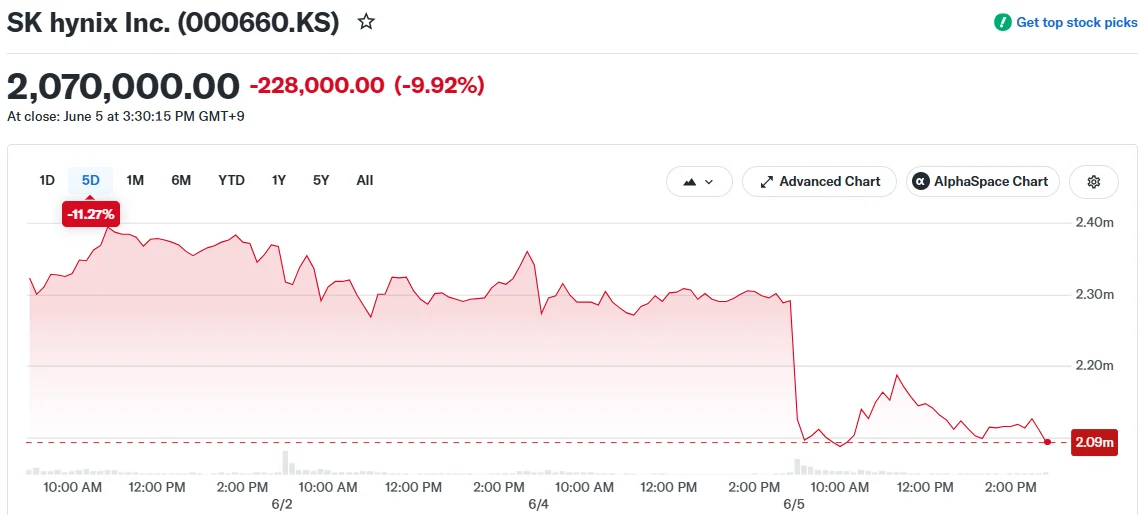
This partnership solidifies SK Hynix’s status as a critical supplier within the AI hardware ecosystem. For shareholders of the South Korean memory manufacturer, this development provides strong confirmation that revenue streams from AI infrastructure investments remain robust and expanding.
Supply Constraints Expected to Persist
Huang delivered frank assessments regarding ongoing supply challenges. He indicated that shortages span multiple components including wafers, packaging materials, and silicon photonics, with no near-term resolution in sight.

“It is going to persist for several years,” he said.
While this presents challenges for companies attempting to procure chips, it simultaneously supports favorable pricing conditions for memory manufacturers like SK Hynix and Samsung.
The demand surge originates from cloud service providers and enterprise clients accelerating their AI infrastructure deployments. Huang’s statements indicate that current demand levels significantly exceed what existing supply chains can accommodate.
Broader Strategic Meetings
Nvidia’s presence in Seoul extends beyond the SK Hynix partnership. Huang’s itinerary includes discussions with representatives from Samsung Electronics, Hyundai Motor Group, and LG Group throughout his Korean visit.
The CEO also mentioned ongoing conversations with telecommunications operators regarding network infrastructure’s role in supporting AI systems. This suggests potential future scenarios where AI computing workloads might distribute beyond traditional centralized data centers into telecommunications networks.
Huang characterized the Vera processor as representing significant advancement in processor innovation. Nvidia unveiled Vera during the Computex conference in Taipei earlier in June, where Huang and SK Group Chairman Chey were photographed together at the SK Hynix exhibition area.
The business relationship between Nvidia and SK Hynix encompasses AI supercomputers, CPU development, and robotics implementations, Huang explained. He emphasized that both companies are collaborating across numerous industry sectors.
Nvidia (NVDA) stock concluded Friday’s trading session at $135.05, reflecting gains exceeding 170% over the trailing twelve-month period. SK Hynix shares trade on the Korea Stock Exchange under the ticker symbol 000660.
Get 3 Free Stock Ebooks
Discover top-performing stocks in AI, Crypto, and Technology with expert analysis.
- Top 10 AI Stocks - Leading AI companies
- Top 10 Crypto Stocks - Blockchain leaders
- Top 10 Tech Stocks - Tech giants


