



Key Takeaways
- The Pudgy Penguins brand secured distribution in over 3,100 Walmart locations plus Target—an exceptional achievement for blockchain-based intellectual property.
- The parent company Igloo successfully secured $11 million in venture funding during 2024, with Founders Fund leading the investment round.
- Official documentation explicitly states the PENGU token serves “for fun and entertainment only” and carries “no commercial value.”
- The token’s complete supply reaches 88.89 billion units, with approximately 70.72% already released into circulation, while additional cliff-based unlocks remain scheduled.
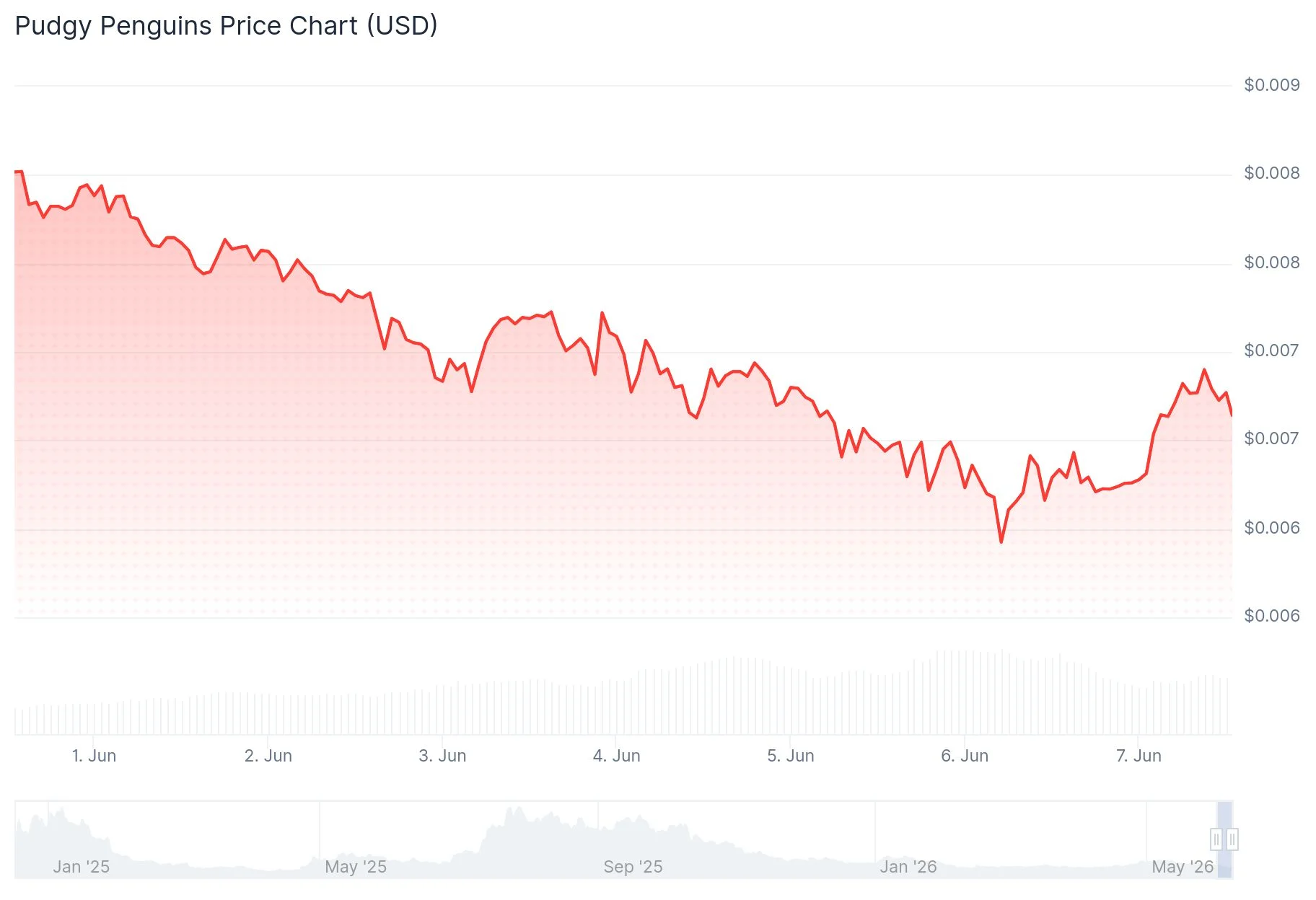
- Current market valuation for PENGU ranges from $396 million to $424 million across roughly 63 billion circulating tokens.
What began as a non-fungible token project has transformed into something significantly more substantial. Pudgy Penguins has evolved beyond digital collectibles into a recognized consumer brand with physical product distribution, mainstream visibility, and an engaged community. Achieving this level of traditional market penetration remains exceptionally rare for blockchain-originated ventures.
The retail expansion represents genuine market validation. Securing shelf space across 3,100 Walmart stores nationwide, plus additional placement in Target locations, demonstrates substantial commercial traction. These partnerships represent significant milestones that the overwhelming majority of cryptocurrency projects never achieve. This retail presence provides the Pudgy Penguins ecosystem with tangible credibility rarely seen in the digital asset space.
Igloo, the corporate entity managing the brand, attracted $11 million in capital during 2024. Founders Fund, a prominent venture capital institution with a strong track record, spearheaded this financing round. This institutional investment suggests sophisticated investors recognize substantial growth potential in Igloo’s business model beyond cryptocurrency speculation.
Understanding PENGU’s Actual Function
This is where the investment thesis becomes more nuanced. PENGU functions as the ecosystem’s digital asset, but ownership conveys no equity position or revenue participation. The official claiming documentation explicitly characterizes the token as existing “for fun and entertainment only” with “no commercial value.” This remarkably transparent language deserves careful consideration from anyone evaluating an investment.
Holding PENGU tokens provides no financial claim to toy revenue, licensing income, or any commercial proceeds generated by the Pudgy Penguins intellectual property. Additionally, insiders control 29.28% of total token supply—specifically 17.80% allocated to current and future team members, with another 11.48% held by the company.

While such allocation structures are common across cryptocurrency projects, it still represents significant centralization within a token offering limited explicit utility beyond community participation.
Token Supply Dynamics and Release Schedule
Current CoinGecko data indicates approximately 63 billion PENGU tokens trading actively, while Tokenomist reports the maximum supply at 88.89 billion tokens. This means roughly 70.72% of all tokens have already entered circulation.
The release mechanism incorporates cliff vesting for certain allocations. Rather than gradual linear unlocks, this structure releases large quantities simultaneously at predetermined dates. These events can create sudden dilution pressure on existing holders. The complete supply distribution timeline continues to unfold.
Trading activity remains consistently robust, with genuine liquidity available across multiple exchanges. PENGU maintains real market presence with sufficient volume depth for typical retail position sizing without excessive slippage concerns.
Valuation currently sits between $396 million and $424 million. This positions PENGU in the middle tier of digital assets—substantial enough to demonstrate market validation, yet distant from top-tier cryptocurrency market capitalizations.
PENGU’s distinguishing characteristic compared to typical meme tokens lies in its underlying brand foundation. The retail partnerships are verifiable. The institutional financing is documented. The cultural recognition is measurable.
However, the disconnect between brand equity and token economics remains the fundamental consideration for anyone assessing PENGU from an investment perspective.
Get 3 Free Stock Ebooks
Discover top-performing stocks in AI, Crypto, and Technology with expert analysis.
- Top 10 AI Stocks - Leading AI companies
- Top 10 Crypto Stocks - Blockchain leaders
- Top 10 Tech Stocks - Tech giants


