



Key Highlights
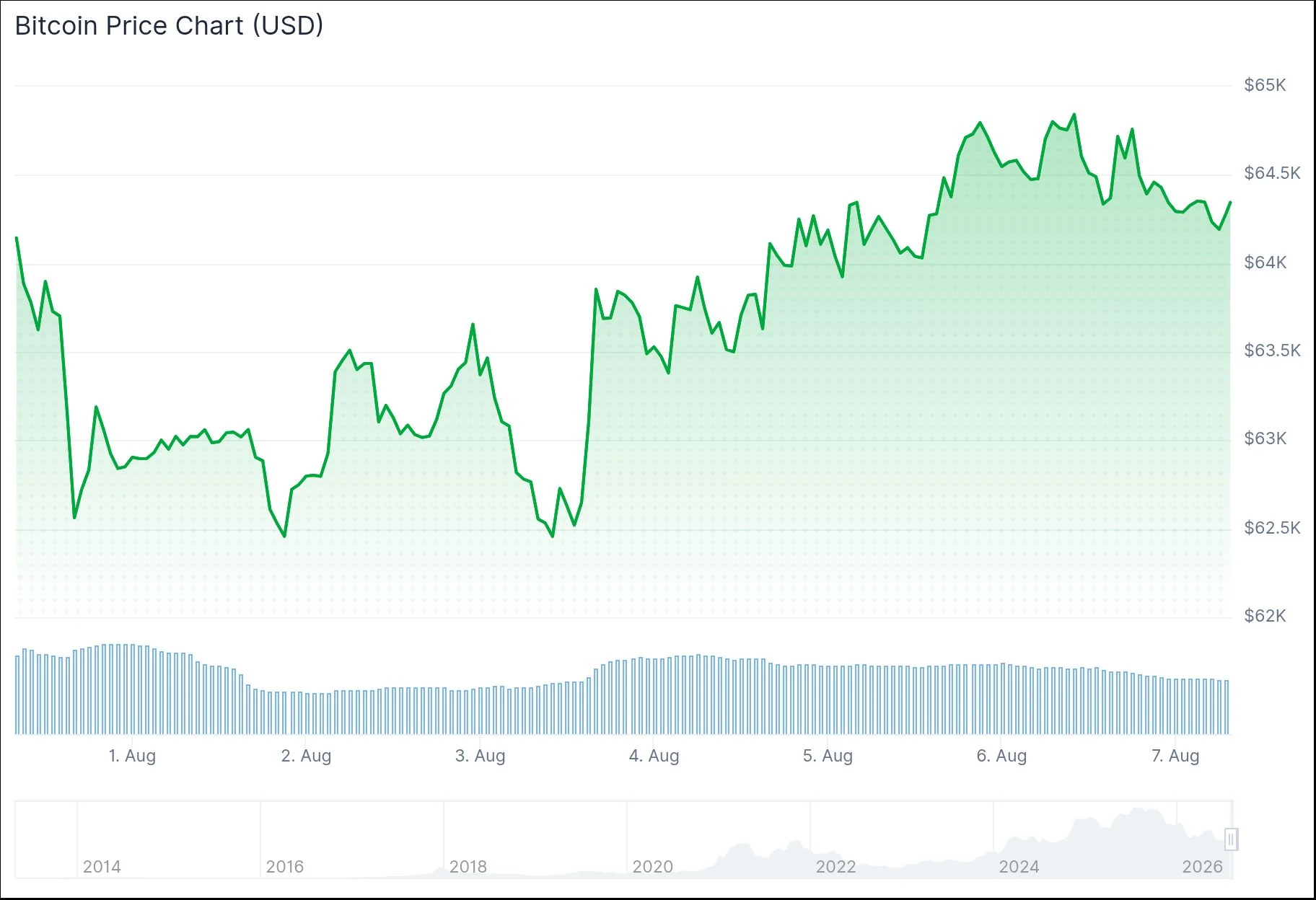
- Bitcoin declined 0.69% to approximately $64,384, facing rejection at the $64,800–$65,000 resistance level
- Weekly U.S. jobless claims registered at 199,000, undershooting expectations of 204,000 and indicating labor market resilience
- Market participants now assign a 54.71% probability to a 25-basis-point Federal Reserve rate increase in September
- Escalating oil prices and geopolitical tensions surrounding the Strait of Hormuz weighed on risk-sensitive assets
- Bitcoin ETF inflows surged to $626 million during early August, representing a significant jump from July’s $172.4 million
Bitcoin experienced downward pressure on Thursday following the release of stronger-than-anticipated U.S. employment figures and mounting expectations for additional Federal Reserve rate tightening. The leading digital asset by market capitalization declined 0.69% to trade at $64,384, retreating after encountering resistance at crucial technical levels.
According to the U.S. Department of Labor’s latest release, initial unemployment claims totaled 199,000 for the week concluding August 1. This figure fell short of economist projections calling for 204,000 and registered marginally above the previous week’s upwardly revised 198,000. Meanwhile, the four-week moving average declined to 198,750, representing a decrease of approximately 4,500 from the prior period’s calculation.
Robust labor market conditions provide the Federal Reserve with additional justification to maintain elevated interest rates for an extended period. An environment of higher borrowing costs typically diminishes investor appetite for speculative assets such as Bitcoin.
Digital asset analyst Ted Pillows shared observations on X indicating that spot market participants were actively accumulating BTC at higher price points, commenting “This looks good.” His remarks suggested that certain market participants continue to identify value at prevailing levels, despite mounting macroeconomic challenges.
According to the CME FedWatch Tool, market participants are currently pricing in a 54.71% likelihood of a 25-basis-point interest rate increase at the Federal Reserve’s September policy meeting. Investors are also closely monitoring Fed Chair Kevin Warsh, who is reportedly developing a revised communication strategy for the central bank.

Middle East Tensions Compound Market Weakness
Crude oil prices climbed sharply on Thursday, further dampening sentiment across risk asset classes. Market participants evaluated emerging reports regarding a potential agreement to restore operations through the Strait of Hormuz, with Iran and Oman reportedly examining a preliminary framework. According to circulating details, the proposed arrangement would impose restrictions on U.S. and Israeli vessel transit through the strategic waterway pending compensation payments.
Such terms would almost certainly face rejection from Washington, ensuring continued uncertainty in global energy markets. Bitcoin trended lower in tandem with other risk-correlated assets as market participants assessed the geopolitical developments.
Institutional Demand Strengthens Through ETF Vehicles
Notwithstanding recent price volatility, spot Bitcoin ETF activity demonstrated notable improvement. Capital inflows totaled $626 million during the opening days of August, marking a substantial increase from the $172.4 million recorded throughout the entirety of July, based on analytics from SoSoValue.
This recovery follows a challenging period during which Bitcoin ETF products experienced approximately $7 billion in combined net outflows spanning May and June.
From a technical perspective, BTC has rebounded from recent lows around $62,400 but continues struggling to establish a foothold above the $64,800–$65,000 resistance zone. Selling pressure has consistently emerged near that threshold, driving prices back toward the $64,000 support region.
The $626 million in spot Bitcoin ETF inflows recorded during early August represents an encouraging development amid Bitcoin’s ongoing price consolidation phase.
Get 3 Free Stock Ebooks
Discover top-performing stocks in AI, Crypto, and Technology with expert analysis.
- Top 10 AI Stocks - Leading AI companies
- Top 10 Crypto Stocks - Blockchain leaders
- Top 10 Tech Stocks - Tech giants


