



Key Takeaways
- BTC is currently priced at approximately $77,327, showing a marginal 0.1% daily gain but facing a weekly decline exceeding 3%
- According to CryptoQuant analysts, bitcoin needs to breach the $81,700 threshold to validate a fresh bull cycle
- Major resistance barriers exist in the $77,100–$80,200 range, with additional ceilings extending toward $88,700
- U.S. spot Bitcoin exchange-traded funds experienced $463 million in combined withdrawals over the past week, breaking a three-week positive flow pattern
- Research from Bitcoin Suisse demonstrates that adding just 2.5% BTC exposure to traditional portfolios can boost annual returns from 6.2% to 8.6%
Bitcoin is currently consolidating near the $77,327 mark, posting a modest 0.1% increase on Sunday while nursing a weekly decline surpassing 3%. Market sentiment remains pressured by sustained elevated interest rate forecasts, which continue to enhance the relative appeal of dollar-based investment vehicles.
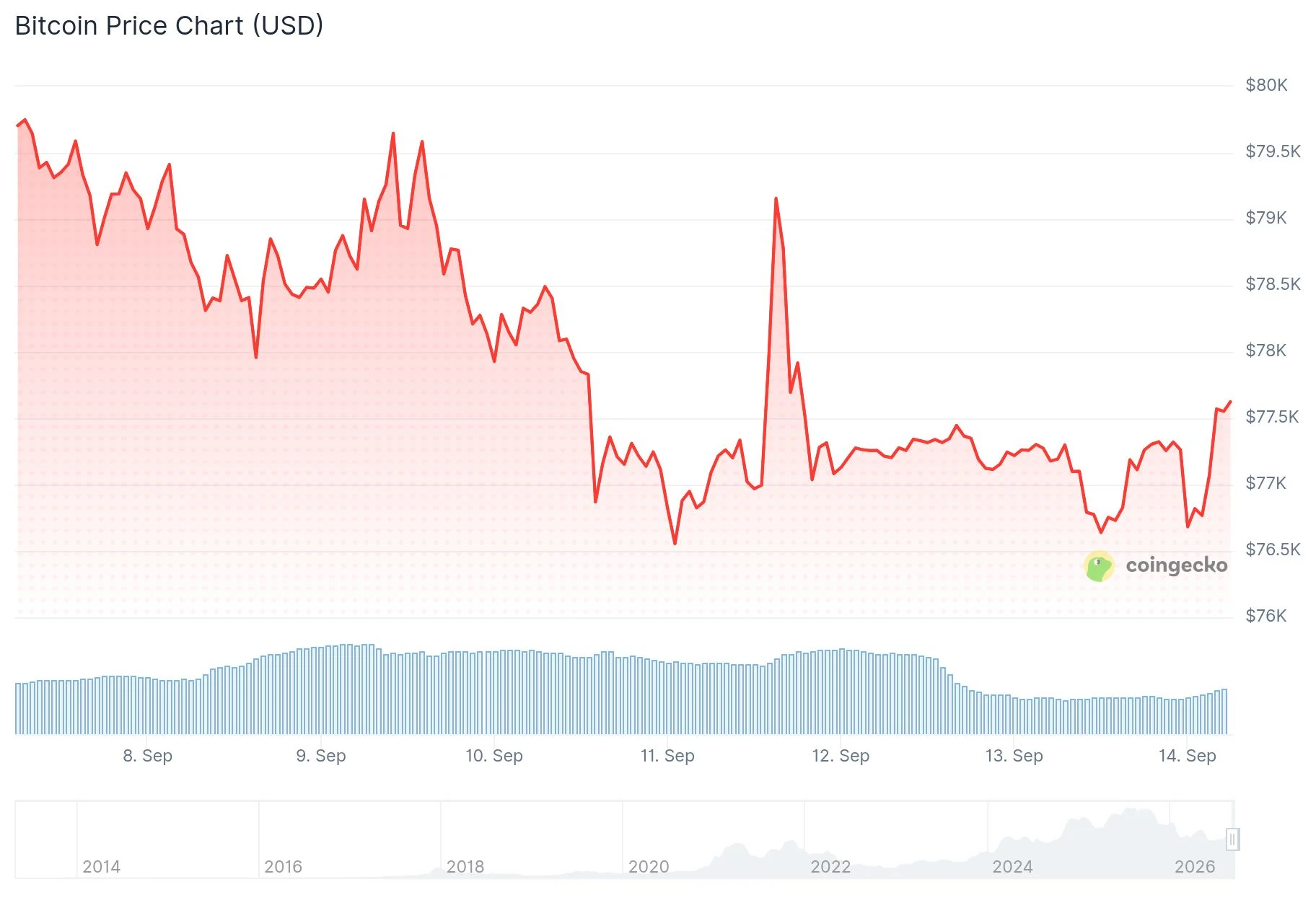
Onchain intelligence provider CryptoQuant has observed that the digital asset’s impressive 24% surge during the preceding two-week period has now lost momentum. The cryptocurrency has entered a consolidation phase, trading within a defined corridor between $76,000 and $82,000 without establishing a decisive directional move.
According to Julio Moreno, who leads research operations at CryptoQuant, the most significant resistance barrier spans from $77,100 to $80,200. Data reveals that long-term bitcoin holders liquidated approximately 539,000 BTC within this price band during a 30-day window earlier this year, establishing it as the most concentrated supply region above present valuation levels.
Beyond this zone, the 365-day moving average currently rests around $81,700. Historical market patterns indicate that sustained bitcoin bull phases typically commence when price action successfully closes above this technical benchmark. Moreno suggests that a definitive move beyond this threshold would provide strong confirmation of an emerging bullish cycle.
Additional overhead resistance can be identified at $83,600, derived from CryptoQuant’s 3x Metcalfe band calculation, which determines fair value by analyzing network utilization metrics including active wallet addresses. The $88,700 price point represents the upper boundary of the trader realized price framework, a level where profit-taking activity has traditionally intensified.

Market analyst Daan Crypto Trades (@DaanCrypto) offered his perspective via X, observing that $BTC continues to “chop around right at its major high timeframe resistance level.” He acknowledged that a move toward the $83K zone remains logical from a liquidity standpoint, while emphasizing that maintaining the $73,000–$74,000 support region is essential for preserving his bullish outlook on extended timeframes.
Exchange-Traded Fund Activity Shifts Negative
U.S. spot Bitcoin ETF products registered combined net withdrawals totaling $463 million during the September 7–11 period, according to data shared by Wu Blockchain (@WuBlockchain). This outflow pattern terminated a three-consecutive-week stretch of positive inflows, contributing to the increasingly cautious market atmosphere ahead of the Federal Reserve’s upcoming FOMC policy decision scheduled for Wednesday.
Examining potential downside scenarios, Moreno identifies the $70,000 level—coinciding with the 200-day moving average—as the nearest substantial support. Should selling pressure intensify beyond that point, the $62,000 to $65,000 zone could attract buying interest, as long-term holders accumulated roughly 476,000 BTC within this range during the current year.
Building the Investment Case for Digital Assets
Bitcoin Suisse presented compelling evidence supporting BTC’s role as a portfolio diversification tool in their recently published Crypto Wealth Management Report 2026. With United States federal government debt surpassing the $40 trillion threshold and hyperscale technology companies projected to deploy over $800 billion toward artificial intelligence infrastructure this year, conventional stock-and-bond diversification strategies face mounting challenges.
Their quantitative analysis demonstrated that reallocating just 1% of a portfolio to BTC from fixed-income holdings increases annualized returns from 6.2% to 7.2%. Expanding that allocation to 2.5% produces an even more substantial improvement, pushing expected returns to 8.6%.
In summarizing the present market environment, CryptoQuant’s Moreno stated: “Bitcoin simply needs to digest the overhead supply and break its valuation ceilings before a new leg up can develop.”
Get 3 Free Stock Ebooks
Discover top-performing stocks in AI, Crypto, and Technology with expert analysis.
- Top 10 AI Stocks - Leading AI companies
- Top 10 Crypto Stocks - Blockchain leaders
- Top 10 Tech Stocks - Tech giants


