



TLDR
- Brent crude declined approximately 2% to reach $102.53 while WTI decreased roughly 1.8% to $100.04 on Friday
- Market sentiment improved following reports suggesting Saudi Arabia could restore 50% of its East-West pipeline capacity in the near term
- The Kingdom has begun offering additional crude supplies to Asian refineries through ship-to-ship operations near Oman
- A Togo-flagged vessel was targeted by Iran’s Revolutionary Guards in the Strait of Hormuz on Thursday
- International diplomatic engagement is intensifying before next week’s UN General Assembly gatherings
Oil prices continued their three-day decline on Friday as market participants took comfort in prospects that Saudi Arabia might partially resume interrupted supply operations, despite ongoing hostilities across the Middle East region.
Brent crude futures declined approximately 2.2% to settle at $102.53 per barrel during mid-morning trading in GMT. West Texas Intermediate decreased 1.8% to reach $100.04 per barrel.
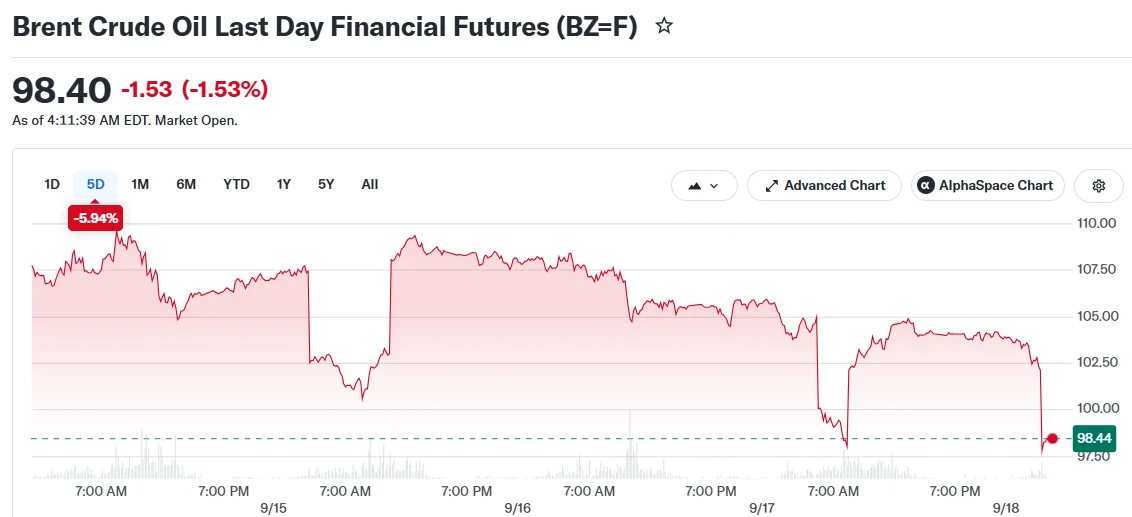
The international benchmark is positioned for its first weekly decline in three weeks, down approximately 2% across the trading period.
Saudi Arabia Works to Restore Pipeline Capacity
Earlier in the week, benchmark prices had surged near four-month peak levels. The rally followed initial reports indicating that crude shipments from Saudi Arabia’s Yanbu export terminal on the Red Sea had been halted after drone strikes targeted the East-West pipeline infrastructure.
The Kingdom has since initiated efforts to restore approximately 50% of the pipeline’s operational capacity within the coming days, based on multiple media sources. The critical pipeline infrastructure typically transports crude oil westward to Yanbu for international export operations.

Additionally, Riyadh has begun providing supplementary crude shipments to Asian refining facilities via ship-to-ship transfer operations near Oman’s Sohar port facility, offering purchasers alternative supply channels and alleviating immediate availability concerns.
“Recent steps to restore Saudi export infrastructure have alleviated some of the immediate supply concerns,” commented Priyanka Sachdeva, head of market insights at Phillip Nova.
Despite the recent retreat, both international and U.S. crude benchmarks continue trading above the $100 per barrel threshold. Market participants await concrete confirmation that actual petroleum shipments have normalized.
“The critical issue is whether actual supply flows can return to normal levels and what the realistic timeframe might be. If we observe a consistent improvement in Hormuz shipping activity, additional geopolitical risk premium could dissipate further,” Sachdeva noted.
Conflict and Diplomacy Both in Focus
Military confrontations have persisted. Saudi Arabia and Yemen’s Iran-aligned Houthi forces conducted additional cross-border attacks on Thursday.
Iran’s Revolutionary Guards Navy also confirmed that a Togo-flagged tanker vessel was attacked during what authorities described as an “unauthorized transit” through the Strait of Hormuz on Thursday. Iranian government media outlets reported the incident early Friday morning.
The Strait of Hormuz continues to serve as a critical flashpoint. The waterway represents one of the planet’s most vital petroleum shipping corridors.
On the diplomatic front, President Trump informed Axios he is approaching a determination on whether to restart comprehensive military operations against Iran.
Trump is scheduled to convene with leadership from Saudi Arabia, the UAE, Qatar, Bahrain, Kuwait and Oman during next week’s UN General Assembly sessions in New York.
China has simultaneously expanded its diplomatic engagement. Chinese Foreign Minister Wang Yi called on both Washington and Tehran to demonstrate restraint and facilitate the reopening of the Strait of Hormuz.
Iranian Foreign Minister Abbas Araghchi conducted individual consultations with Chinese and Pakistani representatives.
The United States and Iran have not engaged in peace negotiations since an interim arrangement reached in June collapsed within several weeks.
Market analysts indicate oil prices will maintain elevated levels until tangible evidence emerges showing improved petroleum flows throughout the region.
Get 3 Free Stock Ebooks
Discover top-performing stocks in AI, Crypto, and Technology with expert analysis.
- Top 10 AI Stocks - Leading AI companies
- Top 10 Crypto Stocks - Blockchain leaders
- Top 10 Tech Stocks - Tech giants


