



Key Highlights
- Brent crude declined 0.8% to settle at $106.91 per barrel while WTI fell 1% to $101.14 on Wednesday
- Prices have remained near or above the $100 threshold since hostilities between the U.S.-Israel alliance and Iran commenced in late February
- Tehran’s blockade of the Strait of Hormuz has cut off approximately 20% of worldwide oil and LNG transportation
- President Trump will conduct talks with Chinese President Xi Jinping on Thursday and Friday; Beijing remains Tehran’s largest petroleum customer
- U.S. Energy Information Administration forecasts the critical waterway will stay shut through late May, with full recovery unlikely before late 2026
Crude oil markets retreated on Wednesday, snapping a three-session winning streak. Brent crude futures declined 0.8% to settle at $106.91 per barrel, while U.S. West Texas Intermediate benchmark slipped 1% to close at $101.14.
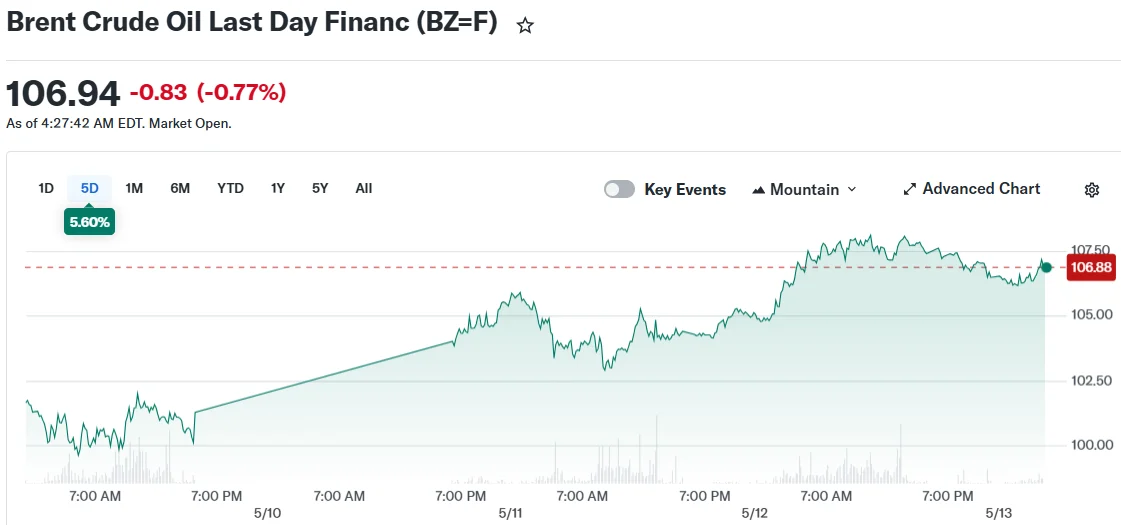
The downturn emerged as market participants awaited developments on a tenuous Middle East ceasefire agreement and monitored preparations for the upcoming bilateral summit between President Donald Trump and Chinese President Xi Jinping scheduled for Thursday and Friday in Beijing.
Both major oil price indicators have hovered at or beyond the $100 per barrel mark since military operations involving the United States, Israel, and Iran erupted in late February. The hostilities prompted Tehran to implement an effective blockade of the strategically vital Strait of Hormuz.
Approximately 20% of the world’s oil supplies and liquefied natural gas shipments typically transit through this narrow waterway. The shutdown has created significant supply constraints and sustained elevated pricing levels across energy markets.
“The market remains highly reactive to every update from the region, meaning sharp swings are likely to persist,” said Priyanka Sachdeva, senior market analyst at Phillip Nova.
On the previous trading day, prices had surged more than 3% following the collapse of optimism regarding a durable ceasefire arrangement. This development eliminated near-term prospects for reopening the strategic waterway.

Supply Disruption From Iran Conflict
Energy analysts at ING noted that petroleum markets continue operating “in limbo” as the conflict enters its tenth week. The combination of Gulf region supply interruptions and declining storage levels has created substantial uncertainty for market forecasts.
Crude oil stockpiles in the United States decreased for the fourth consecutive week in the most recent reporting period, based on figures released by the American Petroleum Institute. Refined product inventories also registered declines. Official government inventory statistics were scheduled for release later on Wednesday.
Eurasia Group informed clients through a research note that cumulative supply losses have now surpassed one billion barrels. The consultancy projects crude prices will maintain levels above $80 per barrel throughout the remainder of 2025.
The U.S. Energy Information Administration’s baseline scenario anticipates the Strait of Hormuz will remain effectively closed through at least the final weeks of May. Even assuming maritime traffic resumes in June, the agency projects shipment volumes will not return to pre-conflict levels until the latter portion of 2026.
Beijing Summit Takes Center Stage
Trump stated on Tuesday that he anticipates resolving the Iran situation without requiring Beijing’s assistance. China continues purchasing Iranian crude oil in substantial volumes despite ongoing U.S. sanctions enforcement efforts.
The upcoming Trump-Xi bilateral discussions have captured significant attention from energy market observers. Any modification to China’s approach regarding Iranian petroleum imports could materially impact worldwide supply equilibrium.
Escalating crude prices are increasingly affecting American households. Transportation fuel expenses have climbed higher, and overall U.S. consumer price inflation accelerated substantially for the second consecutive month in April, marking the steepest annual increase witnessed in nearly three years.
Economic forecasters anticipate additional inflationary pressure during upcoming months. The Federal Reserve is broadly anticipated to maintain current interest rate policy unchanged, a stance that could eventually dampen petroleum demand over an extended timeframe.
Get 3 Free Stock Ebooks
Discover top-performing stocks in AI, Crypto, and Technology with expert analysis.
- Top 10 AI Stocks - Leading AI companies
- Top 10 Crypto Stocks - Blockchain leaders
- Top 10 Tech Stocks - Tech giants


