



Key Takeaways
- Brent crude declined 0.67% to $89.10 while WTI slipped 0.77% to $82.89 during Friday trading
- Weekly declines range from 4% to 5.5% across both major oil benchmarks
- Washington confirms no intention to restore June peace framework with Tehran
- American officials near completion of deal for long-term Venezuelan oil field development
- Caracas mulls OPEC departure amid warming relations with United States
Crude oil markets declined Friday, steering both primary benchmarks toward their first weekly decline following two consecutive weeks of upward movement.
Brent crude settled at $89.10 per barrel, with West Texas Intermediate closing at $82.89. Weekly performance shows Brent declining approximately 5.3% while WTI has retreated roughly 4.3%.
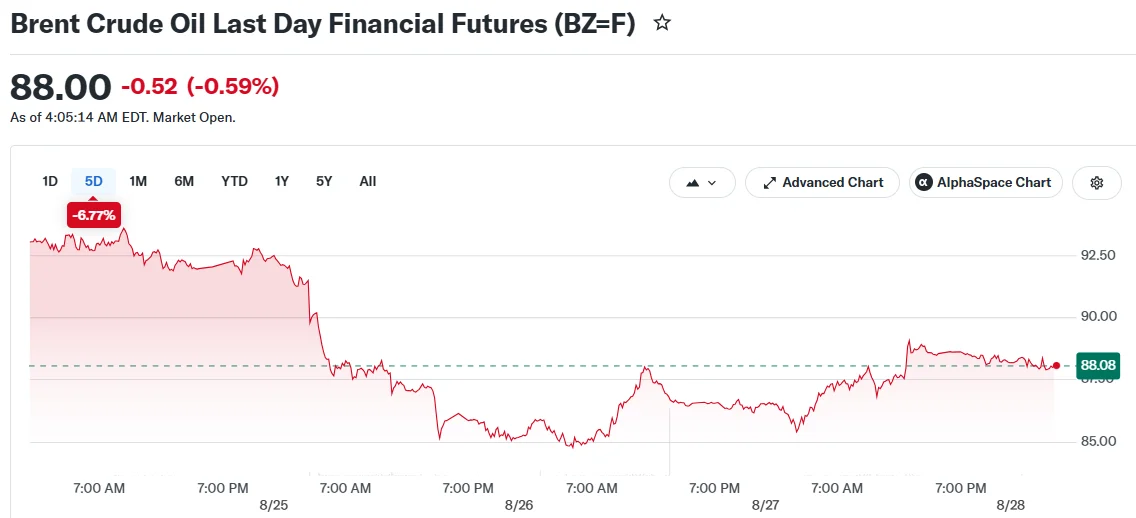
This downward trajectory persisted despite Thursday’s temporary uptick, sparked by Wall Street Journal coverage revealing the Trump administration’s unwillingness to reinstate the June peace framework with Iran.
Iranian officials have consistently maintained that Washington must respect the previous agreement before any fresh negotiations commence. The framework expired in early August.
U.S. officials confirmed this week that active diplomatic engagement with Tehran has ceased, despite international pressure from other nations attempting to restart dialogue between both parties.

Hormuz Strait Developments
The Strait of Hormuz continues serving as a critical flashpoint for oil markets. Recent reports indicate Iran and Oman have reached an understanding permitting limited maritime passage, while Tehran prepares requirements for expanded access.
Prior to U.S.-Iran hostilities, approximately one-fifth of global petroleum supplies transited through this strategic waterway. Any expansion of passage rights would introduce additional supply capacity, creating downward price pressure.
Goldman Sachs calculations indicate current Gulf region exports stand at 15 to 16 million barrels daily. This represents a shortfall of 7 to 8 million barrels versus pre-conflict volumes, yet exceeds March’s nadir by 5 to 6 million barrels.
ING analysts observe that petroleum producers are adjusting operations and demonstrating increased confidence shipping crude through the strait notwithstanding continued regional tensions.
Earlier this week, Washington unveiled what it characterized as unprecedented sanctions targeting Iran. Tehran denounced the measures as cruel and claimed they’ve become ineffective tools.
Venezuelan Oil Developments
Another significant factor pressuring crude prices involves Venezuela. Reports suggest the Trump administration approaches finalization of extended access arrangements to Venezuelan petroleum reserves.
The proposed arrangement would permit U.S. corporations to operate multiple Venezuelan oil fields. Washington removed Nicolas Maduro from power and assumed operational control of the nation’s petroleum sector earlier this year.
Industry experts warn that meaningful supply increases from Venezuela remain distant, considering the deteriorated condition of the country’s petroleum extraction and processing facilities.
Venezuela reportedly contemplates withdrawing from OPEC membership as Washington relations strengthen. This would mark the second significant departure from the cartel following the United Arab Emirates’ announced exit.
Geopolitical tensions contributed additional market volatility after Moscow indicated potential strikes against British military installations following Ukraine’s deployment of British-provided cruise missiles. Trump stated his skepticism regarding Russian aggression toward NATO member states.
Get 3 Free Stock Ebooks
Discover top-performing stocks in AI, Crypto, and Technology with expert analysis.
- Top 10 AI Stocks - Leading AI companies
- Top 10 Crypto Stocks - Blockchain leaders
- Top 10 Tech Stocks - Tech giants


