


Key Highlights
- Brent crude climbed 1.3% to reach $101.59 per barrel on Tuesday, breaking a four-day losing streak
- WTI crude advanced 0.7% to $96.45 per barrel, rebounding from the previous session’s 4.5% decline
- President Trump expressed willingness to engage with Iranian President Pezeshkian during the UN General Assembly
- Saudi Arabia ramped up crude exports via the Strait of Hormuz following earlier pipeline complications
- Libya’s Sharara field production plunged from 340,000 to 127,000 barrels daily after armed militants disrupted pipeline operations
Oil prices staged a recovery on Tuesday, snapping a four-session slide. Brent crude futures climbed 1.3% to settle at $101.59 per barrel, while West Texas Intermediate advanced 0.7% to close at $96.45 per barrel.
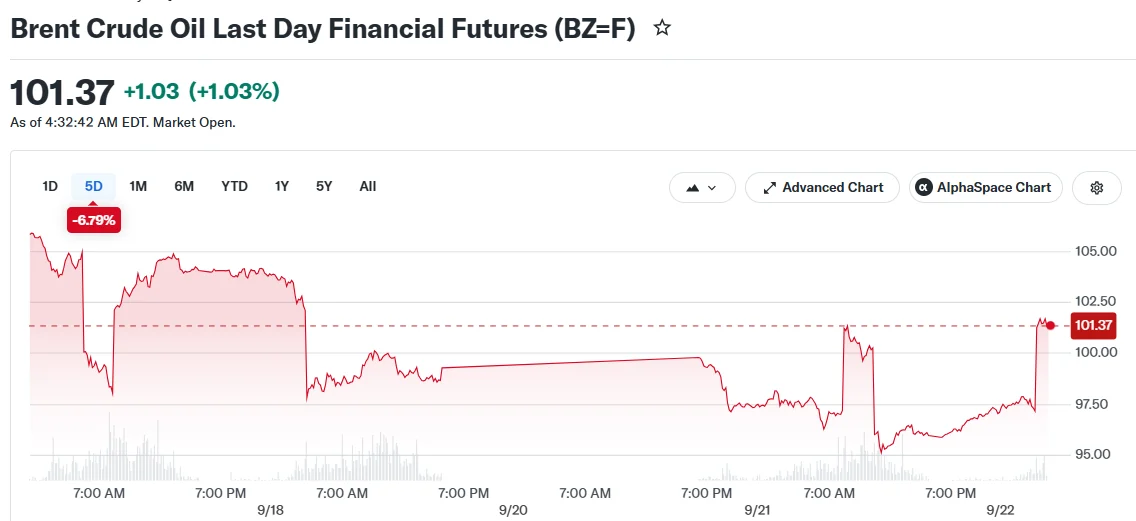
The uptick followed a challenging session on Monday, when Brent dropped 3.4% and WTI tumbled 4.5%, marking the lowest settlement prices for both benchmarks since early September.
Market participants are closely monitoring potential diplomatic engagement between Washington and Tehran. President Donald Trump indicated his openness to a meeting with Iranian President Masoud Pezeshkian, who is currently in New York for the UN General Assembly proceedings.
Tehran has allegedly conveyed its conditions for resuming talks through intermediary channels. This development has sparked optimism that diplomatic channels could defuse regional tensions and minimize the conflict’s effect on worldwide energy supplies.
Crude has surged more than 60% year-to-date. The persistent Middle Eastern conflict has created bottlenecks in energy transport through the Strait of Hormuz, a vital passage for international oil distribution.

Kingdom Redirects Crude Flows Through Strategic Waterway
Saudi Arabia recently experienced interruptions to its critical east-west pipeline infrastructure. As a countermeasure, the nation redirected its crude shipments back through the Strait of Hormuz.
Satellite tracking reveals that Saudi loadings from Persian Gulf terminals surged during the weekend period. Transit volumes through the Strait of Hormuz reached approximately 2.9 million barrels daily over the preceding six days, representing a substantial increase compared to August figures.
Market experts at ING highlighted that Middle Eastern geopolitical uncertainties maintained elevated risk premiums across the sector. Crude benchmarks recovered some ground Tuesday morning driven by these ongoing concerns.
Meanwhile, Houthi forces in Yemen continue battling for territorial control near the Bab el-Mandeb Strait. This narrow passage connecting the Red Sea to the Gulf of Aden represents another crucial route for Saudi petroleum exports.
Libyan Production Collapses as Russia Considers Diesel Restrictions
Supply interruptions extend beyond the Persian Gulf region. Libya’s Sharara oil field, the nation’s most productive facility, has experienced a dramatic production decline.
Daily output collapsed from approximately 340,000 barrels to roughly 127,000 barrels. Armed militants blocked a critical pipeline linking the field to the Zawiya export facility.
Russia is simultaneously considering prolonging its prohibition on most diesel shipments abroad. Ukrainian strikes targeting Russian energy facilities have diminished refining capacity, driving diesel prices to unprecedented levels across American and European markets.
The convergence of supply disruptions spanning multiple geographic areas has maintained elevated anxiety in oil markets. Market participants are scrutinizing UN diplomatic proceedings for any indication of conflict de-escalation that might alleviate supply constraints.
Get 3 Free Stock Ebooks
Discover top-performing stocks in AI, Crypto, and Technology with expert analysis.
- Top 10 AI Stocks - Leading AI companies
- Top 10 Crypto Stocks - Blockchain leaders
- Top 10 Tech Stocks - Tech giants


