



Key Highlights
- Crude oil benchmarks advanced more than 2% during Thursday’s trading session, building on momentum from earlier gains.
- Brent crude futures surpassed the $105 per barrel mark while WTI crude approached $94 per barrel.
- Iran’s leader declared at the UN General Assembly that the nation will not capitulate to American demands.
- The critical Strait of Hormuz shipping lane stays shuttered, with Iranian officials stating prerequisites must be satisfied before reopening.
- Market speculation about a potential 90-day restriction on US diesel exports triggered a significant decline in diesel futures mid-week.
Oil prices continued their upward trajectory on Thursday, maintaining the bullish momentum established in the prior trading session.
Brent crude futures advanced beyond 2% to reach approximately $105.40 per barrel. Meanwhile, West Texas Intermediate crude pushed higher to $93.94 per barrel.
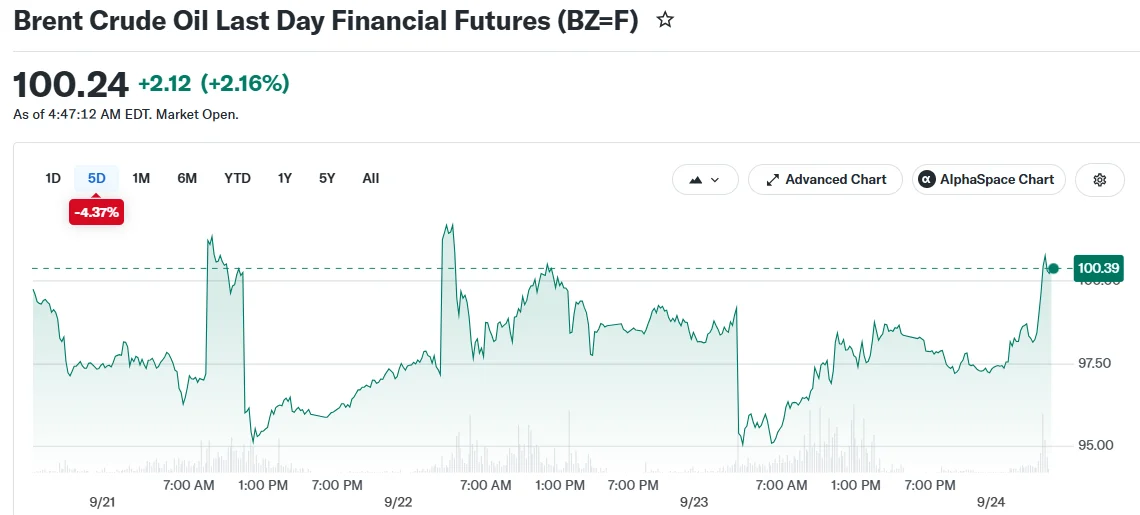
The upward price movement occurred amid stagnating negotiations between Washington and Tehran. Market participants continue monitoring developments in the ongoing diplomatic stalemate.
Tehran and Washington Struggle to Bridge Differences
President Masoud Pezeshkian of Iran delivered remarks at the United Nations General Assembly earlier this week. During his speech, he emphasized that his country would not yield to American coercion.
Despite his firm stance, Pezeshkian indicated Tehran’s willingness to engage in diplomatic channels. A high-ranking Iranian representative informed Reuters that dialogue must persist.

According to this official, Iran is currently assessing Washington’s latest response to Tehran’s peace framework. Iranian authorities are demanding that the United States withdraw its naval blockade and permit the reopening of the Strait of Hormuz.
Under normal circumstances, the Strait of Hormuz facilitates approximately 20% of worldwide petroleum and natural gas transport. The waterway has remained blocked since combined American and Israeli military operations against Iran commenced in late February.
Mohsen Rezaei, Iran’s security official, stated earlier this week that the strategic passageway will remain inaccessible until Tehran’s requirements are satisfied.
President Donald Trump issued warnings this week suggesting the possibility of escalated military intervention against Iran should negotiations fail. Secretary of State Marco Rubio acknowledged that achieving an agreement will require considerable time and effort.
Potential Diesel Restrictions Compound Market Volatility
Market participants are also monitoring reports regarding a possible prohibition on American diesel exports. Politico published information suggesting the Trump administration was developing a 90-day export restriction.
White House officials refuted this reporting. Energy Secretary Chris Wright expressed skepticism about the effectiveness of such a ban, despite President Trump indicating his willingness to support the measure.
Ultra-low-sulfur diesel futures experienced approximately 5% losses on Wednesday following the initial reports. Market observers warned that implementing such restrictions could disrupt international supply chains and elevate prices in other markets.
American distillate reserves, encompassing both diesel fuel and heating oil, decreased by 428,000 barrels during the previous week. This reduction brought aggregate stockpiles to 107.4 million barrels, based on Energy Information Administration data.
US crude oil inventories expanded by 3 million barrels last week, reaching 426.4 million barrels. Market forecasters had anticipated a drawdown of approximately 641,000 barrels instead.
Persian Gulf petroleum production demonstrated modest recovery signals earlier in the week. Reports indicated Saudi Arabia had reactivated its cross-country pipeline to the Red Sea, while Iraq boosted its export volumes.
However, these positive developments were counterbalanced by Rezaei’s statements affirming the Strait of Hormuz will remain closed. Market experts note that Brent crude commands a larger premium over WTI due to its greater vulnerability to Middle Eastern supply disruptions.
By Thursday morning, Brent crude was changing hands around $105.40 per barrel while WTI traded near $93.94 per barrel. Both benchmark contracts maintain substantial gains compared to price levels from earlier in the week.
Get 3 Free Stock Ebooks
Discover top-performing stocks in AI, Crypto, and Technology with expert analysis.
- Top 10 AI Stocks - Leading AI companies
- Top 10 Crypto Stocks - Blockchain leaders
- Top 10 Tech Stocks - Tech giants


