



Key Takeaways
- President Trump revealed plans to restore the US blockade of the Strait of Hormuz while implementing a 20% transit fee on all cargo
- Brent crude surged approximately 4.7% toward $80 per barrel; WTI increased 4.6% approaching $75
- Shipping voyages through the strategic waterway plummeted 52% compared to the previous week, with many vessels disabling tracking systems
- Tehran dismissed Trump’s statements and cautioned neighboring nations that US collaboration would constitute an act of aggression
- Current oil prices stay significantly under the wartime peaks exceeding $100 per barrel recorded in March
Crude oil markets experienced substantial gains Monday following President Trump’s declaration that the United States would restore its Strait of Hormuz blockade while imposing a 20% charge on all cargo transiting the critical waterway.
Brent crude advanced approximately 4.7% to hover around $80 per barrel. WTI crude posted similar gains of 4.6%, trading near $75. Despite these increases, both benchmarks remain considerably beneath their wartime peak levels above $100 per barrel achieved in March during the initial stages of the conflict.
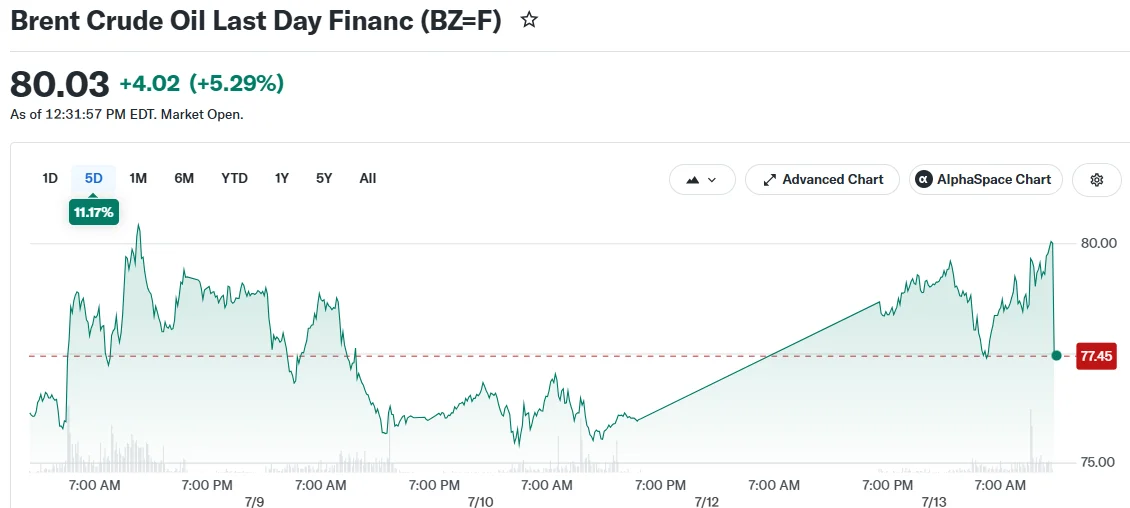
In his announcement, Trump positioned the US as the “Guardian of the Strait of Hormuz” and argued that compensation is warranted for maintaining security along the shipping route. “We can’t be expected to do that for nothing,” he stated during a Fox News appearance.
“As a matter of fairness, the United States should be reimbursed at a rate of 20% on all cargo shipped for the expenses associated with ensuring safety and security in this highly volatile corridor,” Trump wrote on social media.
Military Actions Intensify
US forces conducted operations against approximately 140 targets during the weekend, according to confirmation from US Central Command. This expanded Washington’s three-day military operation to over 300 total targets, initiated after an assault on the Cyprus-registered container vessel M/V GFS Galaxy.
Tehran responded with strikes targeting what Iranian officials characterized as US and coalition military installations throughout the Gulf region. The United Arab Emirates reported intercepting Iranian projectiles and unmanned aircraft. Alert systems activated in Bahrain, while blast reports emerged from Doha.

Iran’s Revolutionary Guard Corps announced the interception of two ships in the strait, alleging they utilized unauthorized navigation routes. Iranian authorities also proclaimed the strait closed “until further notice.”
Trump declared the peace framework defunct. Iranian officials stated the situation had “undoubtedly entered a crisis phase.”
Maritime Traffic Declines Sharply
Vessel transits through the Strait of Hormuz decreased 52% week-over-week during the weekend period, based on data from intelligence provider Kpler. Multiple ships are now conducting “dark” passages, deactivating positioning transmitters to evade detection.
The strategic chokepoint handles approximately one-fifth of global crude oil supply. With worldwide petroleum stockpiles depleted following five months of hostilities, and Chinese refinery demand showing renewed growth, supply constraints are intensifying.
Behind-the-Scenes Diplomatic Efforts
Iran’s Foreign Minister convened with his Omani counterpart in Muscat to address secure transit arrangements through the strait. Omani officials indicated discussions would advance at both governmental and operational levels.
Iran’s newly installed Supreme Leader Ayatollah Mojtaba Khamenei pledged to seek retribution for his father’s death—the former supreme leader who perished in February at the conflict’s outset.
Tehran officials stated they would not honor ceasefire provisions while US military operations persist. Washington has insisted Iran provide guarantees for safe commercial shipping before comprehensive negotiations can recommence.
Get 3 Free Stock Ebooks
Discover top-performing stocks in AI, Crypto, and Technology with expert analysis.
- Top 10 AI Stocks - Leading AI companies
- Top 10 Crypto Stocks - Blockchain leaders
- Top 10 Tech Stocks - Tech giants


