


Key Takeaways
- Dogecoin dropped 4% to $0.079, slipping beneath the 50-day EMA at $0.081
- Large wallet addresses accumulated 240 million DOGE tokens from September 9 through September 14, boosting total holdings to approximately 19 billion DOGE
- DOGE spot ETFs recorded $248,510 in capital inflows on September 16, exclusively through Grayscale’s GDOG product
- Technical analyst Ali Martinez identified potential rally targets of $0.1552 and $0.1774, contingent on maintaining $0.0813 support
- Cryptocurrency ETFs collectively experienced roughly $600 million in withdrawals on September 16 following the Senate’s rejection of the CLARITY Act
Dogecoin (DOGE) is experiencing downward momentum today, shedding approximately 4% to reach $0.079 amid widespread cryptocurrency market weakness. Bitcoin and Ethereum have similarly retreated, posting declines of 0.8% and 1.6% respectively.
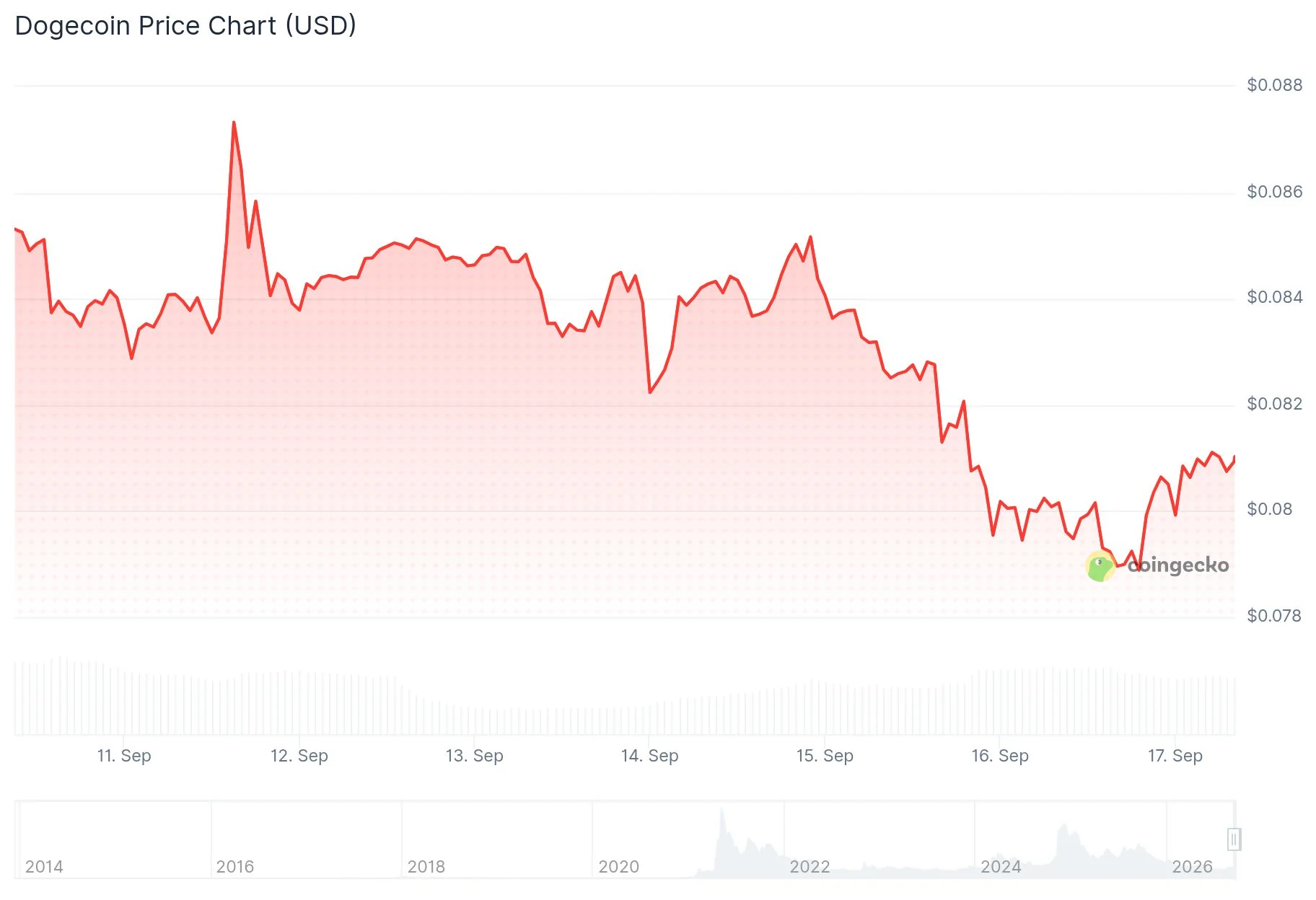
The selloff follows the United States Senate’s failure to advance the CLARITY Act, proposed legislation designed to establish regulatory framework for digital assets. This legislative setback prompted approximately $600 million in net withdrawals from US-listed cryptocurrency ETFs on September 16 — marking the most significant single-day capital exodus since June 2026.
However, beneath the surface of declining prices, substantial DOGE holders have been aggressively increasing positions. Whale wallets — defined as addresses containing a minimum of 100 million DOGE — added 240 million tokens during the six-day period spanning September 9 through September 14, based on metrics from Santiment. These major holders now control approximately 19 billion DOGE, representing roughly 12.18% of circulating supply.
Cryptocurrency technical analyst Ali Martinez highlighted this accumulation pattern and established specific price objectives for Dogecoin using blockchain analytics. Leveraging the UTXO Realized Price Distribution (URPD) indicator from Glassnode, Martinez pinpointed a critical support region at $0.0813, where historically 35 billion DOGE tokens changed ownership.
Price Target Projections
According to Martinez: “As long as this level holds, the bullish setup remains intact, with $0.1552 and $0.1774 as the next upside targets.”

Despite whale accumulation, bearish momentum persisted. CoinGlass tracking reveals $39 million greater spot outflows compared to inflows during the September 9–14 window, indicating retail and institutional selling pressure exceeded whale purchasing activity.
Meanwhile, market observer Trader Tardigrade (@TATrader_Alan) examined Dogecoin’s long-term monthly chart patterns. His analysis identifies that DOGE has established a “floor level” consolidation on three previous occasions — occurring in 2015, 2019, and 2022 — with each instance preceding significant upward price movements. He characterizes the current price structure as forming a comparable third floor formation, emphasizing this represents historical pattern recognition rather than mere speculation.
Exchange-Traded Fund Activity and Chart Analysis
Regarding investment product flows, Dogecoin recorded $248,510 in ETF inflows on September 16, with all capital directed toward the Grayscale Dogecoin Trust (GDOG). The Bitwise DOGE ETF, scheduled for closure in October, and the 21Shares TDOG ETF registered zero inflows.
DOGE emerged as one of merely four cryptocurrency assets experiencing positive ETF flows that trading session, joining Solana, Tron, and Hedera.
From a technical perspective, DOGE has penetrated below both its 50-day exponential moving average and the bottom boundary of a descending triangle formation. Should the price close beneath this threshold for three successive trading days, a potential decline toward $0.069 becomes increasingly probable.
The Relative Strength Index presently registers at 42, trending downward. A breakthrough above $0.086 would be required to reverse the near-term bearish momentum, with the 200-day EMA positioned at $0.093 representing the subsequent resistance objective.
Despite recent weakness, DOGE maintains a gain of 14.53% over the trailing 30-day period.
Get 3 Free Stock Ebooks
Discover top-performing stocks in AI, Crypto, and Technology with expert analysis.
- Top 10 AI Stocks - Leading AI companies
- Top 10 Crypto Stocks - Blockchain leaders
- Top 10 Tech Stocks - Tech giants


