


Key Takeaways
- The greenback retreated modestly on Wednesday yet remained close to multi-week peaks as investors awaited the Federal Reserve’s policy announcement.
- Traders have assigned a 92% probability to a 25 basis point rate increase, lifting the target range to 3.75%-4.00%.
- Chair Kevin Warsh’s post-decision commentary will be critical, as markets seek clarity on whether this represents an isolated move or the beginning of a sustained tightening campaign.
- The yen gained ground modestly, with market participants pricing an 80% likelihood of a Bank of Japan rate hike this Friday.
- Crude prices surging beyond $113 per barrel, fueled by Saudi facility attacks and Red Sea turbulence, have intensified inflation pressures prompting central bank action.
The U.S. dollar softened marginally on Wednesday, breaking a six-session winning streak as it retreated from near multi-week peaks while forex traders positioned themselves ahead of an anticipated Federal Reserve rate announcement scheduled for later in the trading day.
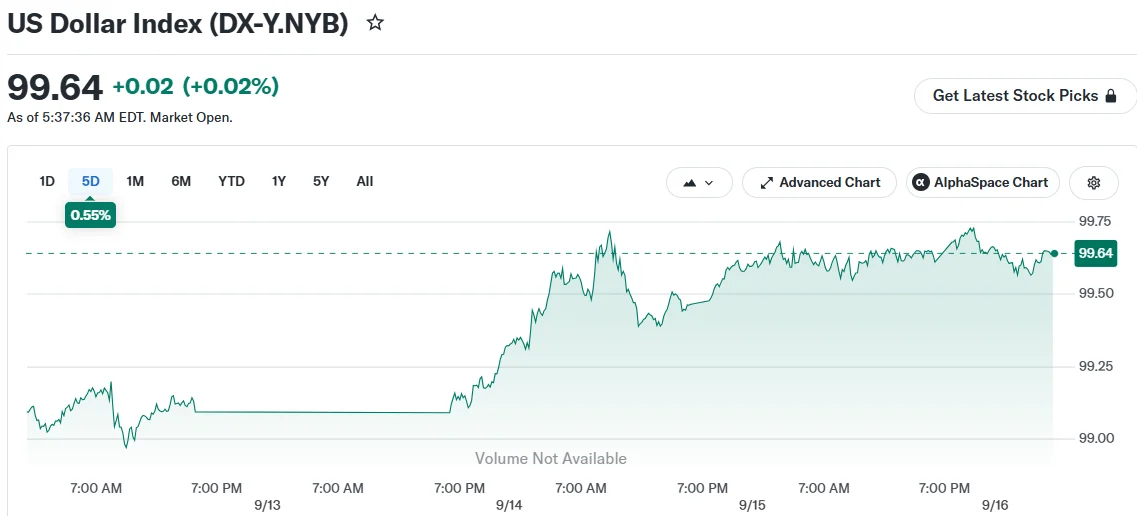
The Dollar Index, a gauge measuring the currency against a basket of six major peers, traded virtually unchanged around 99.59 following multiple sessions of appreciation.
Market participants have assigned a 92% likelihood to the Fed implementing a quarter-point increase to its policy rate, which would establish a new target corridor of 3.75%-4.00%. This adjustment would represent America’s first rate elevation since the middle of 2023.
While the rate adjustment itself is broadly anticipated, currency traders are predominantly focused on the messaging from Fed Chair Kevin Warsh following the policy verdict.
Investors are eager to determine whether Warsh characterizes the increase as an isolated defensive measure against elevated energy costs, or whether he telegraphs the initiation of a sustained tightening campaign.

Should Warsh adopt an accommodative stance, the greenback could face downward pressure as market participants lock in gains. Conversely, hawkish rhetoric suggesting additional increases lie ahead could propel the currency higher.
Surging Energy Costs Amplify Inflation Pressures
Crude oil prices have surged beyond $113 per barrel in the wake of assaults on Saudi Arabian energy infrastructure and Houthi militant operations targeting Red Sea shipping lanes. These supply chain disruptions have elevated energy costs and amplified inflationary pressures, providing justification for monetary authorities to implement restrictive policies.
Analysts at ANZ communicated to their clientele an expectation for the Fed to implement rate increases at consecutive policy gatherings, though they observed the October session coincides with U.S. midterm electoral contests.
The euro traded virtually unchanged near $1.1554, remaining in proximity to a one-month trough. The European Central Bank implemented a quarter-point increase to its deposit facility last Thursday, elevating it to 2.50%, likewise responding to energy-fueled price pressures.
The British pound maintained levels around $1.3483. United Kingdom inflation accelerated to 3.1% in August from July’s 2.9% reading, while core inflation remained stable at 2.6%. The Bank of England announces its policy determination on Thursday. Market pricing suggests a one-in-three probability of a 25-basis-point adjustment.
Yen Gains Ground as BOJ Decision Approaches
The Japanese yen rebounded after touching a one-week nadir of 155.49 against the dollar during early trading. It strengthened back toward approximately 154.97 yen per dollar by midday exchanges.
Market pricing reflects an 80% probability that the Bank of Japan implements a quarter-point policy rate increase to 1.25% during Friday’s meeting. Market expectations incorporate two rate adjustments by late January.
The yen has benefited from increasingly hawkish Bank of Japan expectations, coordinated U.S.-Japan foreign exchange intervention, and Japanese asset managers repatriating overseas capital.
Julius Baer economist David Meier indicated the yen’s trajectory will remain substantially dependent on interest rate differentials and updated the institution’s USD/JPY projection to 155.
China’s yuan maintained levels near 6.71 per dollar despite an expanding differential between Chinese bond yields and borrowing costs in other developed economies.
Market attention remains concentrated on Warsh’s press briefing as the most significant driver for the dollar’s subsequent direction.
Get 3 Free Stock Ebooks
Discover top-performing stocks in AI, Crypto, and Technology with expert analysis.
- Top 10 AI Stocks - Leading AI companies
- Top 10 Crypto Stocks - Blockchain leaders
- Top 10 Tech Stocks - Tech giants


