



Key Highlights
- Ethereum spot ETFs registered a 10-day consecutive inflow streak totaling $633 million
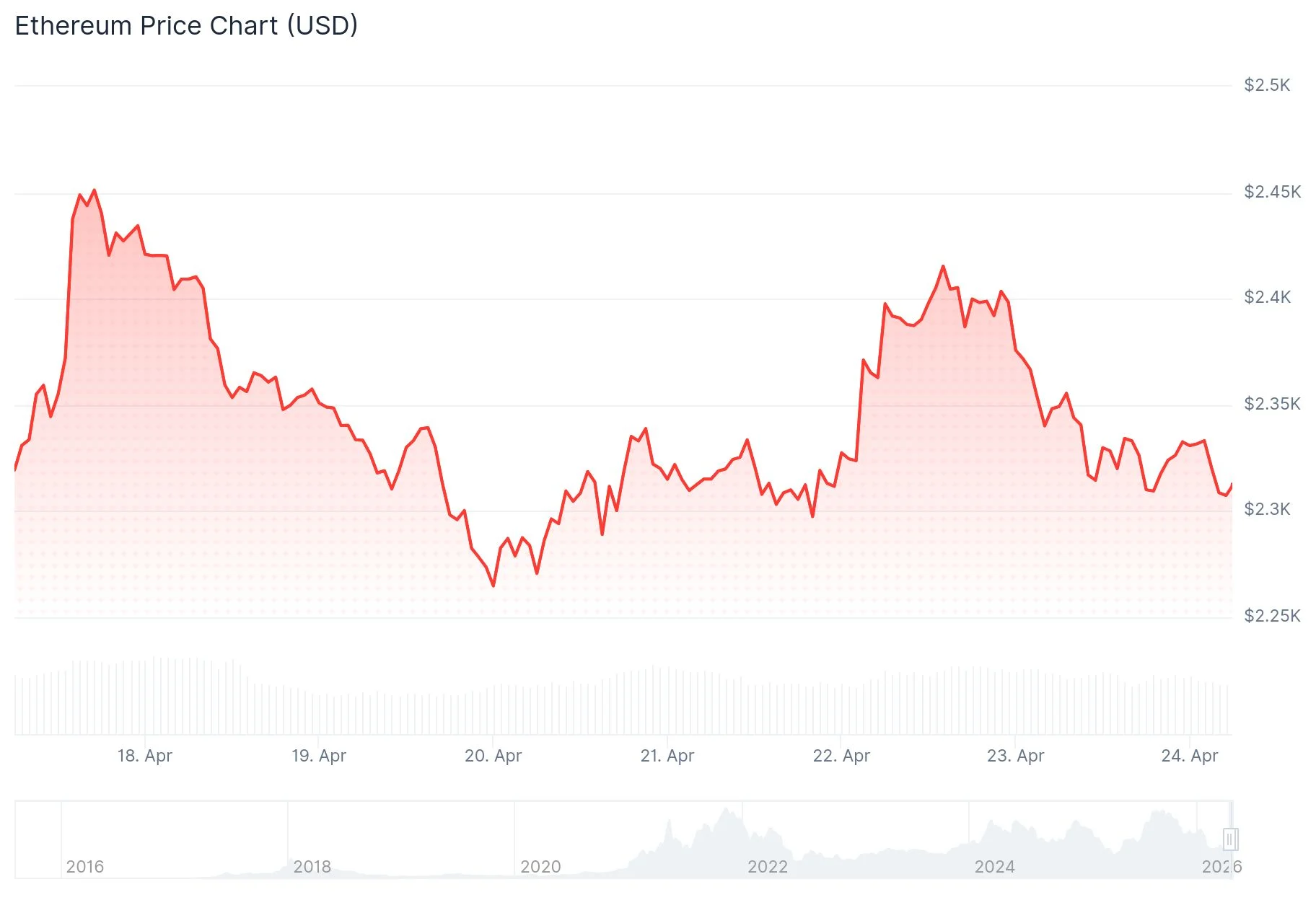
- Price action remains constrained below the $2,400 resistance level with a 22% YTD decline
- Nasdaq listed BESO ETF by GSR Markets, featuring multi-crypto exposure with staking rewards
- Ethereum’s weekly decentralized application revenue fell to $13 million, a 50% decrease from October levels
- Technical analysts highlight $2,250 as critical support if current resistance persists
Ethereum (ETH) is currently hovering near $2,340, consistently unable to sustain price levels above the $2,400 threshold. While the asset experienced upward momentum in tandem with Bitcoin’s push toward $79,000, this strength proved insufficient to overcome critical resistance zones.
Institutional interest through spot Ethereum exchange-traded funds demonstrated remarkable consistency, with 10 consecutive trading sessions recording positive net flows through Wednesday. This streak accumulated $633 million in fresh capital, pushing total cumulative ETF inflows close to the $12 billion milestone. The most recent three-day trading period alone contributed $206 million in net inflows, marking the strongest weekly performance since these products launched.
This week saw GSR Markets introduce the BESO ETF on Nasdaq, representing a groundbreaking development as the first actively managed fund in the United States to combine Bitcoin, Ethereum, and Solana exposure while incorporating staking yield generation. The product carries a 1% annual management fee, implements weekly portfolio rebalancing, and distributes ETH staking yields ranging from 3.3% to 4.0% APY directly to fund holders.
BESO now competes in a marketplace dominated by BlackRock’s IBIT, which commands $54 billion in assets under management, alongside Bitwise’s BAVA, offering AVAX exposure with 5.4% staking returns.
Network activity on Ethereum showed a 41% week-over-week increase in transactions, coinciding with heightened ETF participation. Additionally, available supply on centralized exchanges continues declining as staking mechanisms draw tokens away from trading circulation.

Declining DApp Activity Creates Headwinds
Revenue generated by decentralized applications operating on the Ethereum network contracted to $13 million weekly in April, representing nearly a 50% reduction compared to figures from six months earlier. This downturn extends across the broader blockchain ecosystem, with combined weekly DApp revenues across all chains dropping to $73 million from $130 million recorded in October 2025.
Competing platforms including Solana, BNB Chain, and Hyperliquid experienced comparable revenue contractions, indicating this represents an industry-wide phenomenon rather than challenges specific to Ethereum’s ecosystem.
Year-to-date performance shows ETH declining 22% compared to a 14% decrease across the wider cryptocurrency market. Nevertheless, Ethereum maintains its position as the dominant protocol by total value locked, while its layer-2 scaling solutions have captured increasing market share in decentralized exchange trading volumes.
The annualized premium on ETH futures contracts compressed to just 1%, significantly below the 4% level typically considered neutral market conditions. This metric signals diminished appetite for leveraged long exposure, reaching the weakest point observed in four months.
Technical Perspectives on Critical Price Zones
Market analyst Ali Charts identified that ETH is currently testing its Realized Price at $2,340, representing the average acquisition cost for all tokens based on on-chain data. Historical patterns suggest that when this metric successfully holds as support, Ethereum typically transitions into expansionary price phases.
Analyst Ted Pillows highlighted Ethereum’s failure to recapture the $2,400 level and pinpointed $2,250 as the subsequent critical support zone requiring attention. His assessment characterized ETH as demonstrating relative weakness compared to Bitcoin’s recent performance.
Institutional research firms maintain divergent longer-term outlooks, with TD Cowen establishing a $3,650 price objective for ETH, while Standard Chartered projects a $7,500 target based on anticipated institutional capital flows.
Current market sentiment registers 33 on the Fear & Greed Index, reflecting fear territory, while 30-day realized volatility stands at 5%.
Get 3 Free Stock Ebooks
Discover top-performing stocks in AI, Crypto, and Technology with expert analysis.
- Top 10 AI Stocks - Leading AI companies
- Top 10 Crypto Stocks - Blockchain leaders
- Top 10 Tech Stocks - Tech giants


