



Key Takeaways
- Investment bank UBS identifies rising U.S. Treasury yields as an intensifying challenge for European equity markets, with sector-specific impacts varying widely.
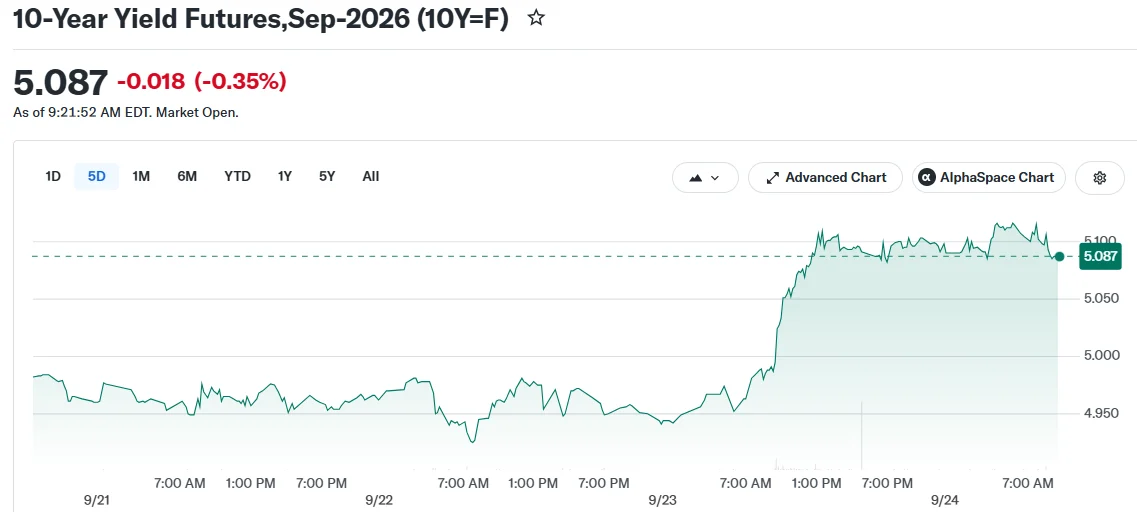
- The benchmark 10-year Treasury yield surged from 3.94% in late February to reach 5.00% last week, while inflation-adjusted real yields jumped from 1.68% to 2.67%.
- According to UBS analysts, the yield surge stems from expanding economic activity and capital expenditure cycles in defense, artificial intelligence infrastructure, and industrial sectors—not inflation concerns.
- Winners over the past quarter include energy, financial institutions, chemicals and materials, while losers encompass construction, telecommunications, utilities and consumer staples.
- European markets showed hesitation Thursday amid heightened geopolitical tensions between the U.S. and Iran, plus anticipation of high-level diplomatic talks between Washington and Beijing.
The pressure from climbing bond yields on European equity markets is intensifying. Investment bank UBS has issued new analysis indicating this phenomenon is affecting different sectors in dramatically different ways.
Treasury yields on the benchmark U.S. 10-year note have experienced a steep ascent throughout 2025. The yield stood at 3.94% when February ended, then surged to 5.00% in recent trading sessions. Meanwhile, real yields—the inflation-adjusted measure that matters most for equity valuations—climbed from 1.68% to 2.67% during the identical timeframe.
UBS market strategists Gerry Fowler and Sutanya Chedda conducted analysis comparing MSCI Europe index behavior during weeks experiencing yield increases against weeks seeing yield declines. Their findings since March 1 reveal that during weeks with climbing yields, merely 42% of index constituents gained ground. By contrast, weeks featuring falling yields saw 64% of stocks advance.
This 22-percentage-point differential represents the most extreme divergence UBS has documented in their research dataset.
Understanding Yield Thresholds and Market Breadth
The analysts emphasize that absolute yield levels tell only part of the story. The critical factor is how level and rate of change interact.

When the 10-year yield remained under 3%, even substantial weekly fluctuations left the majority of the index in positive territory. In that environment, yield increases were interpreted as economic expansion signals.
Between 4% and 4.5%, the dynamic shifts considerably. Market breadth contracted from 61% during weeks with declining yields to merely 30% when yields spiked more than 20 basis points.
Above the 4.5% threshold, UBS identifies rapid weekly surges as the primary destructive force.
The Drivers Behind Climbing Yields
UBS maintains the yield expansion isn’t rooted in inflation anxiety or fixed-income market dysfunction. Rather, the firm points to substantial capital investment across defense manufacturing, AI hardware production, infrastructure development and energy generation.
The investment bank characterizes this as the first coordinated capital expenditure boom of this magnitude in decades. According to their analysis, this industrial investment pattern circulates capital through the economy more rapidly than service-sector expansion typically achieves.
UBS frames this development as a fundamental regime transition that markets haven’t incorporated into pricing for three decades. When velocity accelerates against a constant monetary base, nominal GDP expansion quickens, and previously neutral monetary policy effectively becomes accommodative. This dynamic could necessitate additional rate increases rather than cuts.
The bank cautioned that policy transmission mechanisms may operate with longer lags than historical patterns suggest. Industrial investment operates on multi-year horizons. Capital already allocated to power grid expansion, military procurement and manufacturing facilities won’t reverse course based on individual monetary policy adjustments.
For portfolio positioning, UBS advocates emphasizing equities with minimal bond yield sensitivity, where profit growth can surpass discount rate increases. The past quarter has rewarded energy producers, banking institutions, chemical manufacturers and basic materials companies. Conversely, construction firms, consumer goods producers, telecommunications providers, utility operators and food and beverage companies have underperformed.
The strategists clarify that the crucial dividing line isn’t simply cyclical versus defensive classification. What matters is whether earnings momentum is robust enough, and valuations attractive enough, to counterbalance rising yield pressure.
Thursday’s European trading session reflected investor caution. The STOXX 50 and STOXX 600 indices fluctuated around unchanged levels.
Market participants monitored escalating tensions in the U.S.-Iran situation, which supported elevated crude oil prices and kept bond yields hovering near multi-year peaks. Traders also looked ahead to scheduled discussions between American and Chinese leadership for potential breakthroughs on trade disputes.
Technology and financial services shares ranked among Thursday’s weakest sectors. SAP, UBS, Infineon, Mercedes-Benz and Rheinmetall all declined, while H&M shares tumbled nearly 3% following disappointing third-quarter earnings. LVMH, Novartis and Siemens posted gains.
Get 3 Free Stock Ebooks
Discover top-performing stocks in AI, Crypto, and Technology with expert analysis.
- Top 10 AI Stocks - Leading AI companies
- Top 10 Crypto Stocks - Blockchain leaders
- Top 10 Tech Stocks - Tech giants


