



TLDR
- European equity markets lingered close to two-week lows following their steepest decline in almost four weeks
- The German 10-year Bund yield climbed to 3.22%, marking its highest point since May 2011
- Brent crude remained elevated near three-week peaks at approximately $91.50 per barrel
- Market pricing now completely reflects a 25-basis-point rate increase from the ECB in September
- Market participants are monitoring ECB President Lagarde’s statements and the Fed’s July meeting minutes for guidance
European stock markets struggled to establish momentum on Wednesday, trading near unchanged levels following a significant decline the previous session. The pan-European Stoxx Europe 600 Index remained anchored near two-week lows, still digesting its steepest single-session loss in almost four weeks.
Germany’s DAX index declined 0.2%, while France’s CAC 40 managed a modest 0.2% gain. Both London’s FTSE 100 and Spain’s IBEX 35 traded unchanged. Futures for the Euro Stoxx 50 and Stoxx 600 also showed declines of approximately 0.2% during premarket hours.
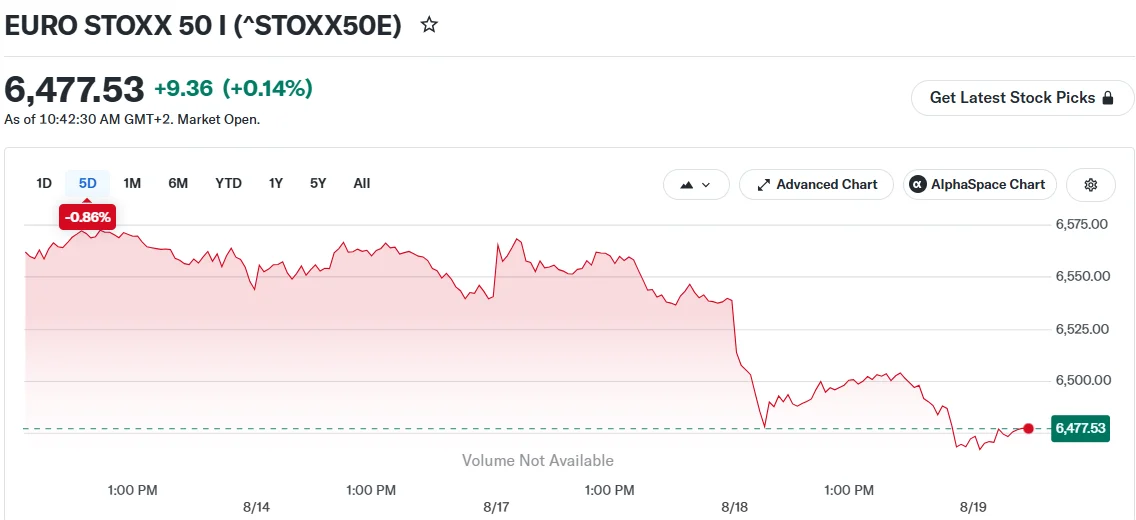
The previous day’s market retreat stemmed from multiple converging factors. Growing tensions in the Persian Gulf region, climbing crude oil valuations, and surging government bond yields compelled traders to rapidly reduce risk exposure.
Government Bond Yields Climb to Decade-Plus Peaks
The yield on Germany’s 10-year Bund surged to 3.22%, representing its loftiest level since May 2011. Meanwhile, the U.S. 30-year Treasury yield climbed beyond 5.30%.
Elevated yields pressure equities through two primary mechanisms. Initially, they diminish the discounted value of companies’ future earnings streams, disproportionately impacting technology and growth-oriented shares. Additionally, they enhance the relative appeal of government debt compared to equities, triggering capital rotation away from stock markets.

Fresh weakness in semiconductor stocks connected to artificial intelligence investments further weighed on European bourses on Wednesday.
Market Anticipation of ECB Tightening Intensifies
ECB Chief Economist Philip Lane cautioned on Tuesday that inflation across the Eurozone, currently hovering around 3%, continues to run “well above” the central bank’s 2% objective. He emphasized that while price pressures have retreated from double-digit peaks, they remain sufficiently elevated to preclude policy relaxation.
Brent crude futures maintained positions near three-week highs at roughly $91.50 per barrel. Maritime transportation bottlenecks through the Strait of Hormuz, triggered by military operations in the Persian Gulf, continue supporting oil prices at elevated levels.
The convergence of persistent inflation and elevated energy costs has compelled markets to reassess rate trajectory expectations. Derivative contracts now virtually fully incorporate a 25-basis-point policy rate increase from the European Central Bank at its September policy gathering. This represents a dramatic pivot from prior expectations of an extended pause.
Market participants are paying particular attention to forthcoming commentary from ECB President Christine Lagarde for insights into the institution’s approach to navigating a potentially stagflationary landscape.
In the United States, the Federal Reserve is scheduled to publish minutes from its July policy committee meeting. Market observers will scrutinize the document for indications of how attentively Fed policymakers were tracking employment conditions prior to the recent elevation in long-dated borrowing costs.
Wednesday’s European calendar features no significant corporate earnings releases. Market attention continues centered on forthcoming UK and Eurozone inflation statistics, central bank communications, and energy market dynamics.
Get 3 Free Stock Ebooks
Discover top-performing stocks in AI, Crypto, and Technology with expert analysis.
- Top 10 AI Stocks - Leading AI companies
- Top 10 Crypto Stocks - Blockchain leaders
- Top 10 Tech Stocks - Tech giants


