


TLDR
- Natural gas prices in Europe increased on Tuesday but remain on course for their first quarterly reduction in over 18 months.
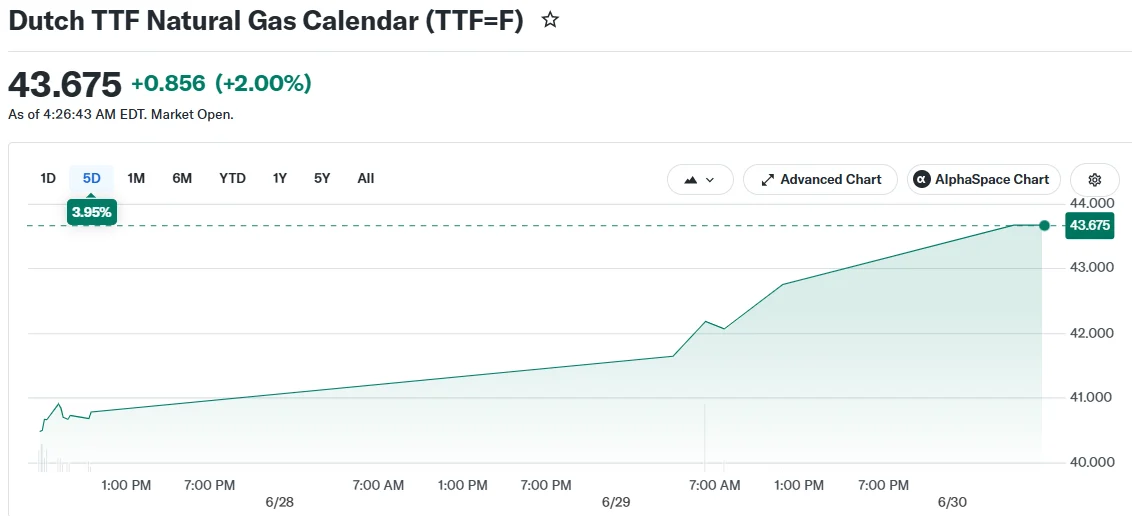
- The Dutch TTF benchmark climbed 2% to reach 43.44 euros per megawatt-hour while maintaining a quarterly downward trajectory.
- A peace agreement between Iran and the United States restored regular maritime operations in the Strait of Hormuz, reducing concerns over supply disruptions.
- Gas storage facilities across Europe stand at approximately 48% full, significantly lower than previous year levels and historical averages.
- European officials maintain that present storage quantities are adequate to ensure energy security throughout the upcoming winter months.
European natural gas markets experienced upward movement on Tuesday in wholesale trading. However, despite this single-day increase, the overall trend points toward the first quarterly price reduction seen in more than twelve months.
The benchmark Dutch TTF front-month contract advanced 2% to settle at 43.44 euros per megawatt-hour. This positions the market for its initial quarterly decrease in six consecutive quarters.
Meanwhile, Britain’s wholesale natural gas contract similarly registered a 2% gain, closing at 104.57 pence per therm. The UK market is similarly positioned for its first quarterly reduction in five consecutive quarters.
Key Factors Behind Market Movements
Prices surged during the early months of this year amid military tensions involving Iran. These hostilities sparked widespread anxiety regarding energy transportation routes throughout the Middle Eastern region.
Maritime attacks last week temporarily disrupted vessel movement through the Strait of Hormuz once more. Today, representatives from the United States and Iran are scheduled to convene in Doha for additional diplomatic discussions.

Approximately one-fifth of global liquefied natural gas supplies transit through the Strait of Hormuz. Any interruption in this critical waterway typically drives gas prices upward across global markets.
A ceasefire agreement established earlier this month enabled shipping traffic to return to normal operational patterns. Postponed LNG cargo shipments originating from Qatar and the United Arab Emirates have resumed their journeys to international destinations.
International crude oil prices have likewise retreated to pre-conflict levels. This development eliminated one of the key factors that had been sustaining elevated European gas and electricity valuations.
Storage Capacity Challenges Persist
Despite the general downward price movement, market analysts indicate that insufficient storage capacity could prevent further significant price drops. European storage infrastructure currently holds just under 48% of total capacity.
This represents a decline from 56.2% recorded during the identical timeframe last year. The figure also trails the five-year average injection level of 61%.
According to a Financial Times analysis referencing Wood Mackenzie data, European Union storage facilities may conclude the refill season at approximately 76% capacity. This would represent the lowest peak storage level recorded since at least 2011.
The storage deficit originated from the Iran conflict, which prevented LNG shipments from passing through the Strait of Hormuz. Decreased output from Qatar and the United Arab Emirates further contributed to the shortfall.
European storage facilities began the injection season at merely 28% capacity. Present average levels throughout Europe hover near 48%.
The European Commission announced on Sunday that existing storage levels do not represent an immediate threat to energy security. Officials emphasized that achieving 80% storage capacity is adequate to satisfy winter energy requirements.
A commission representative stated that storage stands approximately 10% beneath pre-crisis historical averages. The official further noted that natural gas consumption across the EU has decreased by roughly 17%.
The commission has advised member nations to achieve storage levels between 75% and 80%. In previous years, the non-mandatory target had been established at 90%.
Get 3 Free Stock Ebooks
Discover top-performing stocks in AI, Crypto, and Technology with expert analysis.
- Top 10 AI Stocks - Leading AI companies
- Top 10 Crypto Stocks - Blockchain leaders
- Top 10 Tech Stocks - Tech giants


