


Key Takeaways
- Natural gas prices in Europe surged to four-month peaks on Friday, with TTF hub trading up 0.4%
- Markets are extending gains for a fourth consecutive week — the most sustained rally since May 2025
- Norway’s Equinor cautioned that Europe won’t reach its 80% storage goal ahead of winter
- Current storage capacity stands at approximately 54%, marking the second-weakest level in a decade and a half
- Military operations targeting Iran and Houthi disruptions are constraining LNG transport through the Strait of Hormuz
Natural gas prices across European wholesale markets remained elevated near four-month peaks on Friday, marking a fourth straight week of upward momentum.
Europe’s primary pricing benchmark, the Dutch TTF front-month futures contract, advanced 0.4%, while Britain’s corresponding contract climbed 0.3%. Weekly gains have totaled approximately 8%, with July’s cumulative increase exceeding 42%.
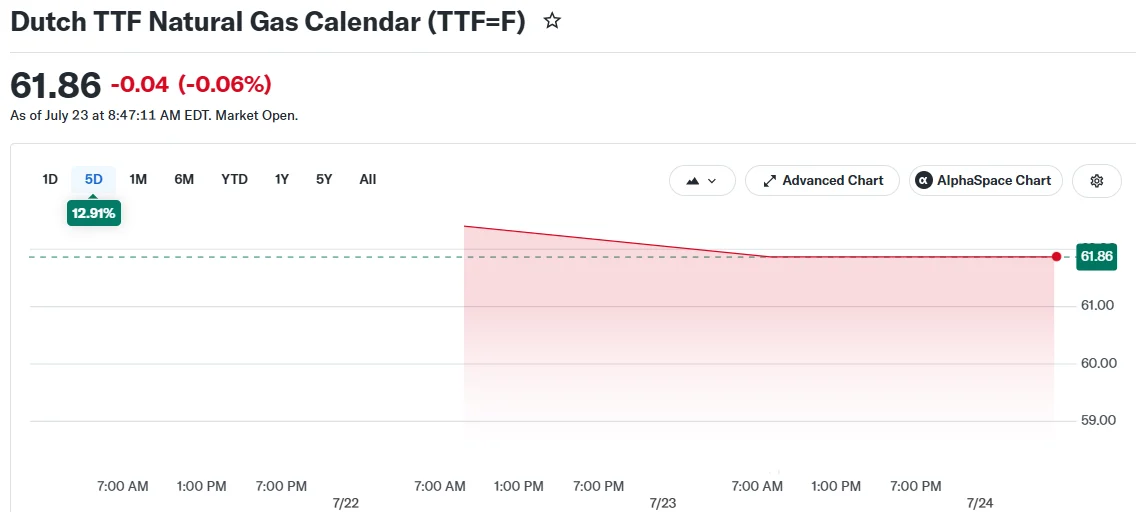
This marks the most prolonged period of consecutive weekly advances European gas markets have experienced since May of the previous year.
Continental Storage Reserves Reach Critical Lows
Norway’s Equinor, the leading domestic natural gas provider for Europe, issued an alert earlier in the week revealing that underground storage facilities across the region currently hold approximately 54% of total capacity. This figure falls significantly below historical five-year seasonal averages and represents the second-weakest position recorded over the past fifteen years.

Equinor’s leadership indicated that achieving the mandated 80% storage threshold before winter’s onset appears increasingly improbable. This regulatory benchmark serves as a critical buffer against potential supply disruptions during peak heating demand periods.
Entering winter with inadequate reserves amplifies the market’s vulnerability to volatile price fluctuations should colder-than-expected weather materialize.
Geopolitical Tensions Constraining Global LNG Availability
American military forces conducted their thirteenth straight night of operations against Iranian targets this week. President Donald Trump issued stern warnings to Tehran and its Yemen-based Houthi proxies regarding continued assaults on commercial vessels traversing the Red Sea.
The escalating regional conflict has severely impacted tanker navigation through the strategically vital Strait of Hormuz, effectively reducing the volume of liquefied natural gas exports originating from Persian Gulf terminals.
With Middle Eastern supply constrained, energy importers throughout Asia have aggressively competed for alternative LNG shipments, consistently outbidding European purchasers. This intensifying competition is diverting critical cargoes away from European receiving facilities during an especially vulnerable period.
Unseasonably warm temperatures throughout the continent have simultaneously elevated power consumption for air conditioning systems, compounding the strain on available gas supplies.
Monetary Policy Implications Under Scrutiny
Escalating energy expenses are contributing to intensifying inflationary dynamics throughout European economies.
Financial markets are progressively incorporating expectations that sustained elevated energy costs could postpone anticipated interest rate reductions. European central banking authorities may be compelled to maintain restrictive monetary policies for extended periods should energy-related inflation persist at current levels.
The convergence of supply constraints, insufficient storage capacity, and robust consumption is providing market participants minimal justification for anticipating near-term price relief.
The TTF futures contract continues trading near its strongest levels since March, and without imminent resolution to Middle Eastern hostilities, the energy cost outlook for European households and businesses approaching autumn remains deeply uncertain.
Get 3 Free Stock Ebooks
Discover top-performing stocks in AI, Crypto, and Technology with expert analysis.
- Top 10 AI Stocks - Leading AI companies
- Top 10 Crypto Stocks - Blockchain leaders
- Top 10 Tech Stocks - Tech giants


