


Key Highlights
- The greenback maintained strength near its weekly peak as markets anticipated Fed Chair Kevin Warsh’s Jackson Hole address
- Warsh’s speech was scheduled for 1400 GMT Friday, with investors seeking monetary policy direction
- Market participants have priced in the possibility of a 25 basis point rate increase this year amid sticky inflation
- Bitcoin retreated to $79,715 while maintaining a 26.7% monthly advance, marking its strongest performance since late 2024
- European currencies weakened modestly, with both heading toward their first weekly decline in four weeks
The U.S. dollar maintained its position near a one-week peak on Friday as financial markets awaited Federal Reserve Chair Kevin Warsh’s highly anticipated address at the Jackson Hole economic symposium in Wyoming.
The dollar index remained steady at 99.18, marginally below the previous session’s peak of 99.26. Trading activity remained subdued in anticipation of Warsh’s 1400 GMT remarks.
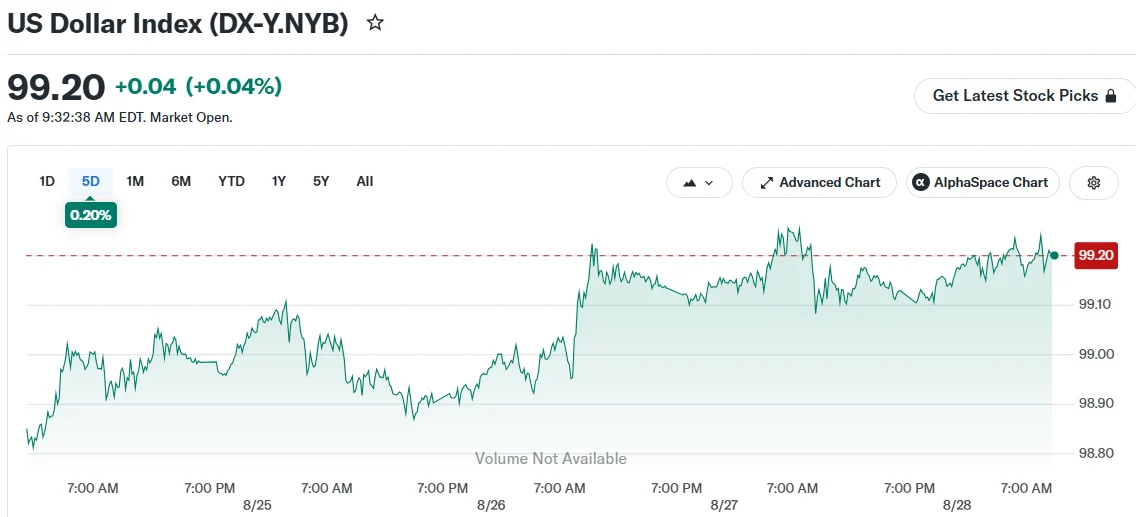
Persistent inflation above the Federal Reserve’s 2% objective has prompted market participants to factor in at least one quarter-point interest rate increase before year-end, providing underlying support for the dollar throughout the week.
Warsh has established a reputation for providing minimal forward-looking policy guidance. Market observers suggested his address would more likely focus on updates regarding the five specialized task forces he established upon assuming his chairmanship rather than delivering explicit rate signals.
Volkmar Baur, an analyst at Commerzbank, suggested the possibility that the Federal Reserve might be evaluating alternative inflation metrics beyond the traditional PCE deflator. He noted that any indication of such a shift would likely be interpreted as accommodative and could weaken the dollar.

Regional Fed Presidents Strike Hawkish Tone
During Thursday’s Jackson Hole conference proceedings, multiple Federal Reserve policymakers reiterated their apprehension regarding elevated inflation levels. Their commentary suggested receptiveness to potential rate increases.
Nevertheless, a substantial number of market strategists continue to anticipate the Fed will maintain its current policy stance through year-end. Chris Turner from ING stated his expectation that the Fed will refrain from hiking in September or throughout the remainder of the year, projecting a dollar/yen exchange rate around 158 by December.
The euro declined modestly to $1.1646 while the British pound retreated to $1.3589. Both currencies were positioned for their first weekly losses in approximately a month.
The Japanese yen depreciated to 159.645 against the dollar. Tokyo’s inflation figures revealed an acceleration in annual core price growth during August, occurring just one day after the Bank of Japan’s deputy governor emphasized the importance of timely rate adjustments. Current market pricing indicates a 68% probability of a 25 basis point BOJ rate hike next month.
Cryptocurrency Markets Post Strong August Returns
Bitcoin experienced a modest pullback to $79,715 on Friday while still maintaining its trajectory for a substantial 26.7% August advance, representing its most impressive monthly performance since the closing months of 2024.
Several market commentators attributed this month’s cryptocurrency strength to growing anxieties surrounding U.S. fiscal debt levels.
The Australian dollar continued its remarkable run, approaching a ninth consecutive weekly advance while trading at a three-month high of $0.7197. Meanwhile, the Canadian dollar remained relatively unchanged but was poised for its sharpest weekly decline since mid-June following escalating trade friction with the United States.
Market attention remained concentrated on Warsh’s upcoming address as the primary catalyst for Friday’s trading session, with interest rate forecasts and currency valuations likely to adjust following his remarks.
Get 3 Free Stock Ebooks
Discover top-performing stocks in AI, Crypto, and Technology with expert analysis.
- Top 10 AI Stocks - Leading AI companies
- Top 10 Crypto Stocks - Blockchain leaders
- Top 10 Tech Stocks - Tech giants


