



Key Highlights
- Equity index futures posted modest gains Wednesday morning in anticipation of Federal Reserve monetary policy announcement
- Market participants anticipate a 25 basis point rate increase to 4.0%, marking the first boost in three years
- Cryptocurrency markets saw Bitcoin decline 2% to approximately $75,000 following Senate’s failure to advance the Clarity Act
- The benchmark 10-year Treasury yield reached 5.03%, its highest level in nearly twenty years, before retreating
- Crude oil trading above $100 per barrel continues to stoke inflationary pressures before central bank decision
Equity index futures posted modest gains Wednesday morning as market participants prepared for a Federal Reserve monetary policy announcement expected to deliver the central bank’s first rate increase in three years.
S&P 500 futures advanced 0.27%, while Nasdaq 100 futures jumped 0.48% and Dow Jones futures increased 0.2% during early trading hours. The uptick followed consecutive sessions of declines across major Wall Street benchmarks.
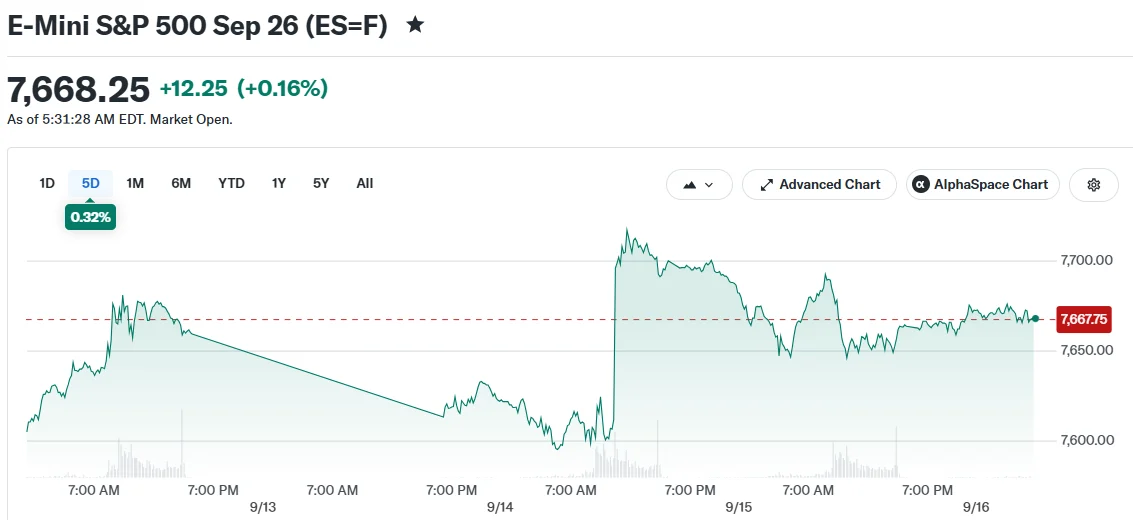
The modest rally emerged despite challenging market conditions. Elevated crude oil prices, weakness in technology equities, and mounting expectations for tighter monetary policy had pressured indexes downward in recent sessions.
Market consensus anticipates the Federal Reserve will implement a 25 basis point rate increase, pushing the federal funds rate to 4.0%. Data from CME Group indicates a 92% probability of the rate adjustment.
Federal Reserve Chairman Kevin Warsh has consistently indicated he will minimize forward guidance to financial markets. He recently reinforced the central bank’s dedication to achieving its 2% inflation objective, suggesting a continued restrictive policy approach.

The benchmark 10-year Treasury note yield surged to 5.03% earlier in the week, approaching two-decade highs, before moderating. Treasury Secretary Scott Bessent provided support for the administration’s economic strategy and revealed plans for a forthcoming dialogue with Chinese officials, helping to relieve some upward pressure on borrowing costs.
Digital Currency Market Weakens
Bitcoin declined approximately 2% to the $75,000 threshold after lawmakers in the Senate were unable to advance the Clarity Act through a critical procedural vote. The legislation sought to establish a comprehensive regulatory structure for digital assets. The vote’s collapse eliminated a potentially bullish driver for cryptocurrency markets and triggered price weakness.
The cryptocurrency selloff occurred during a period of heightened caution for speculative assets, with traders adopting defensive positioning before the Federal Reserve’s policy statement.
Technology Sector Faces Headwinds
Technology equities encountered broad selling pressure throughout the week following public statements from prominent artificial intelligence industry leaders advocating for reduced AI development pace due to concerns about existential risks. The commentary dampened investor enthusiasm across the technology sector.
Nevertheless, signs of potential stabilization emerged. Intel drew attention following a Reuters report indicating SK Hynix was engaged in negotiations with the semiconductor manufacturer to establish domestic memory chip production facilities in the United States for the first time.
Crude oil quotations remained elevated as another source of concern. Both Brent and WTI futures contracts held above $100 per barrel, sustaining inflation anxieties in advance of the central bank’s policy determination.
Economic data releases include August retail sales figures anticipated to demonstrate improvement, while a housing market sentiment indicator is projected to weaken as mortgage borrowing costs continue climbing.
Market attention now shifts to Chairman Warsh’s post-decision press briefing, where investors will scrutinize commentary for signals regarding the trajectory of future monetary policy adjustments.
A rate increase could potentially intensify tensions between the Federal Reserve and President Trump, who has publicly advocated for accommodative interest rate policy.
Get 3 Free Stock Ebooks
Discover top-performing stocks in AI, Crypto, and Technology with expert analysis.
- Top 10 AI Stocks - Leading AI companies
- Top 10 Crypto Stocks - Blockchain leaders
- Top 10 Tech Stocks - Tech giants


