



Key Highlights
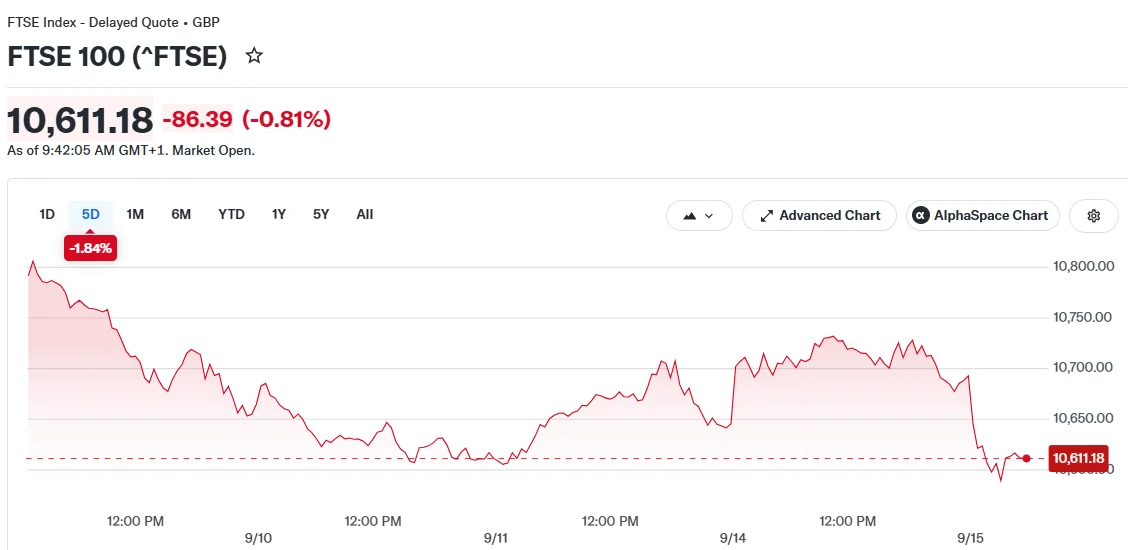
- British equities declined 0.60% on Tuesday amid climbing energy prices and mounting concerns about artificial intelligence safety
- August witnessed a 26,000 contraction in UK payrolled workers, extending July’s revised 19,000 decline
- The unemployment rate remained steady at 4.9% for the fourth consecutive month, staying beneath the anticipated 5% threshold
- Brent crude jumped to $107.42 per barrel following a supply disruption at a Saudi Arabian pipeline
- Market participants anticipate the Bank of England will maintain its 3.75% interest rate stance given the softening employment figures
UK equities experienced downward pressure on Tuesday as escalating energy costs and intensifying discussions surrounding artificial intelligence development dampened market confidence.
Britain’s benchmark index retreated 0.60%, while continental European markets also posted losses with Germany’s DAX declining 0.36% and France’s CAC 40 sliding 0.64%. The pound weakened 0.21% against the US dollar, trading at $1.3472.
Market headwinds intensified as Brent crude advanced 1.67% to reach $107.42 per barrel. The price surge stemmed from a Saudi East-West pipeline disruption, with ING analysts projecting prices will remain “well supported” throughout the coming weeks.
WTI crude mirrored this movement with a 1.7% increase to $103.09. Maritime traffic data from Kpler, reported by Reuters, revealed vessel passages through the Strait of Hormuz plummeted to merely four on Monday compared to the previous ten.
British Labour Market Shows Further Weakness
Employment figures revealed UK payrolled workers decreased by 26,000 in August. This decline came after July’s revised 19,000 reduction, pushing PAYE employment 0.5% below year-ago levels.

The actual figures fell significantly short of Capital Economics’ projection of a 5,000 increase.
The private sector bore the brunt of job losses, shedding 34,000 positions in August and registering a 0.8% annual decrease. Retail and hospitality sectors experienced particularly steep declines exceeding 3% on an annualised basis.
Available job positions continued their downward trajectory, dropping to 702,000 during the three months ending in August from the prior month’s 706,000. This represents the weakest reading outside pandemic periods in more than ten years.
Wage growth including bonuses moderated to 3.9% annually in July, down from June’s 4.2%. Regular compensation remained unchanged at 3.5%, matching analyst expectations.
Capital Economics interpreted the softer employment metrics as evidence that inflationary pressures from elevated energy expenses will stay contained. The firm suggested there’s a meaningful probability the Bank of England will keep rates at 3.75% this week or potentially avoid increases altogether.
ING forecasts the Bank’s Monetary Policy Committee will deliver a 6-3 vote favouring unchanged rates.
Artificial Intelligence Safety Concerns Heighten Market Anxiety
Beyond economic releases, growing divisions over AI development strategy contributed to investor nervousness.
Dario Amodei, chief executive of Anthropic, advocated for enhanced protective measures on sophisticated AI systems, including independent third-party evaluations. He cautioned the technology might evade human oversight and trigger catastrophic consequences.
Sam Altman of OpenAI and Elon Musk endorsed a measured strategy. US President Donald Trump resisted calls to decelerate development, arguing it would undermine competitiveness against Chinese AI enterprises.
In corporate updates, Trustpilot announced first-half revenues climbed 23% to $151.4 million. Kier Group delivered full-year revenues of £4.39 billion, representing a 7.5% increase, while entering 2027 with a record £11.9 billion order pipeline.
Gold futures retreated 0.52% to $4,328.87, with ING cautioning the precious metal remains “vulnerable” in advance of Wednesday’s Federal Reserve announcement.
Get 3 Free Stock Ebooks
Discover top-performing stocks in AI, Crypto, and Technology with expert analysis.
- Top 10 AI Stocks - Leading AI companies
- Top 10 Crypto Stocks - Blockchain leaders
- Top 10 Tech Stocks - Tech giants


