


Key Highlights
- Spot gold advanced 1.0% to reach $4,385.76 per ounce on Friday, setting up a weekly increase of approximately 0.9%
- Crude oil continued its decline for the third consecutive session following Saudi Arabia’s announcement of an imminent pipeline restoration
- The Bank of Japan implemented a rate increase Friday, following similar tightening moves by the Fed and ECB
- A weaker dollar, influenced by declining crude prices, provided additional tailwinds for gold
- Holdings in gold-backed ETFs have experienced inflows across eight consecutive trading sessions, per ANZ data
Gold prices advanced on Friday, positioning the precious metal for a weekly increase as declining crude oil values and a marginally weaker greenback provided support.
Spot gold climbed 1.0% to settle at $4,385.76 per ounce during early session activity. Gold futures gained 0.6% to trade at $4,425.20 per ounce. New York-traded gold futures increased 0.8% to $4,434.90 during early European hours.
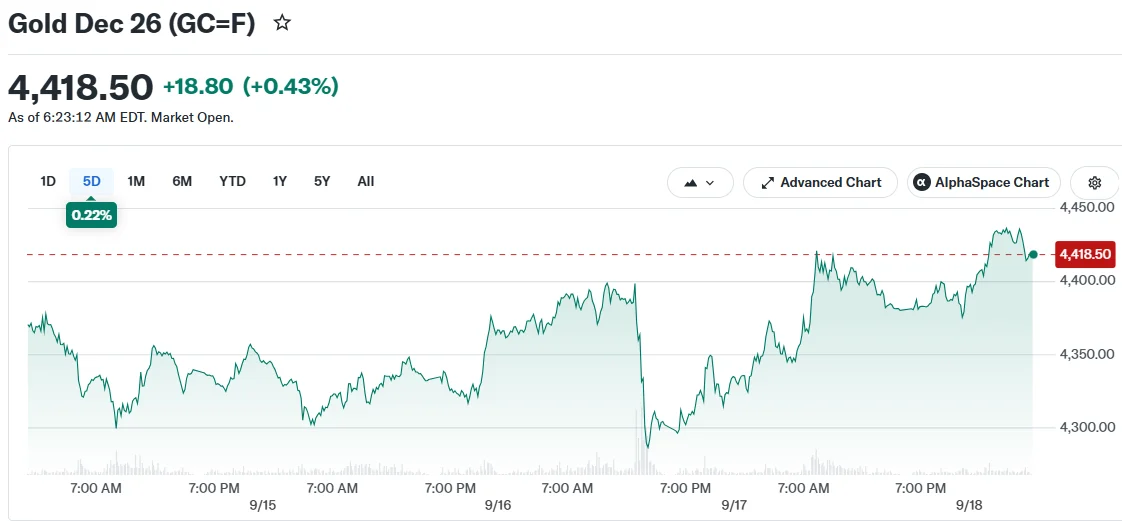
The precious metal is positioned for a weekly increase of roughly 0.9%. Gold recovered more than 2% during Thursday’s session after touching a near six-week low earlier in the week.
Crude oil extended its losing streak to three consecutive days. Saudi Arabia announced it anticipates resuming operations through a critical pipeline in the coming days. Meanwhile, China has intensified diplomatic initiatives aimed at curtailing the influence of Houthi militants, who have strengthened their control over the Bab el-Mandeb Strait.
The decline in oil prices has alleviated concerns that energy-fueled inflation would compel central banks to accelerate their rate-tightening schedules.

Major Central Banks Continue Tightening
The Bank of Japan implemented a rate increase on Friday, citing inflation levels approaching its 2% annual objective. This action comes on the heels of rate increases from the Federal Reserve and the European Central Bank.
The Fed initiated its first rate hike in three years on Wednesday. ING analysts noted that retreating oil prices have relieved some upward pressure on the dollar in the aftermath of that decision.
Nevertheless, ING highlighted potential upside risks for the greenback. The Fed’s hawkish stance has enabled markets to fully incorporate expectations for another rate increase in October, contingent on inflation statistics and energy price movements.
A strengthening dollar typically pressures gold by increasing its cost for international buyers using alternative currencies. The U.S. dollar index edged up 0.1% to 100.38 on Friday.
Exchange-Traded Fund Inflows Signal Sustained Interest
Gold-backed exchange traded funds monitored by Bloomberg have registered substantial inflows in recent trading. ANZ analysts reported that assets in these funds have expanded for eight consecutive sessions.
ANZ further highlighted robust demand for options contracts on several of the largest gold-backed funds. This activity indicates traders are maintaining their engagement with gold even as elevated interest rates increase the carrying costs of the non-yielding asset.
Saxo Bank analysts emphasized gold’s remarkable resilience considering the Fed has just initiated a new tightening cycle while the dollar maintains relative strength.
They noted this resilience reflects ongoing demand from investors who are less influenced by the conventional inverse relationship between interest rates, dollar strength, and gold valuations.
Rising interest rates generally elevate the opportunity cost of maintaining positions in gold, which generates no income or dividends. This headwind persists as additional rate increases are anticipated throughout the remainder of the year.
Gold’s capacity to sustain levels above the $4,400 threshold despite these challenges has garnered analyst attention heading into the weekend session.
Get 3 Free Stock Ebooks
Discover top-performing stocks in AI, Crypto, and Technology with expert analysis.
- Top 10 AI Stocks - Leading AI companies
- Top 10 Crypto Stocks - Blockchain leaders
- Top 10 Tech Stocks - Tech giants


