


Key Highlights
- Spot gold declined more than 1% to approximately $4,025 per ounce Tuesday
- The U.S. dollar reached its strongest level in nearly a month, pressuring gold
- Traders see an 80% probability of a Federal Reserve rate increase in September
- Diplomatic progress between Washington and Tehran reduced geopolitical risk premiums
- Other precious and industrial metals including silver, platinum, and copper also declined
Precious metals faced selling pressure Tuesday as the U.S. dollar strengthened to near month-long highs, dampening appetite for bullion before the Federal Reserve’s upcoming policy announcement.
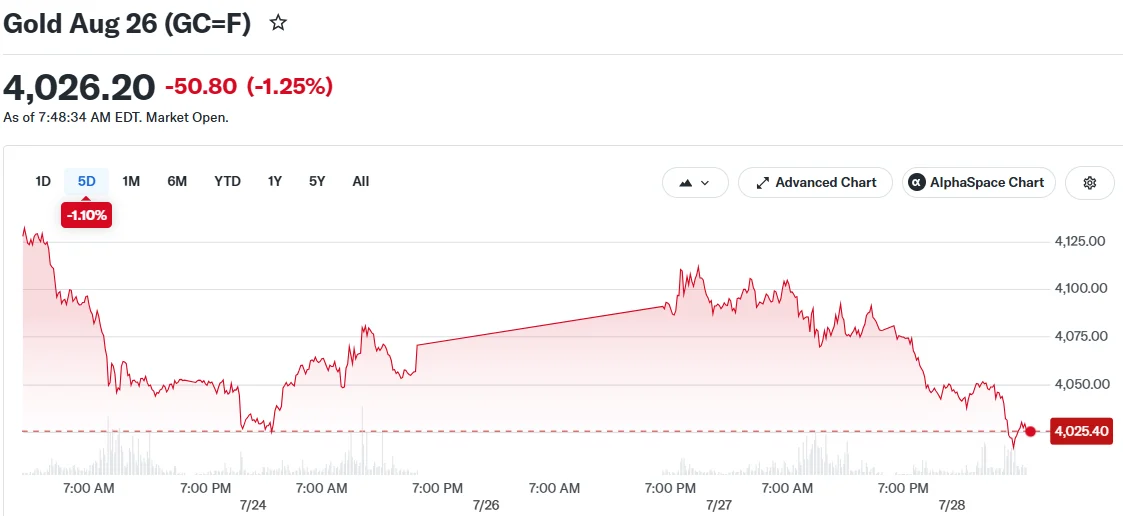
Spot gold declined approximately 1.3% to settle at $4,025.42 per ounce. Gold futures experienced comparable losses, falling to $4,023.45. The precious metal had recorded modest advances during the previous two trading sessions.
The U.S. Dollar Index maintained its position near a one-month peak. When the greenback strengthens, gold becomes costlier for international buyers holding other currencies, generally dampening demand.
Federal Reserve Policy Meeting Takes Center Stage
The Federal Reserve’s two-day policy meeting is scheduled to wrap up Wednesday. Market participants broadly anticipate no change to interest rates at this gathering.
Nevertheless, anticipation for subsequent rate increases has intensified. According to the CME FedWatch tool, markets are factoring in roughly a 40% likelihood of a rate hike this week and an 80% chance of an increase in September.

Rising interest rates generally weigh on gold since the precious metal generates no yield. When rates climb, investors must consider the opportunity cost of holding bullion versus interest-bearing assets.
Market observers noted that gold continues to trade within a broad range. More definitive signals from Fed Chair Kevin Warsh are necessary before market participants commit to significant positions.
Investment professionals are also exercising caution ahead of key U.S. economic releases scheduled for later this week, including second-quarter GDP data and the PCE index, the Federal Reserve’s favored inflation gauge.
U.S.-Iran Relations Show Signs of Improvement
Regarding international relations, President Donald Trump indicated Monday that Washington was engaged in “good talks” with Iran. He suggested an agreement remained achievable while cautioning that military operations could restart if negotiations collapsed.
The United States and Iran implemented a temporary cessation of hostilities following the halt of military strikes over the weekend. This development reduced concerns about potential energy supply interruptions and alleviated some inflation worries.
Oil prices continued their downward trajectory Tuesday, further easing concerns about energy-fueled inflation.
As geopolitical anxieties subsided, the safe-haven appeal that had previously bolstered gold diminished.
Broader Metals Market Experiences Weakness
Silver decreased 1.8% to $57.387 per ounce. Platinum retreated 0.9% to $1,611.60 per ounce.
Industrial metals faced similar headwinds. Copper futures traded on the London Metal Exchange declined 0.6% to $13,677.33 per tonne. U.S. copper futures decreased 0.5% to $6.364 per pound.
The trajectory for gold in the near term will likely hinge on the Federal Reserve’s guidance regarding future interest rate policy when Wednesday’s meeting concludes.
Get 3 Free Stock Ebooks
Discover top-performing stocks in AI, Crypto, and Technology with expert analysis.
- Top 10 AI Stocks - Leading AI companies
- Top 10 Crypto Stocks - Blockchain leaders
- Top 10 Tech Stocks - Tech giants


