


Key Takeaways
- Precious metal declined as the greenback gained strength after the Federal Reserve’s initial rate increase in three years
- Declining crude oil prices helped ease inflationary concerns, containing further gold price declines
- Chinese central bank acquired approximately 20 tonnes of the precious metal in August, marking a three-year peak
- Gold-backed exchange-traded funds received roughly 50 tonnes in inflows during September to date
- Federal Reserve policymakers indicated additional monetary tightening could be necessary to achieve inflation objectives
Gold prices experienced mixed trading patterns on Tuesday as market participants assessed the implications of a firmer dollar alongside declining energy costs and their collective impact on Federal Reserve policy direction.
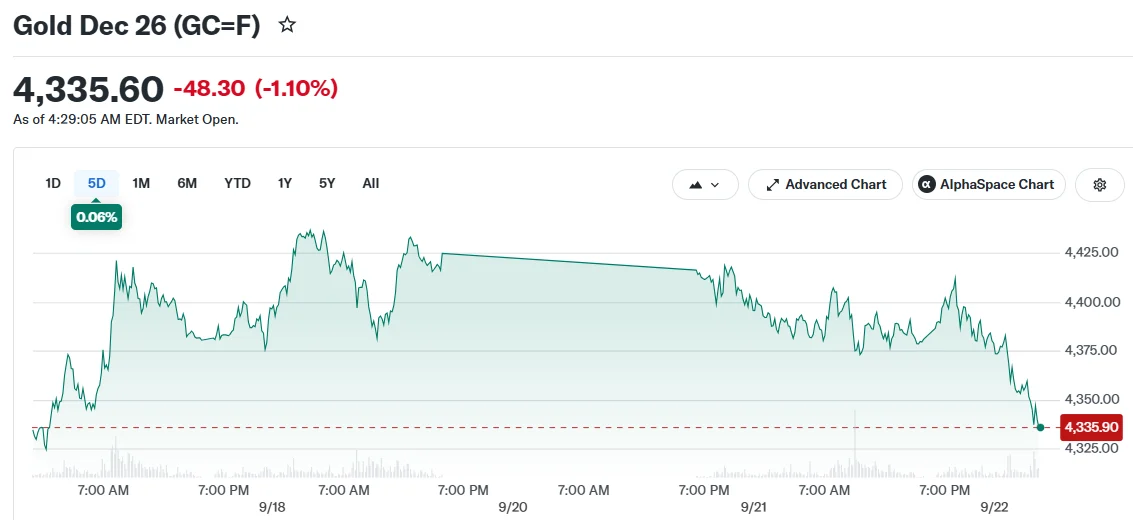
Spot gold hovered near $4,360 per ounce following a recovery from earlier session lows. Gold futures contracts declined approximately 0.6% to settle at $4,357.22.
The U.S. Dollar Index climbed to 100.46 following a weekly gain exceeding 1%. An appreciating dollar typically increases gold’s cost for international buyers using alternative currencies, creating downward price pressure.
The Federal Reserve implemented a rate increase last week for the first time in three years through a unanimous decision. This action has maintained investor attention on the future trajectory of monetary policy.
Two Federal Reserve officials contributed to ongoing policy uncertainty on Monday. Austan Goolsbee, President of the Chicago Federal Reserve, emphasized the central bank must acknowledge persistent supply disruptions. Alberto Musalem, President of the St. Louis Federal Reserve, suggested additional rate increases might be required to achieve inflation targets that have eluded the Fed for over five years.

Energy Market Decline Provides Support
Crude oil prices retreated more than 9% across four consecutive trading sessions as Middle East supply disruption concerns diminished. Renewed diplomatic efforts surrounding the U.S.-Iran situation contributed to market stabilization.
President Trump indicated willingness to engage with Iranian President Masoud Pezeshkian during potential bilateral discussions at the United Nations General Assembly in New York on Tuesday.
Declining energy costs diminish a primary inflation catalyst. This development reduces the probability of additional Federal Reserve rate increases, a scenario typically favorable for precious metals.
ANZ research analysts noted that energy prices remain substantially elevated compared to pre-conflict benchmarks, suggesting inflation may moderate gradually and inconsistently. This dynamic maintains the possibility of continued policy tightening.
Ryan McKay, analyst at TD Securities, observed that gold is “holding extremely strong” following the rate adjustment, with declining energy prices providing underlying support. He characterized near-term price weakness as “increasingly seen as a buying opportunity.”
Institutional and Fund Demand Remains Robust
China’s central bank acquired approximately 20 tonnes of gold during August, representing the largest monthly purchase in three years. Chinese gold imports have simultaneously surged over 80% on a year-over-year basis. This activity helped compensate for reduced purchasing from India.
Exchange-traded fund inflows into gold-backed products reached approximately 50 tonnes throughout September, representing the third consecutive month of positive flows. ANZ indicated that investment demand is beginning to resurface.
ANZ further highlighted that U.S. initiatives to support the yen and Treasury Department actions to alleviate pressure on long-duration yields signal broader apprehension regarding debt sustainability and fiscal challenges. The bank anticipates these concerns will attract additional investors to gold once rate increase expectations begin to diminish.
Market participants are also monitoring this week’s Trump-Xi summit, anticipated to address trade relations, investment frameworks, and artificial intelligence cooperation. Treasury Secretary Scott Bessent characterized weekend negotiations with China’s trade representative as “very successful.”
Silver advanced 0.8% to reach $66.56 per ounce. Platinum and palladium also registered modest gains during Tuesday’s session.
Get 3 Free Stock Ebooks
Discover top-performing stocks in AI, Crypto, and Technology with expert analysis.
- Top 10 AI Stocks - Leading AI companies
- Top 10 Crypto Stocks - Blockchain leaders
- Top 10 Tech Stocks - Tech giants


