



Key Highlights
- Gold advanced 0.4% to approximately $4,418 per ounce on Thursday, benefiting from U.S. dollar weakness
- Climbing 10-year Treasury yields limited upside potential, as elevated yields diminish gold’s attractiveness
- Brent crude reached the $100 per barrel threshold for the first time since July, intensifying inflation worries
- Traders are assigning approximately 65% odds to a Federal Reserve rate increase at the upcoming September 14-15 policy meeting
- Worldwide gold-backed exchange-traded funds absorbed $18 billion during August, marking the second-highest monthly influx ever recorded
Gold continues to maintain its position near the $4,400 per ounce threshold as market participants await crucial U.S. inflation data that may shape the Federal Reserve’s interest rate decision later this month.
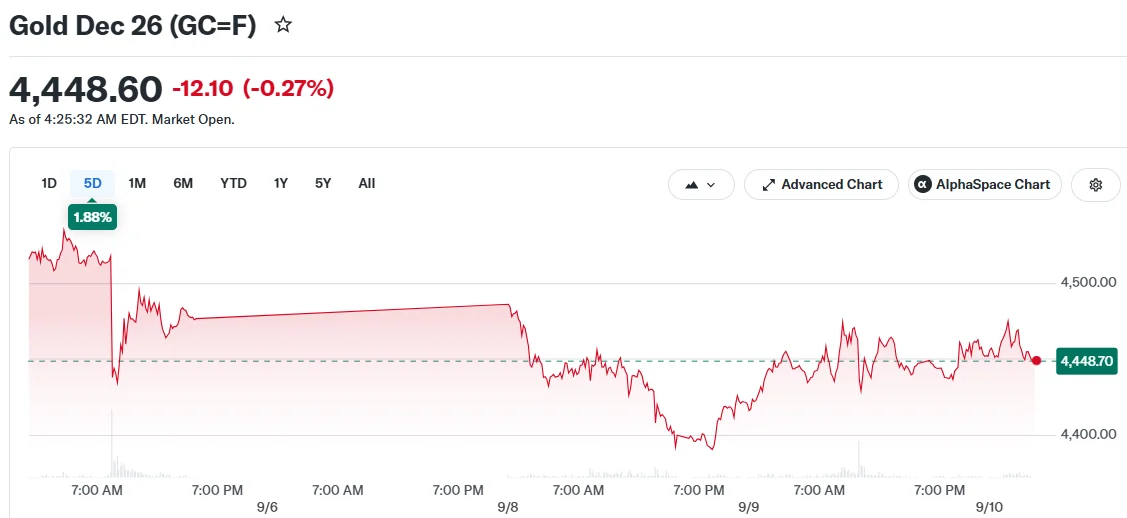
Spot gold prices climbed 0.4% to reach $4,418.87 during Thursday’s trading session. Gold futures contracts experienced a modest 0.03% increase, settling at $4,461.82. The precious metal’s advance follows a reversal of its three-session decline from the prior day.
The primary catalyst behind gold’s modest rally was renewed weakness in the greenback. The U.S. Dollar Index declined to 98.74, effectively reducing gold’s cost for international purchasers holding foreign currencies.
Bond Yields and Energy Prices Create Headwinds
Strengthening bond yields continue to present challenges for gold investors. Yields on 10-year U.S. Treasury securities climbed following the government’s announcement of plans to purchase as much as $6 billion in long-duration debt, though the initiative failed to generate significant bond market response.
Given that gold generates no yield, rising interest rates on competing assets like bonds reduce its relative appeal to investors. This dynamic has established a resistance level for gold prices throughout recent trading periods.

Energy market developments compounded the situation. Brent crude oil prices climbed to $100 per barrel, a milestone not witnessed since July. This surge has reignited inflation anxieties, potentially strengthening the case for additional Federal Reserve tightening.
Current swaps market pricing indicates roughly 65% probability of a rate increase during the Federal Reserve’s September 14-15 policy gathering. Market participants are closely monitoring Thursday’s producer price index release and Friday’s consumer price index data for policy clues.
According to Tony Sycamore, senior market analyst at IG, gold continues trading substantially beneath its 200-day moving average, which sits around $4,537. Breaking through this technical barrier would be necessary to confirm that gold’s correction from the $4,697 peak has concluded.
Geopolitical Risks Remain Elevated
The Middle Eastern conflict, now extending into its seventh month, maintains its influence over financial markets. Iranian officials have indicated readiness for escalated confrontation should U.S. military strikes against its assets and infrastructure persist.
These sustained geopolitical tensions are amplifying concerns about potential energy supply disruptions originating from the region. Consequently, some market participants continue viewing gold as a strategic long-term protective asset, despite mounting near-term headwinds.
Following its rebound from support levels near $4,000 in July, gold has predominantly consolidated within a trading range centered around $4,400.
Exchange-Traded Fund Inflows Reach Historic Levels
Investment demand through fund vehicles has demonstrated remarkable strength. According to World Gold Council data, global gold-backed exchange-traded funds captured $18 billion in August, representing their second-largest monthly inflow in history.
Total holdings expanded by 121 tonnes, reaching an unprecedented 4,189 tonnes. Assets under management surged 16% to $615 billion.
North American funds registered their third-highest monthly inflow on record. Meanwhile, European-listed funds achieved their largest-ever monthly inflow.
Among other precious metals, silver advanced 0.5% to $67.62. Platinum declined 0.6% to $1,889.34.
Get 3 Free Stock Ebooks
Discover top-performing stocks in AI, Crypto, and Technology with expert analysis.
- Top 10 AI Stocks - Leading AI companies
- Top 10 Crypto Stocks - Blockchain leaders
- Top 10 Tech Stocks - Tech giants


