


Key Points
- Gold prices remained stable near $4,600 per ounce Friday as market participants anticipated Fed Chair Kevin Warsh’s Jackson Hole address
- The precious metal touched a three-month peak close to $4,700 earlier in the week, propelled by worries over U.S. fiscal strategy
- The yellow metal is poised for its most substantial monthly advance since 1999, climbing approximately 14% throughout August
- Traders estimate a 34% probability of a September rate increase and 74% likelihood by year’s conclusion
- Other precious metals including silver, platinum, and industrial copper posted modest gains Friday
The price of gold remained relatively unchanged Friday as market participants positioned themselves ahead of Federal Reserve Chair Kevin Warsh’s highly anticipated remarks at the Jackson Hole economic conference.
Spot gold hovered around the $4,600 per ounce mark, while U.S. Gold Futures declined modestly by 0.3% to settle at $4,651.41. The precious metal had climbed to a three-month peak approaching $4,700 during earlier trading sessions this week.
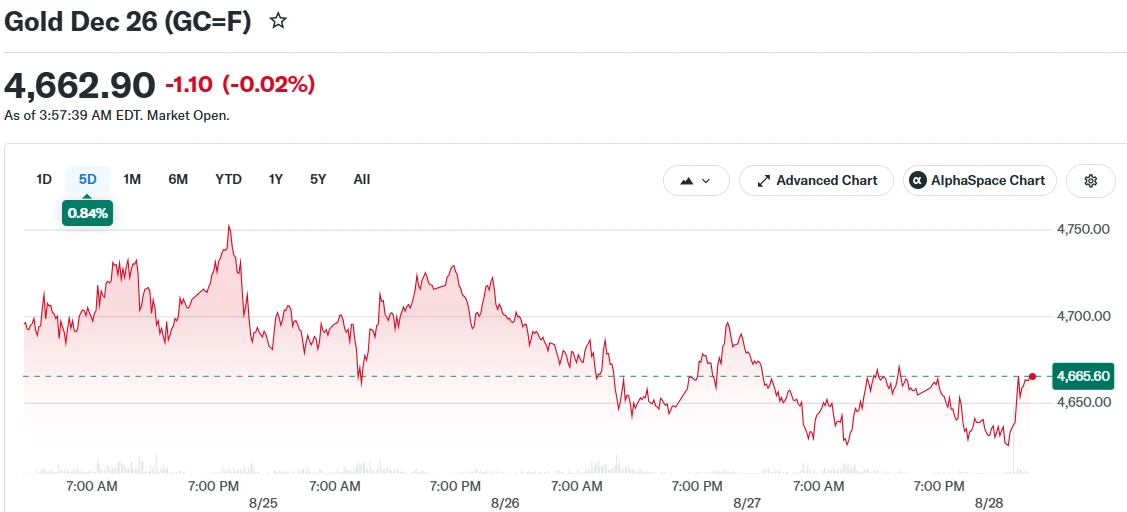
While experiencing a modest retreat Friday, the yellow metal remains positioned for a slight weekly decline following three consecutive weeks of positive momentum.
August Delivers Exceptional Returns for Gold
The month of August has proven remarkably favorable for the precious metal. Gold has surged approximately 14% during this period, positioning it for the strongest monthly performance in a quarter-century, dating back to 1999.
The impressive rally received significant momentum from an unexpected U.S. Treasury initiative aimed at supporting longer-maturity bonds. This strategy reignited the debasement narrative, a key factor that propelled gold to unprecedented highs during the previous year.

Exchange-traded funds backed by physical bullion, monitored by Bloomberg, accumulated over 28 tons during the preceding week—the largest influx since January. An additional 20 tons flowed into these funds in subsequent trading days. Global central banks have simultaneously intensified their gold acquisition programs.
The precious metal has additionally drawn support from a weakening U.S. dollar and declining Treasury yields, both of which diminish the opportunity cost associated with holding the non-interest-bearing asset.
Monetary Tightening Concerns Shadow Future Performance
The Federal Reserve maintained its policy rate unchanged during its July meeting, though three committee members dissented in favor of implementing a quarter-percentage-point increase. This division has maintained heightened uncertainty across financial markets.
The personal consumption expenditures index, which serves as the Fed’s primary inflation gauge, registered a 3.7% year-over-year increase through July. This elevated reading has strengthened speculation that monetary policymakers may implement additional rate increases before year-end.
Data from the CME FedWatch tool indicates that market participants are assigning a 34% probability to a September rate hike, with expectations increasing to 74% for a move by December.
Elevated interest rates typically exert downward pressure on gold valuations, as the metal generates no yield, diminishing its appeal relative to interest-bearing alternatives.
During Thursday’s Jackson Hole proceedings, two central banking officials suggested that current policy settings were insufficiently restrictive to adequately moderate economic activity. However, Federal Reserve Bank of Boston President Susan Collins characterized prevailing rates as “mildly restrictive.”
Market attention centered on Warsh’s scheduled remarks at 10 a.m. ET Friday. As his inaugural major policy address since assuming the Fed chairmanship, investors scrutinized his comments for directional guidance on future monetary policy.
Industrial and Precious Metals Roundup
Silver advanced 1.3% to reach $70.11 per ounce. Platinum registered a 1.8% gain to $1,882.60 per ounce. Copper futures trading on the London Metal Exchange increased 0.4% to $14,338.15 per ton.
The gold market continues consolidating near the $4,600 threshold as investors await clarity on Warsh’s strategy for addressing persistent inflation and calibrating interest rate policy through the remainder of the year.
Get 3 Free Stock Ebooks
Discover top-performing stocks in AI, Crypto, and Technology with expert analysis.
- Top 10 AI Stocks - Leading AI companies
- Top 10 Crypto Stocks - Blockchain leaders
- Top 10 Tech Stocks - Tech giants


