


Key Takeaways
- Bullion declined approximately 0.9% to roughly $4,318 per ounce amid U.S. dollar appreciation.
- The greenback index surged to levels not witnessed since late July, increasing gold costs for international purchasers.
- Last week’s 25-basis-point Federal Reserve rate increase to 3.75%-4.00% signals additional monetary tightening ahead.
- Declining crude oil prices provide modest inflation relief, though energy costs remain substantially elevated year-to-date.
- Robust demand from China and continued central bank acquisitions prevent steeper declines in gold prices.
Precious metal valuations retreated on Wednesday as the strengthening U.S. currency and anticipation of an extended elevated interest rate environment diminished appetite for the non-interest-bearing asset.
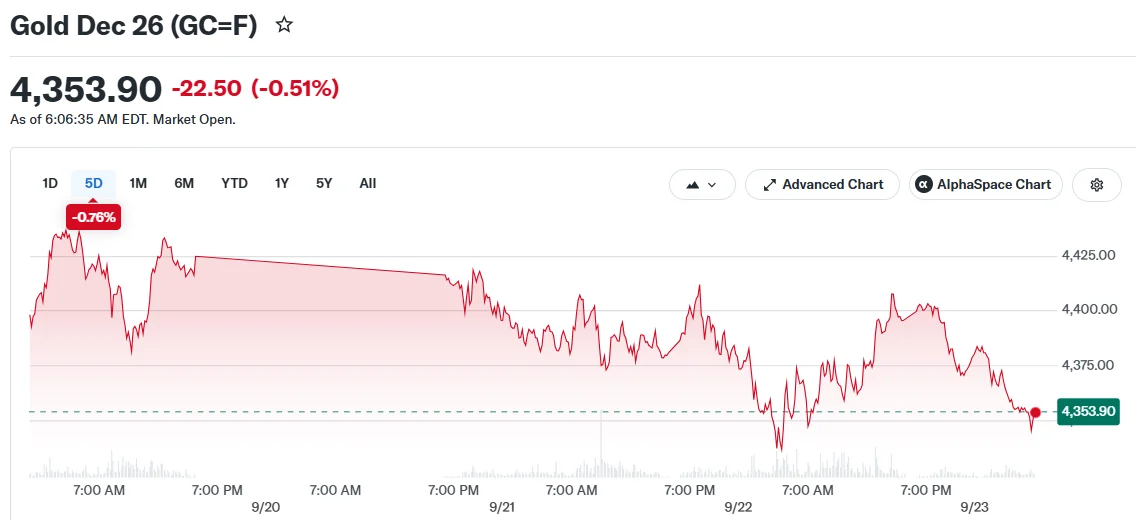
Spot bullion decreased roughly 0.9% to $4,318 per ounce, with U.S. gold futures declining approximately 0.5%. The dollar index advanced to approximately 100.71, representing its most robust performance since July 30.
Elevated Interest Rates Create Headwinds for Precious Metals
The central bank implemented a 25-basis-point rate adjustment last week, elevating its benchmark rate to a 3.75%-4.00% range—marking its first upward adjustment in over three years. Policy architects additionally suggested another rate elevation could materialize before 2026 concludes.
Elevated borrowing costs typically create downward pressure on gold valuations since the precious metal generates no yield. Market participants can alternatively secure enhanced returns through fixed-income securities and additional income-producing instruments.
Central bank representatives have persistently emphasized inflationary concerns. Boston Federal Reserve President Susan Collins indicated that a moderately more restrictive policy stance might prove necessary to guide inflation sustainably back toward the institution’s 2% objective.

The appreciating dollar compounds the challenge. Since gold trades in dollars internationally, an ascending U.S. currency elevates bullion costs for purchasers transacting in euros, yen, and alternative currencies.
Declining Energy Prices Provide Modest Support
Petroleum valuations have retreated as optimism grows regarding enhanced Middle Eastern supply. Iran has suggested the Strait of Hormuz could potentially reopen contingent upon specific conditions, while Saudi Arabia has reactivated its East-West pipeline infrastructure.
Brent crude has descended beneath $100 per barrel, alleviating certain concerns that energy expenses will perpetuate elevated inflation. Nevertheless, petroleum remains considerably above valuations observed at the year’s commencement.
Diminished energy expenditures could ultimately reduce pressure on monetary authorities to maintain rate increases. For precious metals, this establishes a balancing force against the stronger currency and prevailing expectations for restrictive monetary policy.
Chinese Market Activity Bolsters Gold Valuations
Physical purchasing and investment demand continue providing foundational support. ANZ reported Chinese bullion imports achieved approximately 1,000 tonnes throughout the initial eight months of 2026, while Chinese gold-backed exchange-traded funds accumulated roughly 44 tonnes during August.
The People’s Bank of China also purportedly intensified gold acquisitions to approximately 20 tonnes in August. Central bank purchasing has constituted one of the significant long-term demand sources for precious metals.
Gold has nonetheless encountered challenges as market participants concentrate on real yields and currency dynamics. Reuters disclosed Tuesday that bullion had retreated more than 22% from its January peak of $5,594.82 per ounce as elevated rates diminished its comparative attractiveness.
Currently, the principal market drivers remain the dollar, Treasury yields, and anticipation surrounding the Federal Reserve’s subsequent policy decision.
Get 3 Free Stock Ebooks
Discover top-performing stocks in AI, Crypto, and Technology with expert analysis.
- Top 10 AI Stocks - Leading AI companies
- Top 10 Crypto Stocks - Blockchain leaders
- Top 10 Tech Stocks - Tech giants


