



Key Takeaways
- The yellow metal declined approximately 1% Thursday following Wednesday’s two-week peak
- Crude oil prices climbed on Middle East geopolitical tensions, amplifying inflation worries
- Next week’s Federal Reserve policy meeting remains the primary catalyst for precious metal traders
- Market participants remain uncertain about the possibility of additional rate increases
- Bargain hunters have been accumulating positions in gold despite elevated interest rate environment
The precious metal experienced a decline Thursday after reaching its strongest level in two weeks during the previous session. Contracts in New York decreased approximately 1% to $4,110 per troy ounce during morning trade.
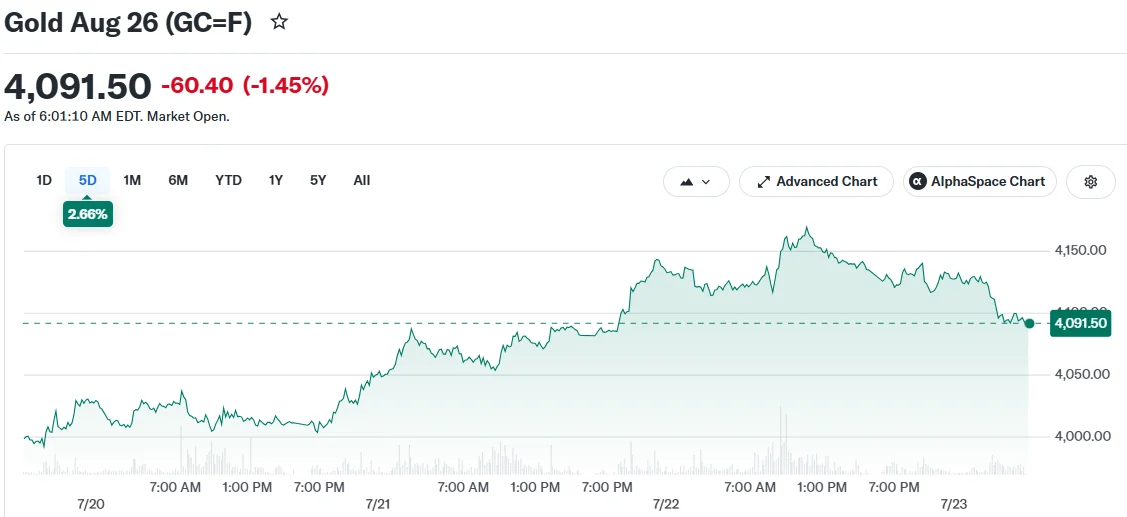
This retreat followed a roughly 3% advance across the prior two trading days. Opportunistic buyers had entered the market even as strengthening U.S. Treasury yields applied downward pressure on the metal.
Spot prices for the yellow metal decreased 0.1% to $4,127.99 per ounce around 5:31 GMT. Futures contracts dropped 0.5% to $4,130.62. Meanwhile, silver and platinum both registered modest gains for the session.
Geopolitical Tensions Elevate Crude Prices
Intensifying conflict across the Middle East continues to fuel inflation anxieties. The United States and Iran demonstrated minimal progress toward diplomatic resolution as tensions mounted.
Reports emerged of attacks targeting oil tankers in the Red Sea—the first such incidents since hostilities erupted in late February. Yemen’s Houthi forces took credit for these strikes.

This critical waterway serves as a vital corridor for Saudi Arabian crude shipments. The supply disruption contributed to oil prices reaching multi-week peaks, prompting markets to reassess inflation projections.
Higher oil prices directly influence inflation forecasts. This connection matters for gold because elevated energy costs increase the likelihood of the Federal Reserve maintaining restrictive monetary policy for an extended period.
Elevated interest rates raise the opportunity cost associated with holding non-yielding assets like gold. This dynamic generally creates headwinds for precious metal valuations.
Central Bank Decision Takes Center Stage
Market participants are closely monitoring next week’s Federal Reserve policy announcement. The central bank is broadly anticipated to maintain current interest rate levels this month.
Nevertheless, futures markets are incorporating at least one additional rate increase before year-end. Fed Chair Kevin Warsh has provided limited forward guidance on monetary policy direction, contributing to market ambiguity.
Market participants remain divided regarding the timing of potential future rate adjustments. This uncertainty has kept gold trading within a relatively narrow range around current price levels.
Notwithstanding rate pressures, certain investors have been expanding their gold allocations. ANZ analysts observed that speculative net long positions have reached their most elevated level since January.
Capital flows into gold-backed exchange-traded products have also accelerated. ANZ indicated that some market participants are deploying gold as a protective measure against elevated equity market valuations.
The investment bank highlighted that value-oriented buying has enabled gold to maintain stability despite energy price dynamics suggesting a more hawkish policy environment.
The precious metal has sustained prices above the $4,000 threshold throughout this week, a psychologically significant level monitored by technical traders. The metal experienced a sharp correction from its January record peak earlier this year.
The subsequent critical level attracting trader attention is resistance around $4,200. Whether gold can generate sufficient upward momentum to test that barrier will probably hinge on the Federal Reserve’s communication strategy next week.
Get 3 Free Stock Ebooks
Discover top-performing stocks in AI, Crypto, and Technology with expert analysis.
- Top 10 AI Stocks - Leading AI companies
- Top 10 Crypto Stocks - Blockchain leaders
- Top 10 Tech Stocks - Tech giants


