



TLDR
- The precious metal retreated from its two-month peak as market participants secured gains following a substantial upward movement
- Market expectations for a Federal Reserve rate increase in September now stand at just 32%
- The leading cryptocurrency declined 0.4% to $63,140 amid heightened Middle Eastern geopolitical concerns
- Crude oil prices surged, with Brent advancing 1.6%, following stalled negotiations over Strait of Hormuz passage
- Yields on 30-year U.S. government bonds reached their highest auction level in over two decades
The precious metal experienced a pullback on Friday following its climb to a two-month peak earlier in the trading week. Market participants began securing profits after a robust rally that propelled valuations beyond the $4,400 per ounce threshold.
The spot market for the yellow metal remained essentially unchanged at $4,349.71 per ounce during early Friday sessions. Futures contracts declined 0.4% to $4,404.65. New York-traded futures dropped 0.8% to $4,385.90, positioning the metal for a slight weekly decline despite advancing over the prior two-week period.
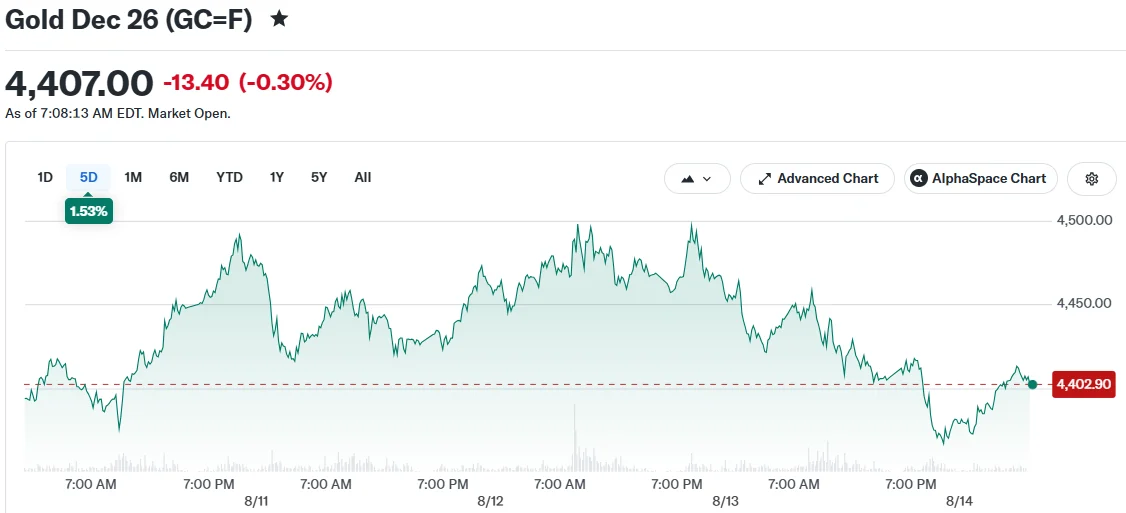
The precious metal surpassed its 100-day moving average earlier this week for the first time since April. Nevertheless, it has subsequently fallen back beneath this technical threshold, indicating that investors have accelerated their profit-taking activities.
Market observers at Sucden Financial highlighted that the yellow metal, along with other asset classes, struggled to maintain recently achieved peaks, attributing this to profit-taking following the aggressive rally. Analysts from ANZ stated that extended positioning leaves the metal’s recent advances susceptible to additional consolidation.
More moderate U.S. inflation figures released this week diminished market expectations regarding a Federal Reserve interest rate increase in September. The CME FedWatch tool indicates that market participants now assign merely a 32% probability to a September rate adjustment, representing a decline from previously elevated levels.

Diminished rate-hike expectations typically provide tailwinds for the precious metal. When interest rates remain subdued, the opportunity cost associated with maintaining a non-interest-bearing asset like gold decreases.
Disappointing employment statistics from the previous week, coupled with restrained consumer and producer inflation data this week, have collectively reduced rate-increase speculation. Financial markets will monitor Fed Chair Kevin Warsh’s commentary at the Jackson Hole economic symposium scheduled for later this month for additional guidance.
Middle East Tensions Push Oil Higher and Weigh on Bitcoin
Oil prices experienced significant gains on Friday as U.S.-Iran diplomatic tensions persisted without resolution. Brent crude advanced 1.6% to $88.45 per barrel, while WTI futures increased 1.9% to $82.78. Both benchmark contracts were positioned for weekly gains approaching 6%.
The U.S. Defense Secretary indicated that the naval blockade of Iranian shipping facilities could continue without time constraints, as military vessels can be systematically rotated. Treasury Secretary Scott Bessent also signaled forthcoming measures designed to economically isolate Iran in the coming week.
Jefferies economist Mohit Kumar stated that no straightforward resolution exists for the current diplomatic impasse. Iran maintains control over the Strait of Hormuz and the U.S. will not tolerate Iran imposing passage fees, he explained.
Analysts from MUFG noted that ongoing threats across both the Strait of Hormuz and Red Sea shipping lanes should maintain an elevated geopolitical risk premium embedded in crude oil valuations.
Bitcoin decreased 0.4% to $63,140 as the continuing Iranian conflict elevated petroleum prices and diminished appetite for higher-risk assets.
U.S. equity index futures traded lower during early European sessions. S&P 500 futures slipped 0.02% and the Dow declined 0.1%, despite the S&P achieving a record closing level in the prior session.
Yields on U.S. 30-year Treasury bonds climbed to 5.228%, representing the highest auction level since 2001. Analysts from Danske Bank suggested the outcome reflects apprehension regarding the expanding federal debt obligation and inflation persisting above the Federal Reserve’s established target.
The dollar index retreated 0.1% to 99.854 as rate-increase expectations continue moderating.
The precious metal’s extended-term recovery has additionally benefited from intensified central bank acquisitions, especially from China, and revitalized investor interest since prices rebounded above the $4,000 per ounce level.
Get 3 Free Stock Ebooks
Discover top-performing stocks in AI, Crypto, and Technology with expert analysis.
- Top 10 AI Stocks - Leading AI companies
- Top 10 Crypto Stocks - Blockchain leaders
- Top 10 Tech Stocks - Tech giants


