


TLDR
- Gold retreated from its highest level in three months, with spot prices declining 0.4% to $4,634.20 per ounce
- The precious metal had rallied strongly last week following the Treasury Department’s announcement to increase buybacks of long-term government securities
- Market participants are focusing on Wednesday’s core PCE inflation report and Fed Chair Kevin Warsh’s Jackson Hole address on Friday
- A softer dollar combined with declining bond yields had previously boosted gold’s appeal to international purchasers
- Market experts indicate gold must sustain levels above $4,700 per ounce to preserve its upward trajectory
Gold experienced a modest decline on Tuesday following its climb to the highest level since mid-May, as market participants adopted a wait-and-see approach before crucial economic announcements scheduled for later in the week.
Spot gold decreased 0.4% to reach $4,634.20 per ounce during early market activity. Gold futures contracts declined 0.2% to settle at $4,691.14.
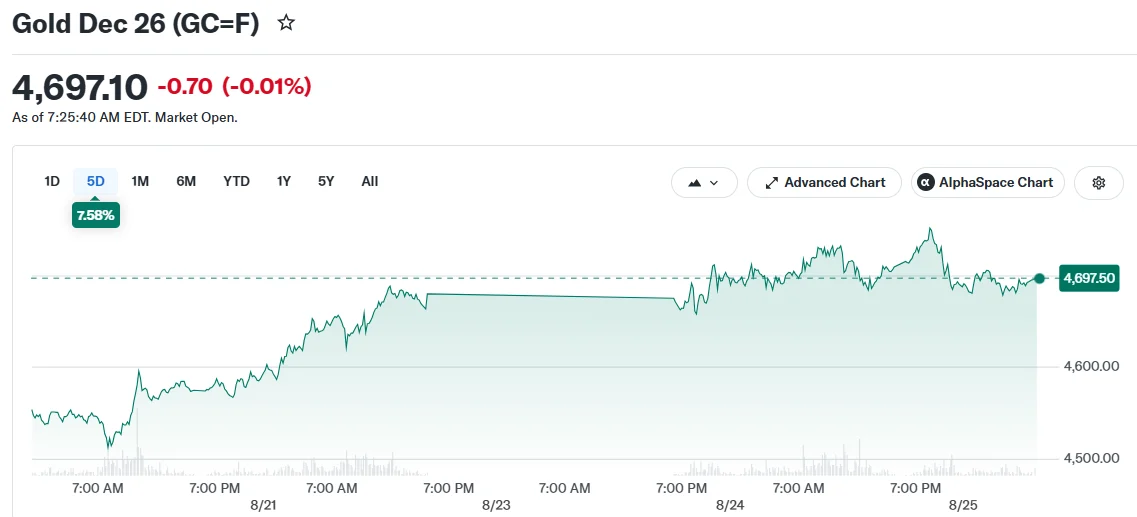
The pullback followed an impressive performance during the previous week that elevated prices to their highest point in over three months.
Catalysts Behind Last Week’s Price Surge
The Treasury Department revealed intentions to substantially increase buybacks of longer-maturity government securities, potentially doubling current levels. This announcement reignited worries about fiscal sustainability and the dollar’s future value.
Government bond yields declined following this news, reducing the opportunity cost associated with owning gold, an asset that generates no yield. Meanwhile, dollar weakness made the precious metal more affordable for international buyers.

On Monday, Treasury Secretary Scott Bessent confirmed his readiness to expand the buyback program further. He additionally indicated that the administration would soon unveil strategies to address elevated government borrowing costs.
These developments revived the currency debasement narrative, an investment approach where gold serves as a hedge against diminishing dollar purchasing power.
This same investment theme had fueled a significant portion of gold’s rally during the previous year.
Key Events on Investors’ Radar
Market attention is centered on two critical events scheduled for this week. On Wednesday, the Bureau of Economic Analysis will publish the core personal consumption expenditures price index. This metric serves as a primary inflation gauge monitored by the Federal Reserve.
Subsequently on Friday, Fed Chair Kevin Warsh will deliver remarks at the annual Jackson Hole symposium. His commentary could significantly influence market expectations regarding future monetary policy direction.
According to analysts from Sucden Financial, maintaining price levels above $4,700 per ounce is essential for gold to sustain its current bullish trend.
Tony Sycamore, senior market analyst at IG, noted that recent price action suggests gold established a solid bottom near $3,942 during late June.
He observed that gold’s movement during early August was partially influenced by optimism surrounding potential diplomatic progress in the Middle East, which would have reduced oil prices and alleviated inflationary pressures on central banks.
Regarding geopolitical developments, the White House issued warnings of economic sanctions against nations maintaining commercial relationships with Iran. Additionally, U.S.-Canada trade relations deteriorated following unsuccessful negotiations, resulting in Washington imposing 50% tariffs on certain Canadian imports.
These dynamics contribute to an uncertain environment that may sustain investor interest in gold as a refuge during turbulent times.
The precious metal continues trading near its strongest levels since mid-May, with market watchers identifying $4,700 as the critical support threshold.
Get 3 Free Stock Ebooks
Discover top-performing stocks in AI, Crypto, and Technology with expert analysis.
- Top 10 AI Stocks - Leading AI companies
- Top 10 Crypto Stocks - Blockchain leaders
- Top 10 Tech Stocks - Tech giants


