


Key Takeaways
- The precious metal declined more than 1% Monday amid renewed U.S.-Iran hostilities and a firmer greenback
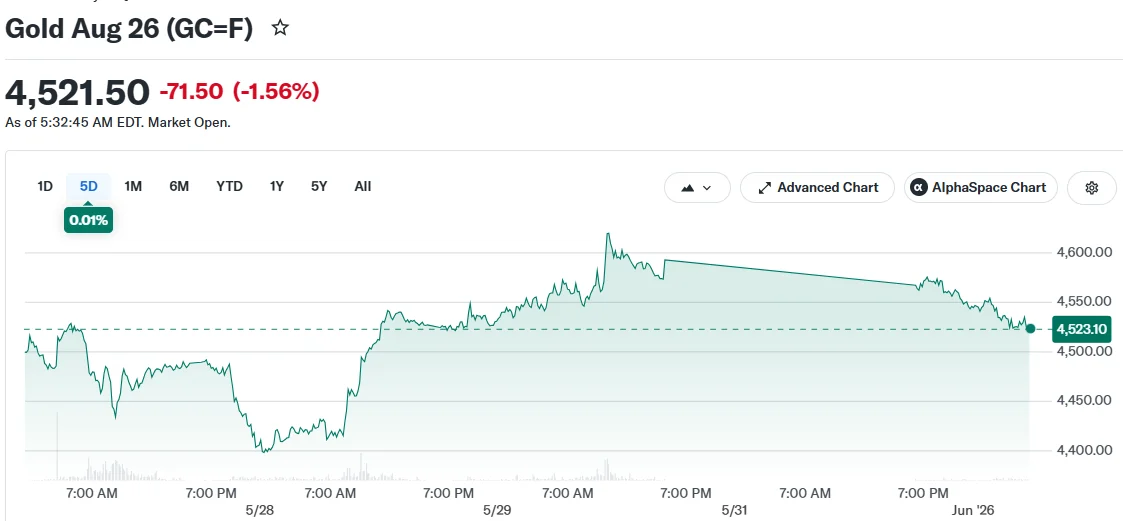
- Spot gold slipped 0.8% to $4,501.54/oz while U.S. Gold Futures retreated 1.3% to $4,532.22
- Crude oil jumped over 3%, intensifying inflation worries and speculation of tighter monetary policy
- The U.S. dollar index climbed 0.1%, reducing gold’s appeal to international investors
- Market participants are monitoring Federal Reserve commentary and forthcoming employment figures for rate guidance
The yellow metal experienced a sharp decline Monday following renewed military confrontations between the United States and Iran over the weekend, casting fresh uncertainty over potential peace negotiations.
Spot gold retreated 0.8% to $4,501.54 per ounce during early market activity. U.S. Gold Futures slipped 1.3% to settle at $4,532.22.
According to U.S. military officials, American forces targeted Iranian air-defense systems and drone infrastructure following Iran’s reported downing of a U.S. unmanned aircraft. Iran subsequently launched attacks on an airfield housing U.S. personnel. Regional defense systems successfully intercepted incoming missiles and unmanned aerial vehicles during the exchanges.
Gold had closed the previous week modestly higher after emerging reports indicated both nations were exploring an extension to ceasefire terms and potential reopening of critical shipping routes through the Strait of Hormuz.
That optimism quickly dissipated following the weekend military actions. Critical sticking points in negotiations remain unaddressed, and any comprehensive settlement requires final authorization from President Donald Trump.

Crude Surges, Complicating Federal Reserve Calculus
Oil prices advanced more than 3% Monday in response to the escalating military situation. The rally sparked renewed anxiety about sustained elevated energy expenses and their potential impact on consumer prices.
Persistent inflation could compel the Federal Reserve to consider tightening monetary policy rather than loosening it. Prior to the escalation, financial markets had anticipated interest rate reductions.
Elevated interest rates typically pressure gold negatively, as the metal generates no income. When borrowing costs increase, capital often flows toward income-producing investments.
The U.S. dollar index advanced 0.1% during Asian market hours. A robust dollar diminishes gold’s attractiveness for holders of foreign currencies, creating additional headwinds for pricing.
Market strategists at Saxo Bank noted that investors are wrestling with competing forces: inflationary pressures stemming from energy market volatility versus structural factors that traditionally bolster gold demand, including sovereign reserve accumulation, mounting government debt levels, and global currency diversification efforts.
Diversified Performance Across Precious Metals Complex
The broader precious metals sector displayed varied movements Monday. Silver advanced 0.5% to reach $75.69 per ounce. Platinum climbed 1.1% to $1,940.95 per ounce.
Copper futures traded on the London Metal Exchange increased 0.3% to $13,663.33 per ton. U.S. Copper Futures similarly gained 0.3% to $6.44 per pound.
Israel simultaneously expanded military operations deeper into southern Lebanon territories as confrontations with Iranian-supported Hezbollah forces escalated, compounding regional instability.
Market observers are closely monitoring scheduled remarks from Federal Reserve policymakers. Critical U.S. employment statistics are anticipated shortly, potentially offering clearer insights into the central bank’s monetary policy trajectory.
Gold touched a two-month nadir last week before staging a partial rebound. The metal’s short-term trajectory will likely hinge on developments in diplomatic negotiations and forthcoming Federal Reserve communications.
Get 3 Free Stock Ebooks
Discover top-performing stocks in AI, Crypto, and Technology with expert analysis.
- Top 10 AI Stocks - Leading AI companies
- Top 10 Crypto Stocks - Blockchain leaders
- Top 10 Tech Stocks - Tech giants


