



TLDR
- Gold advanced 0.2% Monday, reaching approximately $4,024 per ounce following a decline exceeding 2% during the prior week
- Escalating U.S.-Iran hostilities in the Middle East included an assault on a Kuwaiti oil installation
- Brent crude surged past $90 per barrel, heightening concerns about inflation driven by energy costs
- Probability of a Federal Reserve rate increase at the July 29 policy meeting momentarily reached 40% before declining to approximately 10%
- ANZ experts anticipate the Fed will maintain current rates and forecast gold finding stability in the $3,800–$4,000 zone
Gold continues to maintain its position near the psychologically significant $4,000 threshold as market participants weigh escalating geopolitical tensions against potential monetary policy tightening that could exert downward pressure on the precious metal.
Spot gold registered a 0.2% gain Monday, reaching $4,024.09 per ounce. Gold futures demonstrated comparable strength, advancing to $4,028.32. These increases followed a substantial decline of over 2% during the previous week’s trading.
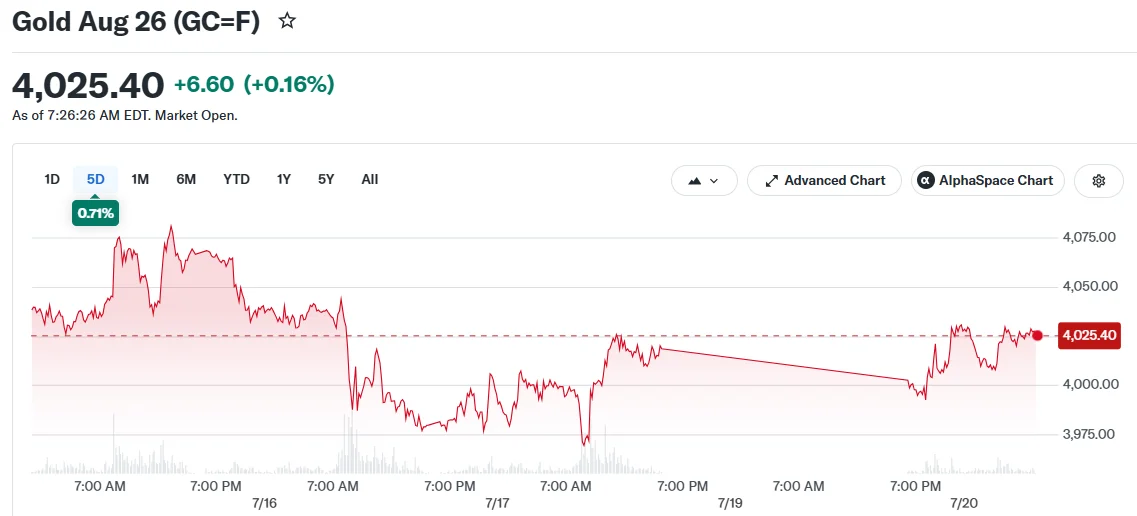
Silver demonstrated stronger momentum, climbing 1.8% to reach $56.97 per ounce. Platinum recorded a modest 0.2% increase, settling at $1,598.45.
Mideast Hostilities Fuel Energy Market Surge
Confrontations between Washington and Tehran intensified dramatically during the weekend period. A significant assault targeted a crucial petroleum facility located in Kuwait, while additional strikes affected maritime vessels navigating through the Strait of Hormuz, an essential corridor for international oil transportation.
Tehran declared the cessation of hostilities with Washington had essentially collapsed. The confrontation has now entered its fifth month, maintaining sustained volatility in energy commodity markets.

Brent crude surged beyond the $90 per barrel threshold following these developments before retreating modestly. Elevated petroleum prices intensify anxieties that inflationary pressures could persist longer than market participants previously anticipated.
Notwithstanding the heightened tensions, certain indicators suggest diplomatic channels remain viable. Secretary of State Marco Rubio indicated Washington’s willingness to engage in dialogue with Tehran. Iranian Foreign Minister Abbas Araghchi similarly expressed readiness for negotiations following the attainment of “strategic gains.”
Federal Reserve Policy Trajectory Constrains Gold
The primary headwind facing gold currently stems from uncertainty surrounding the Federal Reserve’s monetary policy direction. Elevated petroleum prices could maintain inflation above the central bank’s 2% objective, potentially compelling officials to sustain restrictive interest rates for an extended period.
Higher interest rates typically strengthen the U.S. dollar and increase Treasury yields, diminishing the appeal of non-interest-bearing assets such as gold for portfolio managers.
Market-implied probabilities for a Federal Reserve rate increase during the July 29 policy meeting temporarily surged to 40% last week amid intensifying military confrontations. Those expectations have subsequently retreated to approximately 10%.
ANZ research analysts indicate the threshold for additional monetary tightening remains substantially elevated. They project the Federal Reserve will disregard elevated energy costs unless they trigger broader inflationary momentum throughout the economy.
ANZ further anticipates gold will discover technical support within the $3,800 to $4,000 trading band as rate increase expectations diminish.
Gold has remained confined within a tight trading range surrounding $4,000 during recent weeks. The precious metal experienced a 14% decline during the second quarter, marking its most severe quarterly contraction since 2013, as interest rate concerns persistently overshadowed safe-haven buying interest.
Recent economic indicators reflecting U.S. inflation and employment have demonstrated moderate weakening, though market participants await confirmation whether energy cost escalation alters that trajectory prior to the Fed’s upcoming July 29 policy meeting.
Get 3 Free Stock Ebooks
Discover top-performing stocks in AI, Crypto, and Technology with expert analysis.
- Top 10 AI Stocks - Leading AI companies
- Top 10 Crypto Stocks - Blockchain leaders
- Top 10 Tech Stocks - Tech giants


