


Key Highlights
- Spot gold advanced 1.1% to approximately $4,095 per ounce during Monday’s session
- Crude oil tumbled over 5% following a weekend cessation of U.S.-Iran military confrontations
- Trump suspended American airstrikes against Iranian installations Friday following two weeks of continuous attacks
- Declining U.S. dollar strength and retreating Treasury yields provided additional tailwinds for bullion
- Market focus shifts to Federal Reserve’s monetary policy announcement scheduled for Wednesday
Bullion markets experienced upward momentum Monday as currency weakness and retreating energy prices reshaped investor positioning. The cessation of military engagement between Washington and Tehran triggered a steep selloff in crude markets, diminishing inflationary concerns while directing capital flows toward traditional safe-haven instruments.
Spot gold appreciated 1.1% reaching $4,095.37 per ounce during early Monday trading hours. August-dated gold futures contracts registered a 0.7% increase, settling at $4,097.40 per ounce.
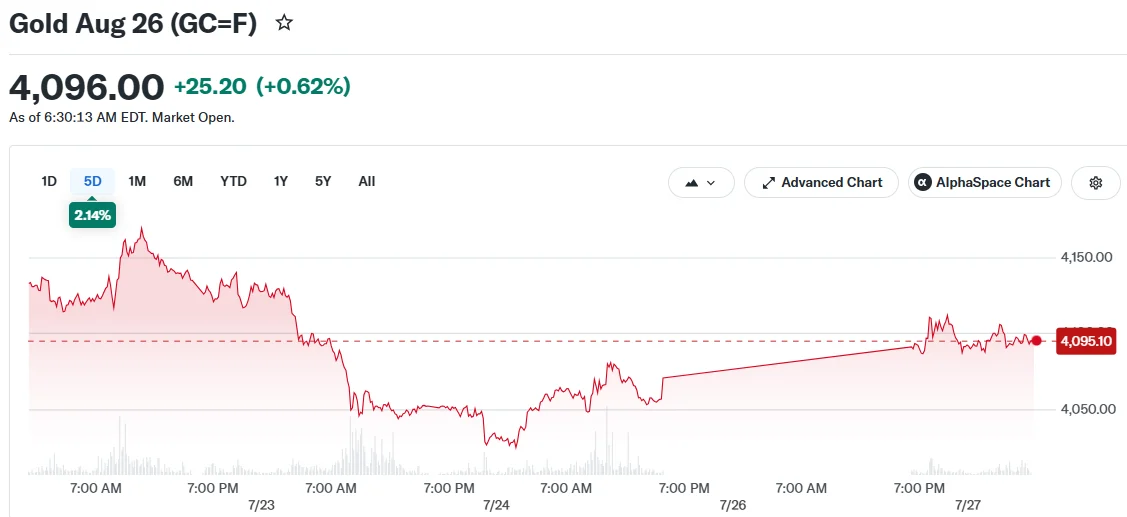
The yellow metal had concluded the previous week with approximately 1% appreciation, navigating through significant price fluctuations throughout the period.
Crude Markets Retreat as Regional Hostilities Subside
Oil prices plummeted more than 5% Monday, erasing substantial portions of the preceding week’s rally. Brent crude had momentarily threatened the psychologically significant $100 per barrel threshold amid mounting concerns regarding possible supply chain interruptions affecting critical waterways including the Strait of Hormuz and Red Sea shipping lanes.
President Donald Trump terminated the American aerial bombardment initiative Friday following thirteen consecutive evenings of offensive operations targeting Iranian infrastructure. The cessation was characterized as establishing space for potential diplomatic engagement.

Tehran refrained from launching counterattacks against regional nations providing facilities for American military installations throughout the weekend. This mutual de-escalation contributed to stabilizing energy commodity markets.
The contraction in petroleum prices may alleviate short-term inflationary momentum. Reduced energy expenditures cascade through consumer pricing mechanisms, potentially affording the Federal Reserve expanded policy maneuverability.
Central Bank Announcement Approaching Wednesday
Financial markets are concentrating attention on the Federal Reserve’s upcoming policy session. Consensus expectations anticipate the monetary authority will maintain current interest rate levels during Wednesday’s announcement.
Nevertheless, CME FedWatch analytics indicate approximately one-third probability of a rate increase. Market participants will scrutinize remarks from Fed Chair Kevin Warsh for directional guidance.
Traders seek clarity regarding the timeline for potential rate reductions and policymakers’ assessment of prevailing inflation dynamics. Gold typically demonstrates enhanced performance during low-rate environments, considering the commodity generates no income stream.
The U.S. Dollar Index retreated 0.3% Monday. Diminished dollar valuations reduce gold’s cost for international purchasers transacting in alternative currencies, typically stimulating demand.
U.S. Treasury yields similarly declined, with the benchmark 10-year note positioned for its most substantial single-session drop in thirty days.
Broader Metals Complex Follows Higher
Silver appreciated 2.1% reaching $59.39 per ounce. Platinum climbed 2.3% to $1,630.83 per ounce.
Copper contracts on the London Metal Exchange advanced 0.4% to $13,693.58 per tonne. Domestically traded U.S. copper futures remained relatively unchanged at $6.36 per pound.
Market participants will maintain vigilance over forthcoming U.S. inflation measurements and employment statistics for additional indicators regarding Federal Reserve policy trajectory.
Get 3 Free Stock Ebooks
Discover top-performing stocks in AI, Crypto, and Technology with expert analysis.
- Top 10 AI Stocks - Leading AI companies
- Top 10 Crypto Stocks - Blockchain leaders
- Top 10 Tech Stocks - Tech giants


