



Key Highlights
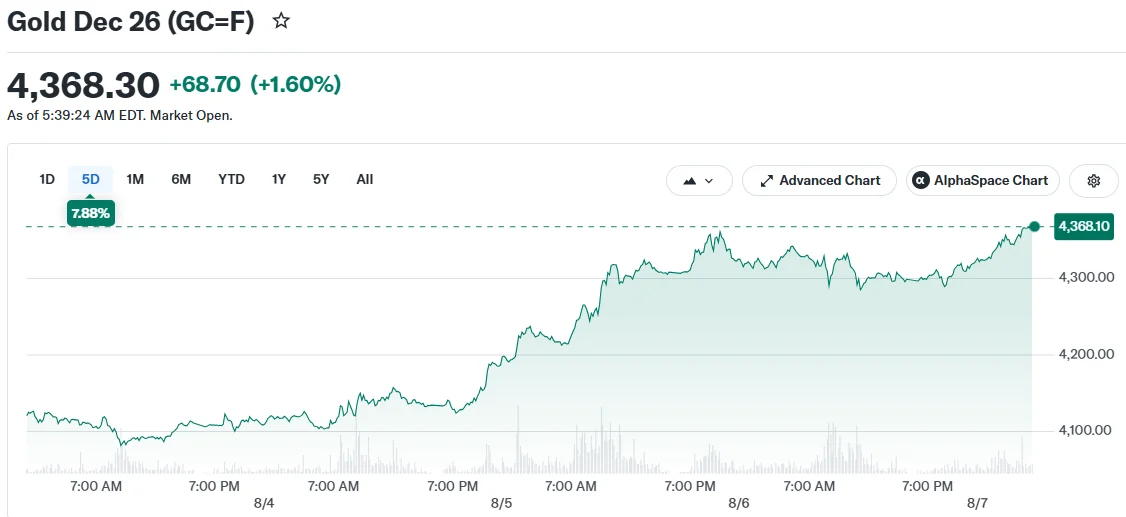
- Precious metal advances 0.6% to reach $4,264 per ounce on Friday, tracking toward strongest weekly performance since early 2025
- Growing conflict in the Strait of Hormuz waterway fuels safe-haven investment flows into gold
- Market participants now estimate approximately 55-60% probability of Federal Reserve interest rate increase in September
- Exchange-traded funds backed by gold in China record 14 consecutive days of capital inflows, bolstering market sentiment
- Upcoming U.S. employment data on Friday expected to determine near-term price trajectory for precious metals
Precious metal valuations extended their upward trajectory on Friday, capitalizing on momentum from previous sessions as escalating Middle East shipping route tensions sustained investor appetite for protective assets. Spot gold advanced 0.6% to reach $4,264.22 per ounce, with futures contracts climbing an identical 0.6% to settle at $4,323.07.
Other precious metals followed suit, with silver jumping 1.2% to $62.26 per ounce. Platinum experienced a 0.6% increase to $1,740.05.
The yellow metal’s weekly performance stands poised to mark its most substantial gains since the opening month of this year, with New York-traded gold futures climbing approximately 1% during early Friday sessions to $4,343.50 per troy ounce.
Iranian state media outlets announced that Tehran conducted strikes against what authorities characterized as “hostile targets” within the Strait of Hormuz region, declaring intentions to prevent American and Israeli maritime vessels from utilizing the critical shipping passage. These developments emerged shortly after indications suggested Iran and Oman were approaching an agreement to restore normal shipping operations.
The Yemen-based Houthi organization additionally took credit for a major offensive against forces supported by Saudi Arabia, intensifying concerns that regional hostilities might expand geographically.

Gold momentarily surpassed the $4,300 threshold on Thursday following positive sentiment regarding a potential Hormuz diplomatic solution that triggered purchasing activity. However, the upward momentum dissipated when confrontations resumed, reigniting worries about elevated energy costs and inflationary pressures.
Federal Reserve Policy Expectations Impact Gold Trajectory
Market participants currently assign a probability range of 55-60% to a U.S. interest rate increase occurring in September. The Financial Times published reports indicating Federal Reserve Chairman Kevin Warsh stands ready to elevate borrowing costs should inflation metrics remain persistently high throughout upcoming weeks.
The U.S. Dollar Index maintained positioning near the 100 threshold, offering minimal definitive guidance for precious metal valuations.
Federal Reserve Bank of St. Louis President Alberto Musalem indicated that central bank officials cannot rely solely on productivity improvements to address inflation challenges independently.
Declining oil prices throughout this week, attributed to optimism surrounding a Hormuz diplomatic breakthrough, contributed to moderating certain inflation anxieties. Reduced inflation projections have diminished urgency for Fed rate increases, consequently providing underlying support for gold valuations.
Investment demand from China has proven significant as well. Gold-backed exchange-traded funds operating in Chinese markets have documented 14 uninterrupted sessions of capital inflows, contributing to price stability despite wider economic headwinds.
Tony Sycamore, senior market analyst at IG, suggested gold may have established a price floor near the late-June minimum of $3,942. He noted that sustained trading above this threshold maintains bullish potential toward the 200-day moving average positioned near $4,489.
Sycamore further projected that a decisive move beyond $4,489 could establish momentum toward the psychologically significant $5,000 milestone.
Market attention now centers on Friday’s U.S. nonfarm payrolls data release, widely anticipated to serve as the primary catalyst determining gold’s subsequent directional movement.
Get 3 Free Stock Ebooks
Discover top-performing stocks in AI, Crypto, and Technology with expert analysis.
- Top 10 AI Stocks - Leading AI companies
- Top 10 Crypto Stocks - Blockchain leaders
- Top 10 Tech Stocks - Tech giants


