



Key Takeaways
- BofA strategist Michael Hartnett identifies gold as the premier protection against declining dollar values
- Precious metal funds attracted $6.3 billion in the past week, marking the largest inflow since January 2026
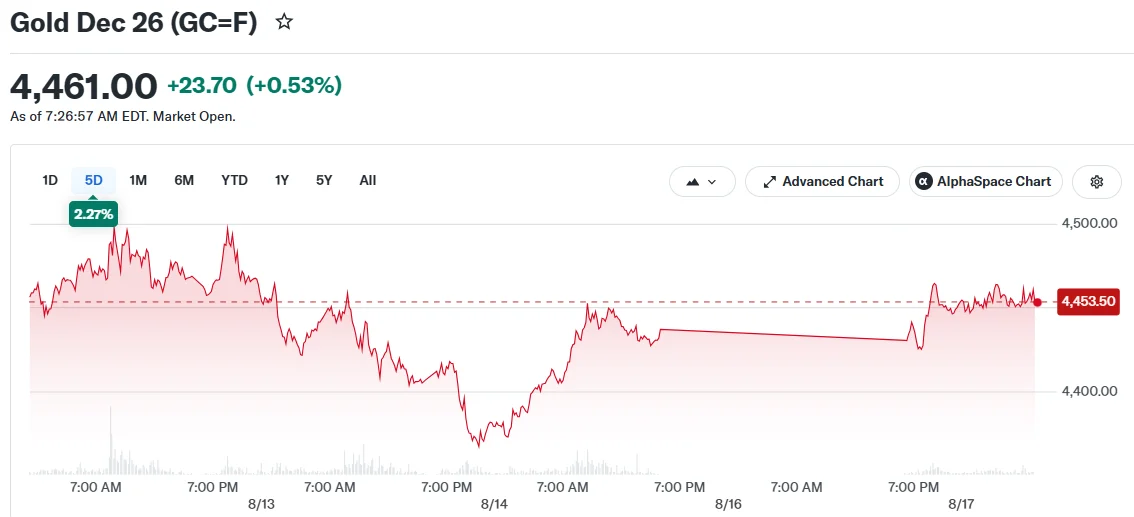
- Spot prices for gold climbed to approximately $4,394 per ounce, benefiting from dollar softness
- Diminishing prospects for a Federal Reserve rate increase in September are enhancing gold’s attractiveness
- Maritime transport issues in the Strait of Hormuz continue to present energy inflation concerns
The precious metal is hovering just beneath the $4,400 per ounce threshold following a robust trading week, with major financial institutions endorsing it as a premier investment strategy for the latter half of 2026.
Michael Hartnett, a prominent strategist at Bank of America, advised investors on Monday that establishing a “long gold” position represents the optimal strategy, positioning the metal as the superior safeguard against dollar depreciation, volatility in fixed-income markets, and the geopolitical friction he characterizes as the defining struggle of the 2020s between capitalist and socialist populist movements.
Investment vehicles focused on gold captured $6.3 billion during the most recent seven-day period, representing the most substantial weekly influx recorded since January 2026. This data emerged from Bank of America’s proprietary flow tracking system, which simultaneously documented $25.4 billion moving into money market instruments, $23.8 billion entering fixed-income securities, and $16.1 billion flowing into stock markets.
The spot price for gold advanced 0.4% to reach $4,394.31 per ounce during Monday’s morning session. Futures contracts for the metal appreciated 0.3% to settle at $4,451.62. The precious metal concluded the previous week with gains approaching 1%.
Declining Dollar and Federal Reserve Policy Outlook
The U.S. dollar index declined 0.3% to reach 99.40, providing additional momentum for gold prices. When the dollar weakens, it reduces the cost of bullion for international buyers utilizing alternative currencies, typically boosting demand levels.

Fresh economic indicators from the United States have also diminished expectations for Federal Reserve rate increases. Consumer confidence measurements fell for the first instance in three months, while retail sales figures showed their steepest monthly contraction in over twelve months.
Reduced expectations for interest rate hikes benefit gold because the asset generates no yield. When market participants anticipate rates will remain stable or decrease, the opportunity cost associated with holding gold diminishes.
The Federal Reserve maintained its current rate policy at its July gathering. Chairman Kevin Warsh provided no definitive guidance regarding future monetary policy decisions, stating merely that the institution would remain steadfast in pursuing its 2% inflation objective. Three committee members registered dissenting votes favoring a 25-basis-point rate elevation.
Market participants are now anticipating Wednesday’s publication of the July Federal Reserve meeting transcript for additional clarity on the trajectory of monetary policy.
Strait of Hormuz Tensions Elevate Inflation Concerns
Energy sector dynamics remain an unpredictable factor. Maritime traffic navigating the Strait of Hormuz experienced a dramatic reduction over the weekend after attacks targeted three tankers managed by the Abu Dhabi National Oil Company. Just five commodity vessels transited the strait on Saturday, with zero passages on Sunday, contrasting sharply with 31 crossings the previous weekend.
Research analysts at TD Cowen cautioned that persistent crude oil price volatility might constrain upward momentum in gold and copper markets should inflation accelerate and compel the Federal Reserve to maintain elevated interest rates.
Bank of America’s Bull and Bear Indicator retreated to 9.3 from its prior reading of 9.7, with market positioning characterized as “excessively bullish.” The financial institution also highlighted Brazil’s October 4 electoral event as a critical catalyst for emerging market trajectory within its “Anything But Dollar” investment framework.
Get 3 Free Stock Ebooks
Discover top-performing stocks in AI, Crypto, and Technology with expert analysis.
- Top 10 AI Stocks - Leading AI companies
- Top 10 Crypto Stocks - Blockchain leaders
- Top 10 Tech Stocks - Tech giants


