


Quick Summary
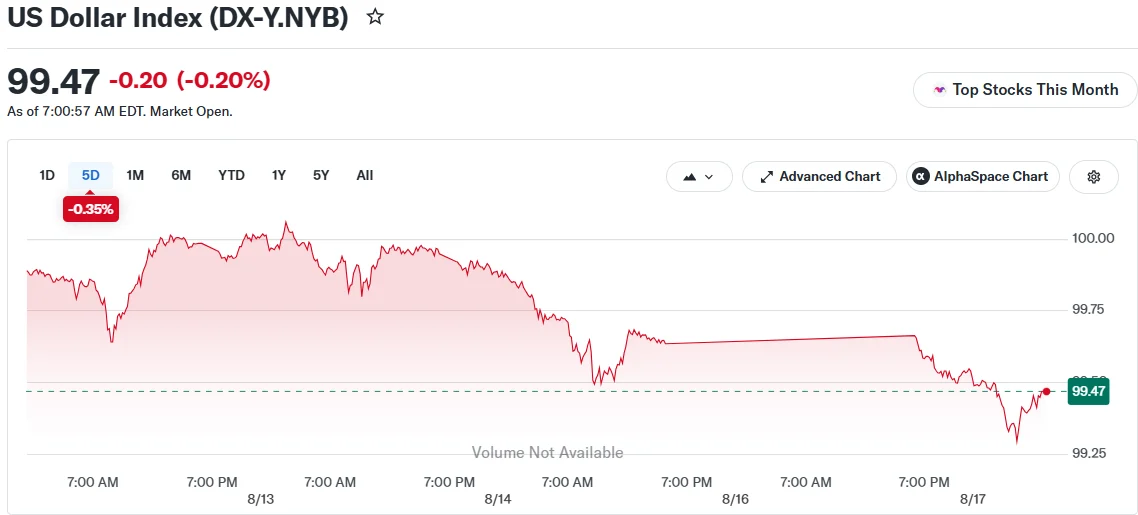
- The Dollar Spot Index declined to 99.33, marking its weakest position since early June
- Disappointing employment figures, consumer spending, and inflation metrics triggered the selloff
- Financial markets now assign a 70% probability to a Fed rate freeze in September
- Japan’s currency hovered near 159.00 following lackluster GDP data; potential BOJ rate increase looms
- India’s currency weakened as the central bank implemented stricter foreign exchange controls
The greenback tumbled to its weakest position in more than 60 days during Monday’s trading session. The Dollar Spot Index shed 0.3% to reach 99.33, marking territory unseen since the first week of June.
The decline followed a series of disappointing economic indicators from the United States. July’s nonfarm payroll numbers showed contraction, consumer spending dropped 0.6%, and inflation measurements through both the Consumer Price Index and Producer Price Index registered either flat or in-line with expectations.
This sequence of underwhelming data effectively eliminated any rationale for the Federal Reserve to implement monetary tightening in the immediate future.
Financial markets have now adjusted their projections to reflect a 70% likelihood that the central bank will maintain its current rate posture at the September policy gathering. Prior to the August 7 employment report, the probability of additional tightening exceeded 50%.
The European common currency surged to a two-month peak of $1.1614. The British pound reached a three-month zenith of $1.3571. Both currencies capitalized on the shifting interest rate landscape away from dollar strength.

Federal Reserve Chairman Kevin Warsh has deliberately avoided providing explicit policy signals, placing emphasis squarely on economic data as it emerges. Market observers note this approach has amplified market reactions to individual economic reports.
Volkmar Baur from Commerzbank indicated that sustained reduction in tightening expectations could drive additional dollar weakness. His institution forecasts three rate reductions by the Fed during the following year.
Market participants are now focused on Wednesday’s publication of minutes from the July Federal Open Market Committee gathering. The central bank maintained its benchmark rate at 3.5% to 3.75% for the fifth consecutive meeting in July.
Japanese Currency Stable, Indian Rupee Weakens
Japan’s currency advanced 0.1% to settle around 159.00 versus the dollar, remaining near the 160 threshold that has elevated concerns about potential government market intervention.
Economic expansion in Japan registered an annualized pace of 1.1% during the April-June period, falling short of the 2% consensus projection. Subdued household spending and declining business investment dampened overall performance.
Notwithstanding the economic shortfall, the yen received underlying support from speculation that the Bank of Japan could implement rate increases as soon as September.
India’s currency diverged from the broader pattern affecting most global currencies. The USD/INR exchange rate climbed 0.2% as domestic importers purchased dollars, responding to persistent energy supply concerns linked to Middle Eastern geopolitical instability.
The Reserve Bank of India accelerated the deadline for financial institutions to gather deposits under its foreign-exchange swap mechanism to August 31, moving it forward from late September. This adjustment followed inflows exceeding $56 billion through the facility.
Global Tensions Limit Dollar Weakness
Brent crude maintained levels around $89 per barrel as Persian Gulf tensions persisted. Diplomatic discussions between Washington and Tehran regarding the Strait of Hormuz reached an impasse during the weekend.
Iranian Foreign Minister Abbas Araqchi stated that Tehran has not committed to restarting official negotiations. President Trump cautioned Americans to anticipate increased fuel costs.
Sustained elevated oil prices continue exerting pressure on emerging market currencies dependent on energy imports, restricting a more widespread currency rally.
The Jackson Hole Symposium represents the upcoming significant gathering for currency market participants seeking clarity on Federal Reserve policy trajectory.
Get 3 Free Stock Ebooks
Discover top-performing stocks in AI, Crypto, and Technology with expert analysis.
- Top 10 AI Stocks - Leading AI companies
- Top 10 Crypto Stocks - Blockchain leaders
- Top 10 Tech Stocks - Tech giants


