


Key Takeaways
- On Tuesday, the U.S. dollar surged to 162.41 yen, pushing Japan’s currency to its weakest position since 1986.
- Market participants are increasingly betting on Federal Reserve rate increases before year-end.
- Japanese authorities deployed 11.7 trillion yen (approximately $72.25 billion) during April and May to prop up the currency, with limited lasting impact.
- Finance Minister Satsuki Katayama indicated readiness to intervene but avoided issuing forceful warnings typically associated with imminent action.
- The euro declined against the dollar as well, hovering around $1.1396, approaching its lowest point in twelve months.
Tuesday witnessed the Japanese yen sliding to a four-decade low against the U.S. dollar. The greenback peaked at 162.41 yen during trading before stabilizing near 162.15.
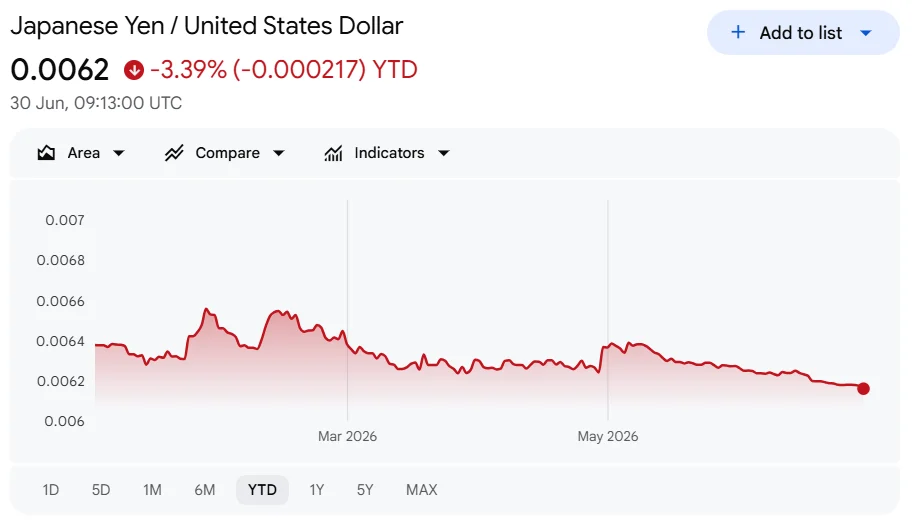
This represents the yen’s most significant decline since 1986, prompting speculation about potential government intervention to stabilize the currency.
Factors Driving Dollar Appreciation
The primary catalyst for the yen’s slide is growing market anticipation of higher U.S. interest rates. American inflation continues hovering above the Federal Reserve’s designated threshold.
During this month’s Federal Reserve policy meeting, nine out of nineteen officials projected at least one rate increase before 2024 concludes. This hawkish pivot has attracted capital flows toward the dollar.
Lee Hardman, who serves as senior currency analyst at MUFG Bank, suggested the Fed might overlook the recent inflation uptick. Nevertheless, he emphasized that no definitive indicators have emerged suggesting the central bank will moderate its hawkish stance.

Market participants are directing attention toward Thursday’s employment data release. Disappointing job figures could reshape expectations regarding the Fed’s forthcoming policy decisions.
Tokyo’s Countermeasures to Date
The yen has experienced consecutive quarterly declines for four periods, representing its most prolonged downturn in four years. This quarter alone projects a 2% depreciation.
Japanese officials allocated 11.7 trillion yen, equivalent to roughly $72.25 billion, throughout April and May attempting to bolster the currency. These efforts produced temporary appreciation, though momentum quickly reversed.
Hardman observed that the unsuccessful spring intervention may encourage greater hesitation before authorities act again. He suggested officials might demonstrate increased tolerance for currency weakness provided the decline remains orderly.
Finance Minister Satsuki Katayama reiterated Japan’s preparedness to take action when circumstances warrant. However, her rhetoric fell short of the aggressive terminology typically preceding immediate market intervention.
A notable distinction from spring conditions is the yen’s weakness concentrating primarily against the dollar. The euro traded at 184.97 yen—elevated historically yet below the April peak of 187.95.
Broader Currency Market Pressures
The U.S. dollar index, measuring the currency against six major counterparts, stood at 101.32. The index is positioned for a 1.4% quarterly advance, following a 1.6% increase during the year’s opening quarter.
The euro declined 0.24% to $1.1396, approaching the one-year low established last week. Subdued inflation readings from France and German regions intensified downward pressure on Europe’s shared currency.
The European Central Bank implemented a rate hike earlier this month, with markets anticipating another increase before year-end. These expectations could shift if inflation moderates or economic conditions deteriorate.
The British pound retreated 0.2% to $1.3234. Commodity-linked currencies also weakened as energy prices moderated.
Norway’s crown declined to its weakest dollar exchange rate in half a year. The Canadian dollar traded near a 14-month trough, while Australia’s currency touched a three-month low at $0.6867.
As Tuesday’s session concluded, the dollar maintained proximity to its 40-year zenith against the yen, with market participants awaiting Thursday’s U.S. employment report for guidance.
Get 3 Free Stock Ebooks
Discover top-performing stocks in AI, Crypto, and Technology with expert analysis.
- Top 10 AI Stocks - Leading AI companies
- Top 10 Crypto Stocks - Blockchain leaders
- Top 10 Tech Stocks - Tech giants


