



Key Takeaways
- Jefferies projects the S&P 500 will hit 8,000 by year-end 2026 and climb to 9,000 by December 2027.
- The bank’s 2027 projection relies on estimated EPS of $450 combined with a forward price-to-earnings ratio of 20x.
- Companies linked to artificial intelligence and data centers comprise approximately 46% of the index’s composition.
- Profit expansion is anticipated to extend beyond the dominant Magnificent Seven technology stocks.
- Primary downside risks include elevated Treasury yields, persistent inflation, rising oil costs, and disappointing AI sector results.
Investment bank [[LINK_START_1]]Jefferies[[LINK_END_1]] has issued a bullish multi-year projection for the S&P 500, anticipating the benchmark equity index will surge to 9,000 by the conclusion of 2027.
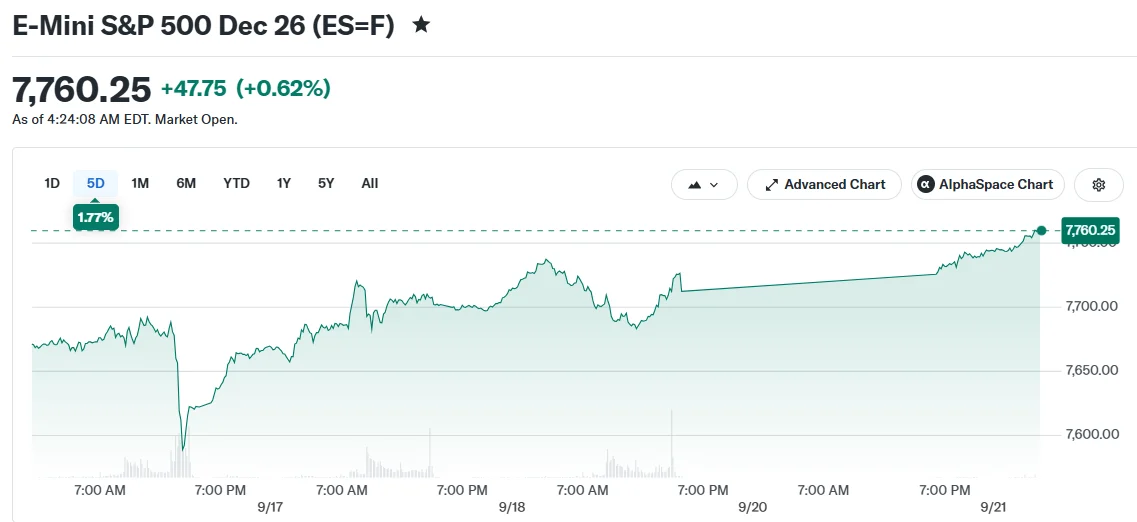
This optimistic outlook emerges after a period marked by substantially upgraded corporate profit expectations, bolstered by robust technology sector performance and sustained capital deployment in artificial intelligence infrastructure.
The firm anticipates profit momentum will expand across a wider array of companies rather than remaining concentrated in mega-cap technology names.
Investment Bank Sets 8,000 Target for 2026, 9,000 for 2027
Jefferies has established an S&P 500 price target of 8,000 for year-end 2026.
This intermediate projection assumes earnings per share will reach $373, representing approximately 35% year-over-year growth.

The Wall Street consensus forecast currently sits closer to 29% expansion.
Looking further ahead to 2027, the firm anticipates EPS will advance to $450.
According to Jefferies’ analysis, this earnings level would justify a 9,000 index valuation when applying a 20x price-to-earnings multiple.
This multiplier actually sits below the approximately 21.5x forward earnings valuation where the index currently trades.
Consequently, Jefferies’ 2027 outlook doesn’t require investors to accept significantly inflated stock valuations.
The investment bank has also outlined a probability-weighted range of outcomes spanning from a pessimistic scenario of 6,900 to an optimistic case of 10,500 for 2027.
Artificial Intelligence Investment Powers Profit Expectations
Artificial intelligence infrastructure spending continues serving as a primary catalyst underpinning earnings projections.
Jefferies calculates that corporations with either direct or secondary connections to AI applications and data center buildouts represent roughly 46% of S&P 500 market capitalization.
These AI-connected enterprises are forecast to generate approximately 60% earnings expansion during 2026.
This aggressive growth trajectory is expected to moderate to approximately 24% in 2027.
The Magnificent Seven technology giants are projected to achieve roughly 45% profit growth through 2026.
Meanwhile, the remaining 493 companies in the S&P 500 are also anticipated to post solid 24% earnings advancement.
Jefferies noted this broadening profit strength could enhance market breadth following an extended period where performance gains concentrated among a narrow selection of stocks.
During the twelve months ending in August, merely 36% of S&P 500 constituents exceeded the index return, falling short of the historical norm around 47%.
Bond Yields and Price Pressures Pose Downside Threats
Jefferies identified rising government bond yields as a principal risk factor to its bullish forecast.
The benchmark 10-year Treasury yield has climbed more than 60 basis points year-to-date.
Historical patterns show that increases exceeding 100 basis points within a 12-month span have frequently corresponded with compressed equity valuation multiples.
Persistent inflation pressures and elevated oil prices could sustain upward momentum in interest rates.
Jefferies maintains overweight positions in technology, financial services, healthcare and materials sectors.
The firm adopts a more defensive stance toward communication services, consumer discretionary and real estate due to deteriorating earnings trends, stretched valuations or heightened sensitivity to financing costs.
Ultimately, the investment bank’s ambitious 9,000 target hinges on sustained corporate earnings expansion, especially among enterprises connected to artificial intelligence and data center infrastructure investment.
Get 3 Free Stock Ebooks
Discover top-performing stocks in AI, Crypto, and Technology with expert analysis.
- Top 10 AI Stocks - Leading AI companies
- Top 10 Crypto Stocks - Blockchain leaders
- Top 10 Tech Stocks - Tech giants


