



Key Highlights
- The KOSPI index recovered 3.3%–4.6% during Wednesday trading after suffering a nearly 10% decline the previous day
- Samsung Electronics jumped as much as 10% following reports of a $5.8 billion share repurchase program
- SK Hynix gained between 1%–3.4% on news of potential American Depositary Receipt listing in the United States
- The previous day’s collapse was sparked by MSCI’s developed market rejection and concerns over AI sector momentum
- The KOSPI continues to hold its position as 2026’s top-performing major index globally, up approximately 100% year-to-date
South Korean equities mounted an impressive comeback on Wednesday following one of the market’s most severe single-session declines in years. The KOSPI benchmark advanced 3.3% to finish at 8,471, after touching highs of 4.6% during intraday trading.
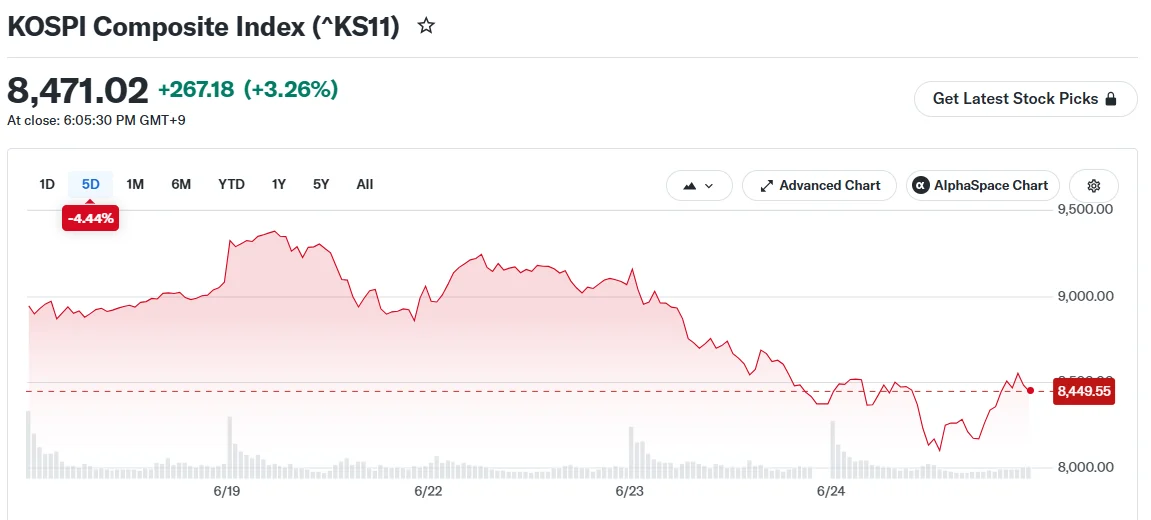
The rally arrived immediately after Tuesday’s brutal session that saw the index crater nearly 10%, erasing billions in valuation from technology and semiconductor stocks.
[[LINK_START_2]]Samsung Electronics[[LINK_END_2]] spearheaded Wednesday’s resurgence, climbing between 7% and 10% throughout the trading day. The dramatic upturn followed a Yonhap news report indicating Samsung was preparing to implement a share repurchase program valued at approximately 90 trillion won, equivalent to about $5.8 billion.SK Hynix similarly rebounded, posting gains ranging from 1% to 3.4%. The chip manufacturer reportedly plans to proceed with listing American Depositary Receipts on US exchanges, a strategic initiative expected to draw substantial international capital.
Both tech giants had experienced losses exceeding 12% during Tuesday’s session, meaning Wednesday’s rally represented only a partial restoration of lost value.

Factors Behind Tuesday’s Market Collapse
Multiple catalysts converged to hammer South Korean equities on Tuesday. The primary trigger was MSCI’s announcement denying South Korea’s request for reclassification to developed market status, an upgrade the nation had actively pursued.
Uncertainty surrounding artificial intelligence investments also contributed significantly. Reports emerged suggesting SK Hynix might be pivoting away from high-bandwidth memory production—critical components for AI processors—toward conventional memory products. This speculation rattled investors heavily positioned in AI-related semiconductor stocks.
Leveraged exchange-traded funds intensified the downturn. As valuations declined, rapid liquidation of these instruments magnified the selling pressure. South Korea’s chief financial regulator publicly acknowledged concerns about authorizing these ETF products just weeks earlier.
Regional Markets Show Divergent Trends
Broader Asian equity markets displayed inconsistent performance on Wednesday. Japan’s Nikkei 225 declined 0.9%. Taiwan’s Taiex retreated 2.2%, with semiconductor manufacturer TSMC falling 4% by the closing bell.
Hong Kong’s Hang Seng bucked the regional pattern, advancing as much as 1%.
Market observers highlighted how deeply integrated major Asian bourses have become with global artificial intelligence sentiment and momentum.
Chris Weston, head of research at Pepperstone, characterized the technology sector selloff as partially driven by profit-taking as risk-reward dynamics evolved, particularly in heavily concentrated AI and memory chip holdings.
Michael Wan, an analyst with MUFG, maintained an optimistic long-term perspective for the sector. He framed the current volatility as initial turbulence within what he described as a transformative technological evolution.
Notwithstanding the dramatic two-day volatility, the KOSPI maintains its position as 2026’s strongest-performing major equity benchmark worldwide, still ahead by nearly 100% year-to-date.
Get 3 Free Stock Ebooks
Discover top-performing stocks in AI, Crypto, and Technology with expert analysis.
- Top 10 AI Stocks - Leading AI companies
- Top 10 Crypto Stocks - Blockchain leaders
- Top 10 Tech Stocks - Tech giants


