


Key Highlights
- LayerZero introduced ATLAS, an advanced trading and settlement platform on the Zero blockchain
- The platform integrates trade execution, clearing, settlement, and risk controls into a unified system
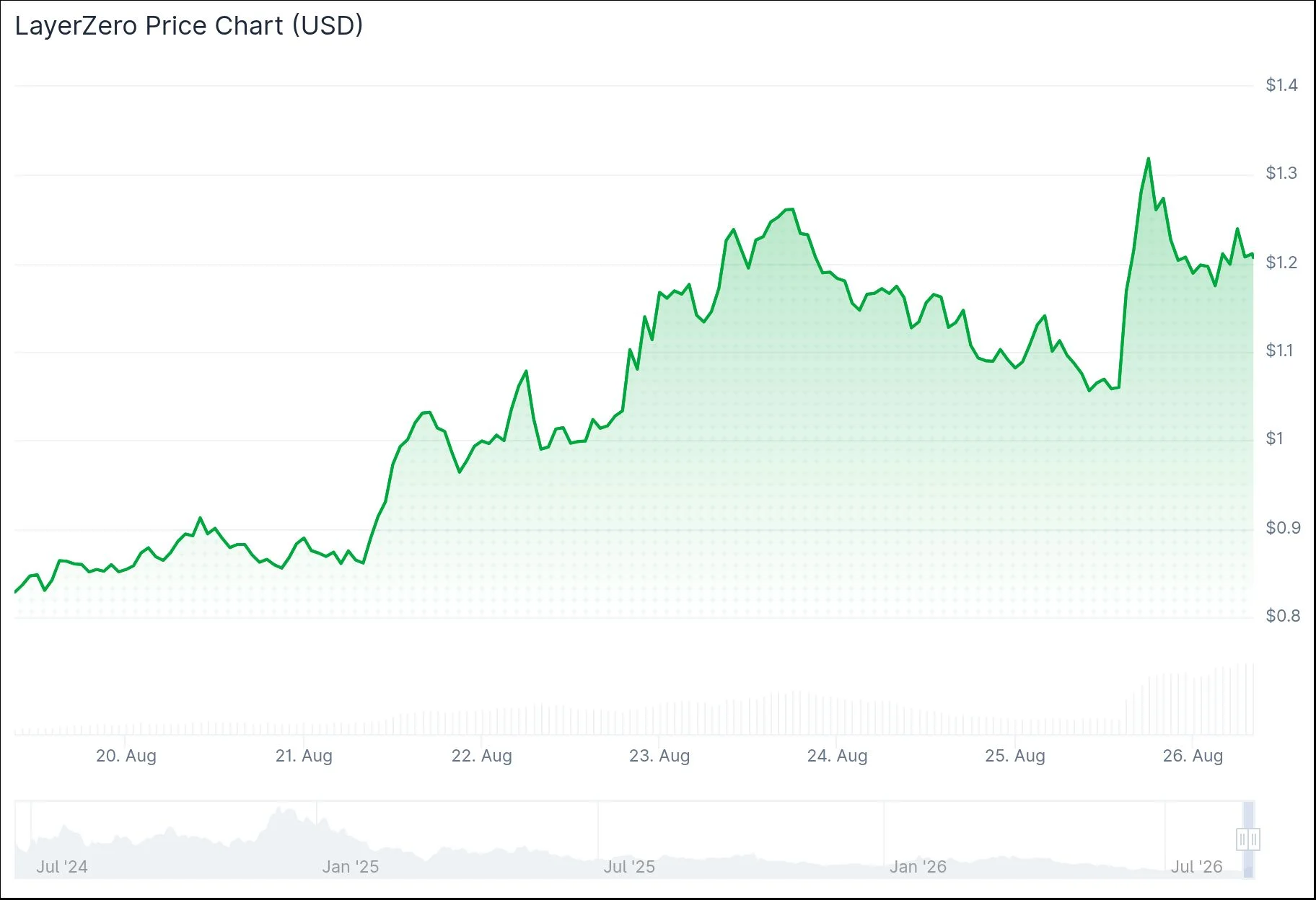
- ZRO token price jumped over 30% post-announcement, reaching approximately $1.26
- A buyback-and-burn mechanism will use 75% of net fees to reduce ZRO token supply
- Strategic partners include Citadel Securities, DTCC, ICE, ARK Invest, and Google Cloud
LayerZero has introduced ATLAS, an innovative trading and settlement platform constructed on its Zero blockchain infrastructure. The revelation triggered a significant rally in the ZRO token, which climbed more than 30% from roughly $1 to $1.26.
ATLAS represents Aggregated Trading, Liquidity and Settlement. The platform functions as backend infrastructure for trading platforms, brokerage firms, and financial institutions — unifying trade matching, clearing, settlement, and risk oversight within a single framework.
LayerZero characterizes ATLAS as a “headless exchange,” meaning it operates without a consumer-facing application. Trading platforms connect to ATLAS infrastructure while maintaining their proprietary user interface and customer base.
The platform offers two distinct configurations. Open ATLAS targets cryptocurrency applications and prediction markets. Institutional ATLAS enables financial entities to establish custom compliance and eligibility requirements for trading participants.
ATLAS-powered markets can facilitate trading across spot cryptocurrencies, perpetual futures contracts, equities, fixed income securities, commodities, and prediction markets, according to official statements.

How ZRO Token Powers ATLAS
The ZRO token functions as a cornerstone element of the ATLAS ecosystem. It will secure the Zero blockchain through a delegated proof-of-stake consensus mechanism and serve as the native gas token for all network transactions.
Trading platforms can stake ZRO tokens to unlock enhanced fee rebate tiers. The premium tier necessitates staking up to 1% of ZRO’s total token supply.
Following distribution of venue rebates, 25% of leftover fees are allocated to market creators. The remaining 75% funds a buyback-and-burn program for ZRO tokens, progressively decreasing the circulating supply.
Strategic Partnerships and Development
LayerZero unveiled the Zero blockchain in February with backing from prominent partners including Citadel Securities, DTCC, Intercontinental Exchange, ARK Invest, and Google Cloud.
Jack Melnick, who transitioned to LayerZero from Berachain to oversee strategy for Zero and ATLAS, drew parallels to how custodial banks developed trading capabilities atop their settlement infrastructure.
Overcoming Recent Setbacks
The ATLAS debut follows a challenging chapter for LayerZero’s primary operations. In April, malicious actors exploited Kelp DAO’s LayerZero-integrated bridge, draining approximately 116,500 rsETH valued at around $292 million.
After the security breach, multiple protocols migrated their cross-chain functionality from LayerZero to Chainlink.
LayerZero reports its OFT Standard has processed over $290 billion in cross-chain transaction volume spanning more than 160 blockchain networks.
ATLAS is scheduled to go live sometime in 2026.
Get 3 Free Stock Ebooks
Discover top-performing stocks in AI, Crypto, and Technology with expert analysis.
- Top 10 AI Stocks - Leading AI companies
- Top 10 Crypto Stocks - Blockchain leaders
- Top 10 Tech Stocks - Tech giants


