


Key Highlights
- The shipping company upgraded its 2026 EBITDA outlook to $8 billion-$10 billion from a previous range of $4.5 billion-$7 billion.
- Shares in both Class-A and Class-B categories posted gains following the revised forecast.
- Robust container volumes from East Asia and elevated spot rates fueled the optimistic revision.
- Expected free cash outflow has been reduced to at least $1.5 billion from an earlier projection of $3 billion.
- The upbeat outlook contrasts sharply with February’s cautious stance when the firm announced job cuts and warned of weak earnings.
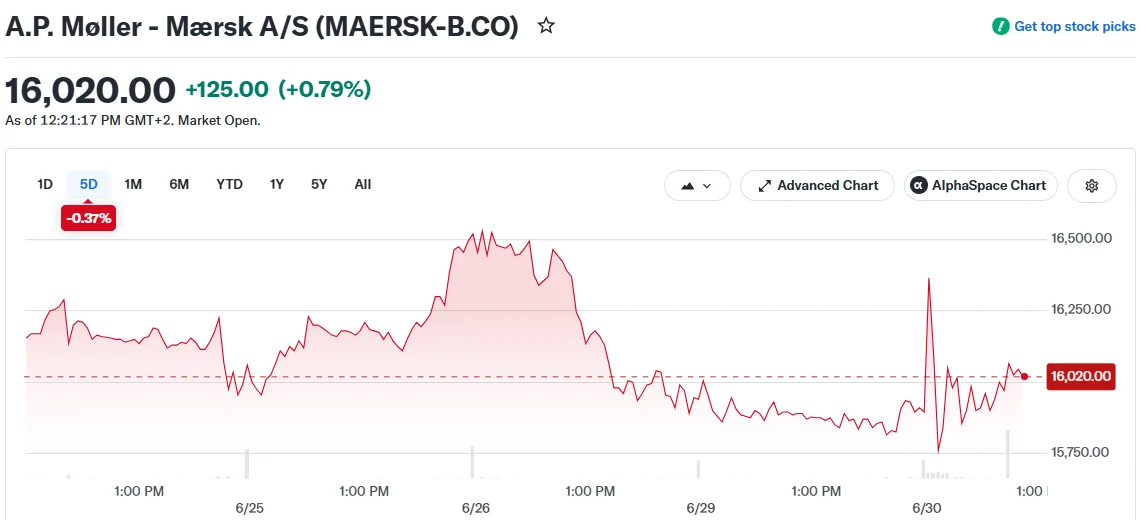
Shares of Maersk (MAERSK.B) advanced 1.4% Monday following the Danish maritime giant’s decision to significantly raise its financial guidance for 2026. The revision comes on the back of robust demand patterns and strengthening freight pricing worldwide.
A.P. Moller-Maersk has revised its full-year underlying EBITDA projection upward to a range of $8 billion to $10 billion. This represents a substantial increase from the company’s prior guidance of $4.5 billion to $7 billion.
The firm also improved its underlying EBIT forecast, now targeting $2 billion to $4 billion. The earlier estimate had ranged from a potential loss of $1.5 billion to a gain of $1 billion.
Cash flow projections have similarly brightened. The company now anticipates a free cash outflow of at least $1.5 billion, an improvement from its previous expectation of at least $3 billion.
Key Factors Behind the Revision
Management cited persistent strength in container shipping volumes, particularly from East Asian markets. The ongoing elevation in spot freight rates has also contributed significantly to the improved financial outlook.

The company now projects approximately 4% growth in worldwide container market volumes for the year. This figure represents the top end of its previously communicated range.
The optimistic update marks a significant reversal from the tone set earlier this year. At the start of 2026, Maersk and other shipping operators had adopted a defensive posture, anticipating softer financial performance.
Conflict in the Middle East had created route disruptions and elevated fuel expenditures. Industry watchers had expected these challenges to substantially impact bottom-line results.
Back in February, the company projected declining earnings and revealed plans to eliminate approximately 1,000 corporate positions as part of efficiency measures.
For reference, Maersk posted underlying EBITDA of $9.57 billion in 2025. The company generated underlying EBIT of $3.36 billion that year, along with free cash flow totaling $2.2 billion.
Market Expert Perspective
Alex Irving, an analyst with Bernstein, observed that the revised projections demonstrate how the current rate climate continues to underpin robust near-term financial performance. Initial freight rate increases stemmed from fuel surcharges connected to Middle Eastern disruptions.
However, Irving highlighted a particularly noteworthy development. Rates have maintained their elevation even as fuel costs have moderated, suggesting authentic demand strength rather than simple cost recovery.
Nevertheless, some ambiguity persists. Irving commented that questions remain about whether elevated freight pricing reflects genuine demand expansion or accelerated shipping activity in anticipation of potential tariff implementations or additional surcharges.
Maersk’s Class-B shares appreciated 0.91% while Class-A units climbed 1.30%. The comprehensive guidance enhancement reflects management confidence despite continuing geopolitical uncertainties affecting maritime routes.
The company’s revised global volume growth estimate of approximately 4% for the full year now stands at the upper boundary of its previous forecast range. This represents the most current figure available from Maersk as of this update.
Get 3 Free Stock Ebooks
Discover top-performing stocks in AI, Crypto, and Technology with expert analysis.
- Top 10 AI Stocks - Leading AI companies
- Top 10 Crypto Stocks - Blockchain leaders
- Top 10 Tech Stocks - Tech giants


