


Key Points
- Block production on MANTRA Chain restarted at approximately 5:30 a.m. UTC on August 22 following a nearly 30-hour network freeze
- An exploit targeting the Cosmos-EVM module vulnerability forced a complete network shutdown, stopping all transaction processing, staking functions, and bridge operations
- Developers released version 8.4.0, which resolved the security flaw and implemented additional protective measures before network reactivation
- The exploit impacted two wallets under MANTRA’s control, while user assets remained secure and untouched
- The native token plummeted approximately 18.5% to an all-time low during the crisis, accompanied by a nearly 600% surge in trading activity
MANTRA Chain has successfully restored full operations after its development team addressed a critical security vulnerability in the Cosmos-EVM module that forced the blockchain into an extended 30-hour offline period.
Network activity recommenced around 5:30 a.m. UTC on August 22, following the implementation of software version 8.4.0, which included both the vulnerability fix and enhanced security infrastructure.
The crisis originated late on August 20, when MANTRA’s security team identified an active exploit targeting a weakness in an upstream software dependency. The decision was made to immediately halt mainnet operations to prevent further damage.
This emergency shutdown effectively paralyzed all network functionality, including transaction processing, staking mechanisms, cross-chain bridges, and inter-blockchain communication protocols. Several cryptocurrency exchanges responded by temporarily suspending deposit and withdrawal services for MANTRA-related assets.
During the downtime, public endpoints, validator infrastructure, and bridging services remained completely inaccessible.

Details of the Security Incident
MANTRA investigators determined that the security breach originated from a weakness in the Cosmos-EVM module. The exploit successfully targeted two specific wallet addresses before the development team successfully isolated the threat.
Subsequent analysis revealed that both compromised addresses belonged to MANTRA’s internal wallet infrastructure. The team emphasized that no evidence suggested any breach of user funds, exchange holdings, or partner assets.
“No user funds were exploited,” MANTRA confirmed in their post-recovery statement.
MANTRA has yet to provide specific details regarding the nature of the malicious activity within those two wallets, the total value at risk, or whether any digital assets were successfully transferred. A comprehensive technical analysis is anticipated within the next few days.
Prior to network reactivation, the development team created a comprehensive blockchain snapshot at block height 17,449,398, representing the final state before the shutdown. Engineers then conducted extensive security audits of potential attack vectors before developing and rigorously testing the security patch.
The updated version 8.4.0 underwent initial testing on the DuKong testnet infrastructure, followed by validation within a controlled environment mirroring mainnet conditions. Multiple simulation runs were executed before validators received authorization to proceed with the restart sequence.
The recovery process began with MANTRA’s own validator infrastructure, progressively expanding to partner validators, independent node operators, RPC providers, and archive node services. All user account balances remained intact throughout the entire process, and no blockchain state rollback was necessary.
Market Impact and Token Performance
Throughout the security incident, MANTRA’s native token experienced significant downward pressure, declining from approximately $0.005060 to an unprecedented low of $0.004126, representing roughly an 18.5% decrease. This record low was recorded at about 11:10 p.m. UTC on August 20, shortly before the network processed its final block.
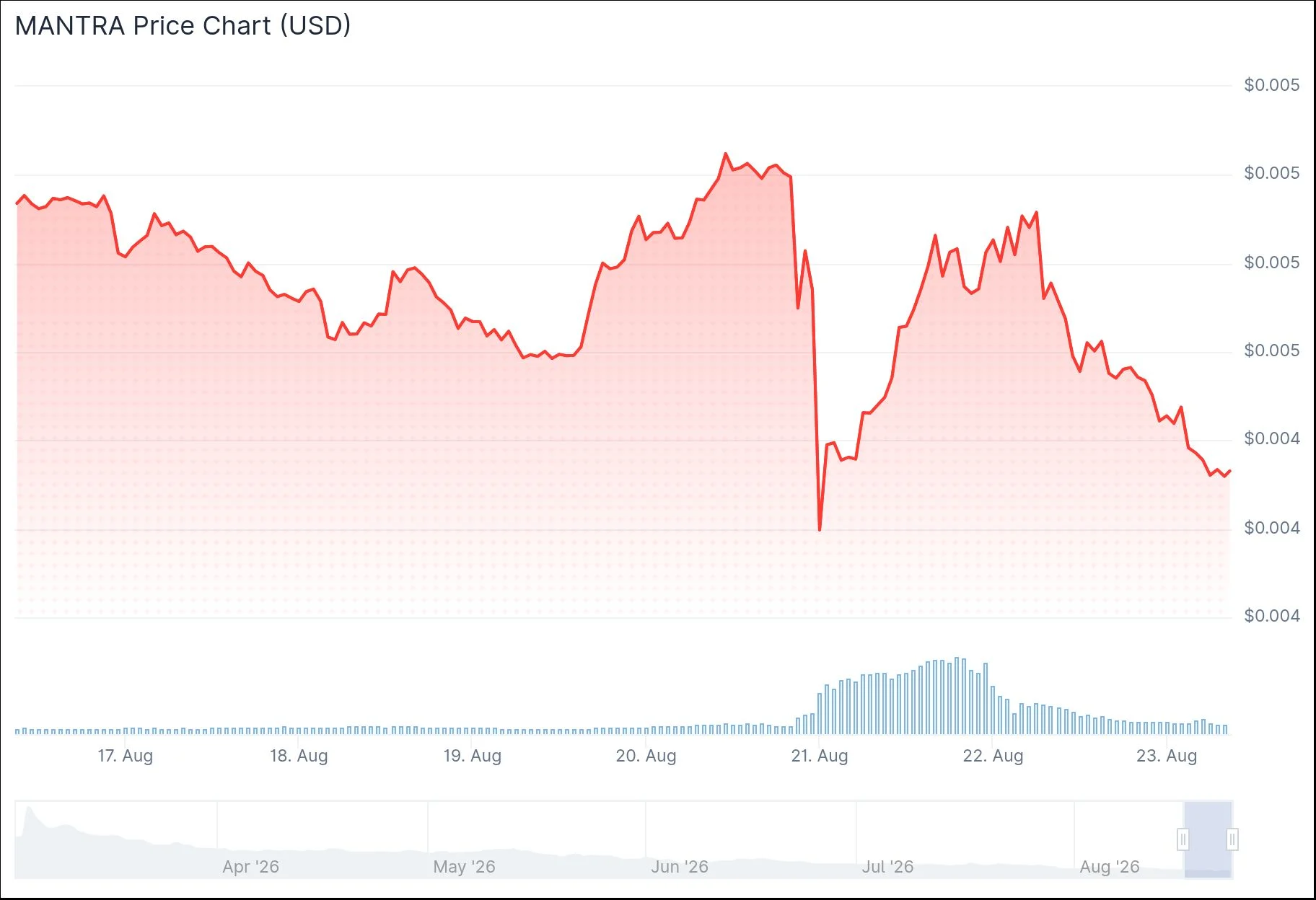
Market participation intensified dramatically, with trading volume escalating nearly 600% to reach approximately $24 million during the initial market response. MANTRA has not publicly established a direct correlation between the price decline and the security breach.
The DuKong testnet infrastructure remained inactive following the mainnet’s successful relaunch. MANTRA indicated that restoration efforts for the testnet environment would proceed throughout the upcoming days.
A detailed incident report documenting the Cosmos-EVM vulnerability and the comprehensive network response strategy is scheduled for publication in the near future.
Get 3 Free Stock Ebooks
Discover top-performing stocks in AI, Crypto, and Technology with expert analysis.
- Top 10 AI Stocks - Leading AI companies
- Top 10 Crypto Stocks - Blockchain leaders
- Top 10 Tech Stocks - Tech giants


