



TLDR
- Stock futures showed mixed direction Tuesday morning as Wall Street prepared for significant banking sector earnings and crucial inflation metrics
- American forces conducted consecutive strikes on Iranian targets for the third night, while Trump reinstated maritime restrictions in the Strait of Hormuz
- Energy markets reacted with Brent crude surging more than 2% to reach $84.78 per barrel
- Five major financial institutions—JPMorgan Chase, Bank of America, Goldman Sachs, Wells Fargo, and Citigroup—are releasing Q2 results today
- The June Consumer Price Index is scheduled for release Tuesday, with forecasters projecting annual inflation declining to 3.8%
Tuesday morning brought mixed signals to U.S. equity futures as market participants confronted multiple significant developments simultaneously—quarterly reports from leading banks, updated inflation metrics, and heightened Middle Eastern geopolitical concerns.
Nasdaq 100 futures registered gains of 0.22%, contrasting with modest declines in both S&P 500 and Dow Jones futures as of 1:30 a.m. EDT.
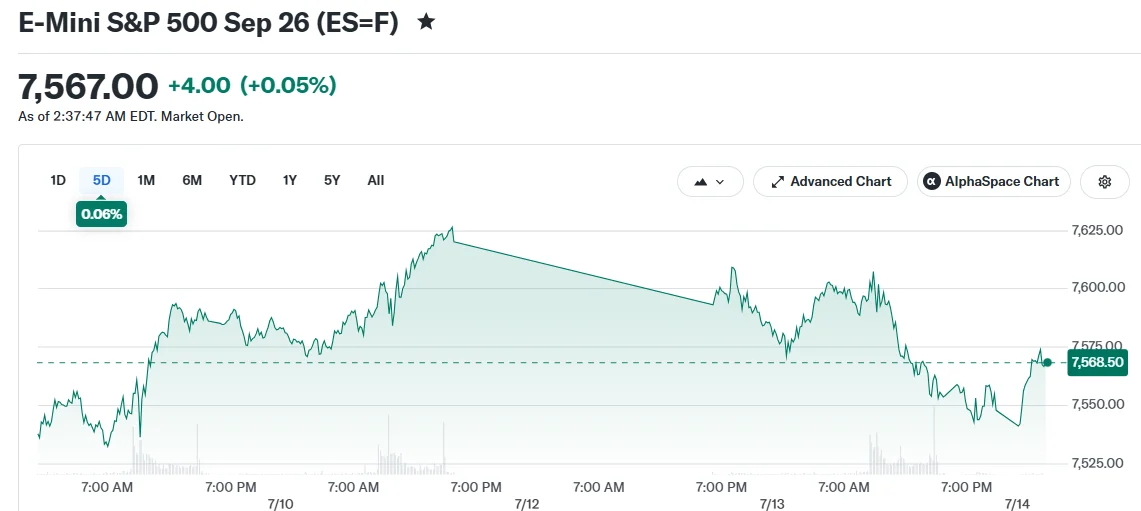
The previous trading session proved challenging for technology shares. The Nasdaq Composite surrendered 1.55% following SK Hynix’s steep 9.3% decline, which pressured semiconductor memory stocks broadly. The S&P 500 retreated 0.79% while the Dow lost 0.26%.
Middle East Conflict Elevates Energy Prices
American military forces executed their third consecutive evening of operations against Iranian positions Monday, focusing on infrastructure connected to maritime commercial vessel attacks. President Trump simultaneously reimposed naval restrictions on Iranian vessels transiting the Strait of Hormuz and suggested implementing a 20% protection fee for commercial traffic navigating the waterway.
Oil markets exhibited strong reactions. Brent crude advanced over 2% to reach $84.78 per barrel. WTI crude increased 2.26% to $79.85.

The Strait of Hormuz represents a critical chokepoint for worldwide petroleum transportation. Any significant interruption in this passage could elevate energy costs and contribute to wider inflationary pressures.
Nvidia remains under scrutiny. Reports indicate the chipmaker dramatically reduced—by more than half—the roster of Asian customers authorized to purchase its artificial intelligence processors. The Financial Times reports that Nvidia established a revised list of approved purchasers across Singapore, Malaysia, and Japan while strengthening adherence to American export regulations. Firms excluded from the updated roster maintain the option to seek recertification after satisfying new compliance standards.
Major Financial Institutions Unveil Q2 Performance
Five leading American banking institutions are presenting second-quarter financial results Tuesday—JPMorgan Chase, Bank of America, Goldman Sachs, Wells Fargo, and Citigroup.
Financial sector earnings receive intense scrutiny because they provide valuable insights into consumer expenditure patterns, commercial lending activity, and overall credit health throughout the economy.
Robust performance could bolster market confidence that economic expansion continues steadily. Disappointing figures might amplify worries regarding decelerating growth momentum.
Market participants are simultaneously monitoring the June Consumer Price Index release, scheduled for Tuesday.
Economists surveyed by Dow Jones anticipate consumer prices declined 0.2% during June, primarily attributable to reduced energy expenses. Such a reading would lower the year-over-year inflation rate to 3.8%.
Core inflation measures, which exclude volatile food and energy components, are projected to maintain their 2.8% annual pace—remaining above the Federal Reserve’s 2% objective.
Fed Governor Christopher Waller indicated Monday that additional rate increases could become necessary should inflation prove persistently elevated. New Fed Chair Kevin Warsh commences two days of congressional testimony this week, potentially offering additional guidance regarding future monetary policy direction.
Get 3 Free Stock Ebooks
Discover top-performing stocks in AI, Crypto, and Technology with expert analysis.
- Top 10 AI Stocks - Leading AI companies
- Top 10 Crypto Stocks - Blockchain leaders
- Top 10 Tech Stocks - Tech giants


