



Key Highlights
- Stock index futures for the Dow, S&P 500, and Nasdaq showed minimal movement Wednesday morning before the PCE inflation data release.
- The 30-year Treasury yield surpassed 5.6% while the 10-year approached 5.3%, reaching levels not witnessed in multiple decades.
- Market expectations for a Federal Reserve rate increase in October dropped to approximately 49% from 71% just one day prior.
- John Williams, President of the New York Federal Reserve, indicated no pressing need to accelerate interest rate adjustments.
- Crude oil remained stable in the mid-$90 per barrel territory amid ongoing geopolitical tensions in Iran entering the seventh month.
US stock futures remained relatively unchanged during Wednesday’s pre-market session as market participants exercised caution ahead of crucial inflation data.
The Dow Jones Industrial Average futures climbed approximately 0.4%. Futures tied to the S&P 500 increased by roughly 0.2%. Nasdaq-100 futures hovered near breakeven with a modest 0.2% uptick.
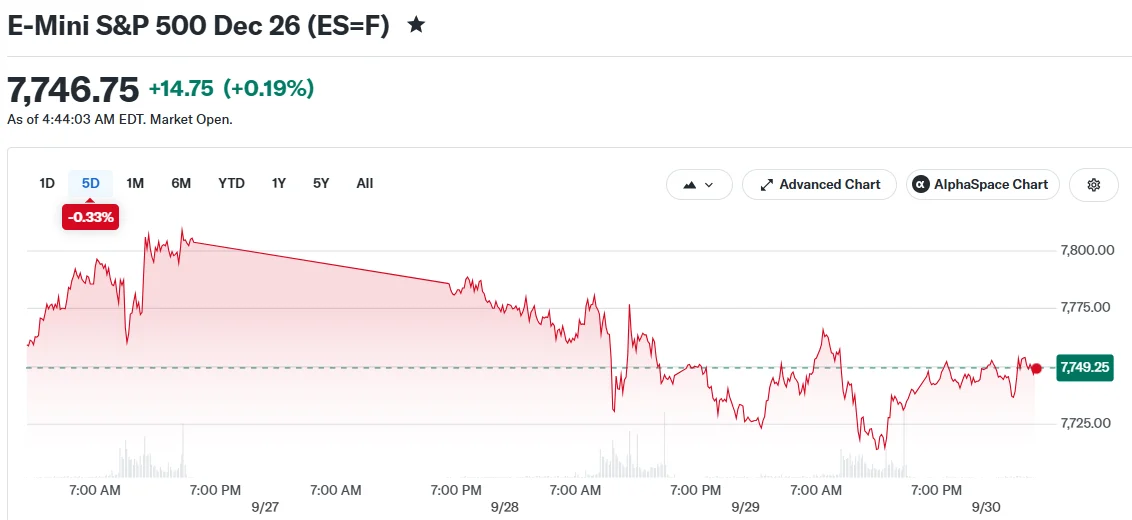
This stability emerged following Tuesday’s turbulent trading session that saw equities decline as government bond yields surged to heights unseen in recent history.
Treasury Yields Surge to Historic Levels
On Tuesday, the yield on the 30-year Treasury bond exceeded 5.6%, marking its highest point since June 2002.
Similarly, the benchmark 10-year Treasury yield advanced to fresh 2007 peaks, approaching 5.3%.

This upward movement in yields created downward pressure on equity markets. The Dow Jones Industrial Average declined by more than 100 points. The S&P 500 retreated 0.2%, while the Nasdaq Composite slipped 0.1%.
Meanwhile, oil prices experienced a decline on Tuesday before finding stability Wednesday around the mid-$90 per barrel mark.
The ongoing conflict in Iran, now extending into its seventh month, continues to generate uncertainty across energy markets.
According to Jose Torres, senior economist at Interactive Brokers, equity markets are “trying to hang in there.” He noted that increasingly restrictive financial conditions are “emboldening the bears and lifting interest in downside hedges.”
Expectations for Federal Reserve Rate Hike Decline Significantly
Market participants had been pricing in a strong likelihood of another interest rate increase at the Federal Reserve’s October policy meeting. However, these probabilities have decreased substantially.
Data from the CME Group’s FedWatch tool indicated a 49% probability of a 25 basis point rate hike next month, representing a sharp decline from the 71% probability recorded just one trading session earlier.
Comments from New York Fed President John Williams contributed to this shift in expectations. Speaking Tuesday evening, Williams stated there is “no need for urgency” regarding an October rate increase.
Williams emphasized the Federal Reserve has sufficient “time to gather more information” before making its next policy decision.
Market attention now centers on Wednesday’s release of the Personal Consumption Expenditures index, which represents the Federal Reserve’s favored inflation measurement.
Analyst forecasts suggest the core measure, which strips out volatile food and energy components, will remain unchanged at 3.3% on an annual basis. Meanwhile, a consensus estimate from Dow Jones-surveyed economists projects the headline monthly increase at 0.3%, translating to an annualized rate around 3.7%.
Corporate earnings also command investor attention. Micron is scheduled to release quarterly results following the closing bell, providing insights into the memory chip and artificial intelligence semiconductor sectors.
Conagra Brands will report earnings before market open.
International markets displayed varied performance overnight. Japan’s Nikkei 225 index advanced 1.94%, while South Korea’s Kospi index declined 0.48%.
Across the Atlantic, Europe’s Stoxx 600 index climbed 0.74% during morning trading hours. Both the UK’s FTSE 100 and Italy’s FTSE MIB posted gains of 0.76%.
Wednesday represents the final trading session for both September and the third quarter. Results have varied across these timeframes.
Throughout September, the S&P 500 and Dow are positioned for monthly declines, while the Nasdaq has gained over 1%. Examining the full quarter, the S&P 500 and Nasdaq have advanced approximately 2%, whereas the Dow has retreated nearly 2%.
Get 3 Free Stock Ebooks
Discover top-performing stocks in AI, Crypto, and Technology with expert analysis.
- Top 10 AI Stocks - Leading AI companies
- Top 10 Crypto Stocks - Blockchain leaders
- Top 10 Tech Stocks - Tech giants


