



Key Highlights
- Stock index futures declined Thursday morning, with Dow and S&P 500 contracts falling approximately 0.3% while Nasdaq-100 futures shed 0.4%
- Major technology firms Alphabet and Tesla announced aggressive artificial intelligence and capital expenditure initiatives, creating downward pressure on shares
- Brent crude oil surged to $97 per barrel amid intensifying Middle Eastern conflicts, with Houthi forces targeting shipping vessels in the Red Sea
- Government bond yields climbed to levels not seen since May as energy price increases sparked renewed inflation concerns
- Weekly unemployment filings plummeted to 187,000, marking the lowest figure since 1969 and significantly undershooting economist projections of 215,000
American equity futures retreated during Thursday’s pre-market session as market participants digested quarterly results from technology sector heavyweights while monitoring crude oil’s approach toward a critical price threshold.
Dow Jones Industrial Average futures and S&P 500 futures each declined approximately 0.3%. Contracts tracking the Nasdaq-100 lost 0.4%.
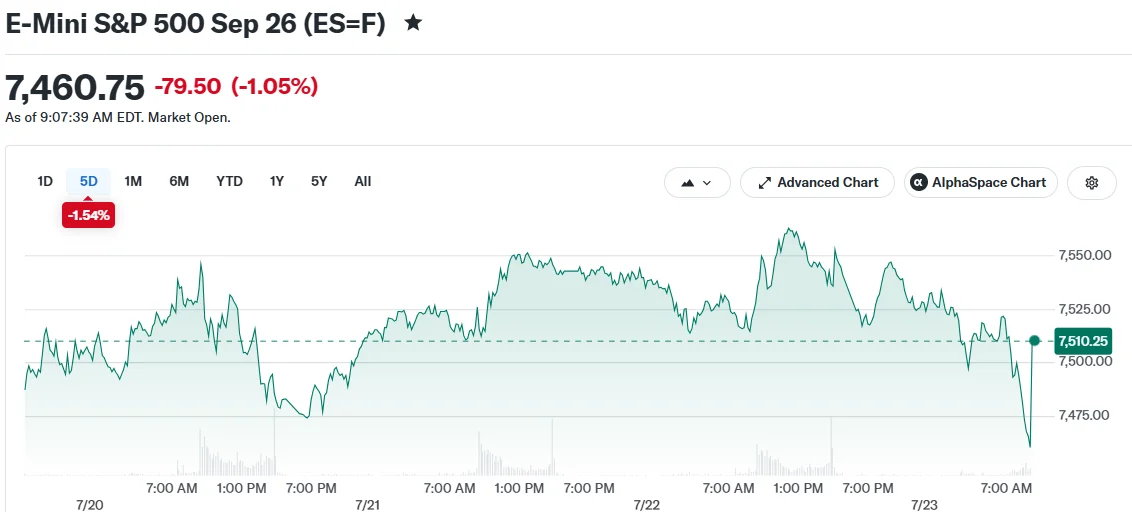
The declines extended Wednesday’s selloff on Wall Street, where major benchmarks retreated following a flurry of corporate earnings announcements.
Big Tech’s AI Investment Plans Trigger Investor Concerns
Alphabet delivered robust quarterly performance, yet its elevated capital spending forecast unsettled market participants. Traders are scrutinizing how aggressively technology giants are deploying resources into artificial intelligence infrastructure and whether these expenditures will generate adequate returns.
Tesla chief executive Elon Musk characterized 2026 as a year of substantial capital investment for the electric vehicle manufacturer. He highlighted autonomous vehicle technology, humanoid robots, and computing infrastructure as primary investment areas.

Shares of both companies faced selling pressure in early Thursday trading. These firms belong to the influential “Magnificent Seven” cohort of mega-cap technology stocks that significantly impact broader market indices.
The expanded investment commitments from these industry leaders have intensified debate surrounding artificial intelligence’s profitability potential. This uncertainty represents a primary factor behind Thursday morning’s futures weakness.
Energy Markets Rally on Escalating Geopolitical Risks
Brent crude futures climbed to $97 per barrel Thursday morning. The price level is approaching the psychologically significant $100 threshold, which could trigger additional market volatility.
West Texas Intermediate advanced to $89 per barrel. The rally intensified after Iranian-supported Houthi militants claimed responsibility for strikes against commercial tankers navigating the Red Sea, representing a dangerous expansion of tensions between the United States and Iran.
Surging energy costs drove government bond yields upward. Both 10-year and 30-year Treasury yields reached their peak levels since May, reigniting worries about persistent inflation.
Elevated yields are also diminishing expectations for Federal Reserve monetary policy easing. Some market participants had anticipated potential interest rate reductions during the latter portion of this year.
Unemployment Claims Register Historic Low
Thursday’s economic data delivered one encouraging signal through the weekly jobless claims report. Just 187,000 Americans submitted initial unemployment benefit applications during the week concluded July 18.
This figure represents a decline of 22,000 from the prior week and substantially undershot the 215,000 consensus estimate among economists. The reading marks the strongest labor market performance since May 1969.
The record low for American unemployment claims stands at 162,000, established in November 1968.
New York accounted for a significant portion of the weekly decline, reporting approximately 17,000 fewer claims compared to the previous period. Stephen Stanley, Santander’s chief US economist, attributed the movement to typical seasonal fluctuations and normalization following elevated June figures.
He emphasized that workforce reductions have remained marginally lower throughout this year relative to recent historical trends.
Market participants are additionally monitoring Thursday earnings releases from Intel, T-Mobile US, and Lockheed Martin.
Get 3 Free Stock Ebooks
Discover top-performing stocks in AI, Crypto, and Technology with expert analysis.
- Top 10 AI Stocks - Leading AI companies
- Top 10 Crypto Stocks - Blockchain leaders
- Top 10 Tech Stocks - Tech giants


