


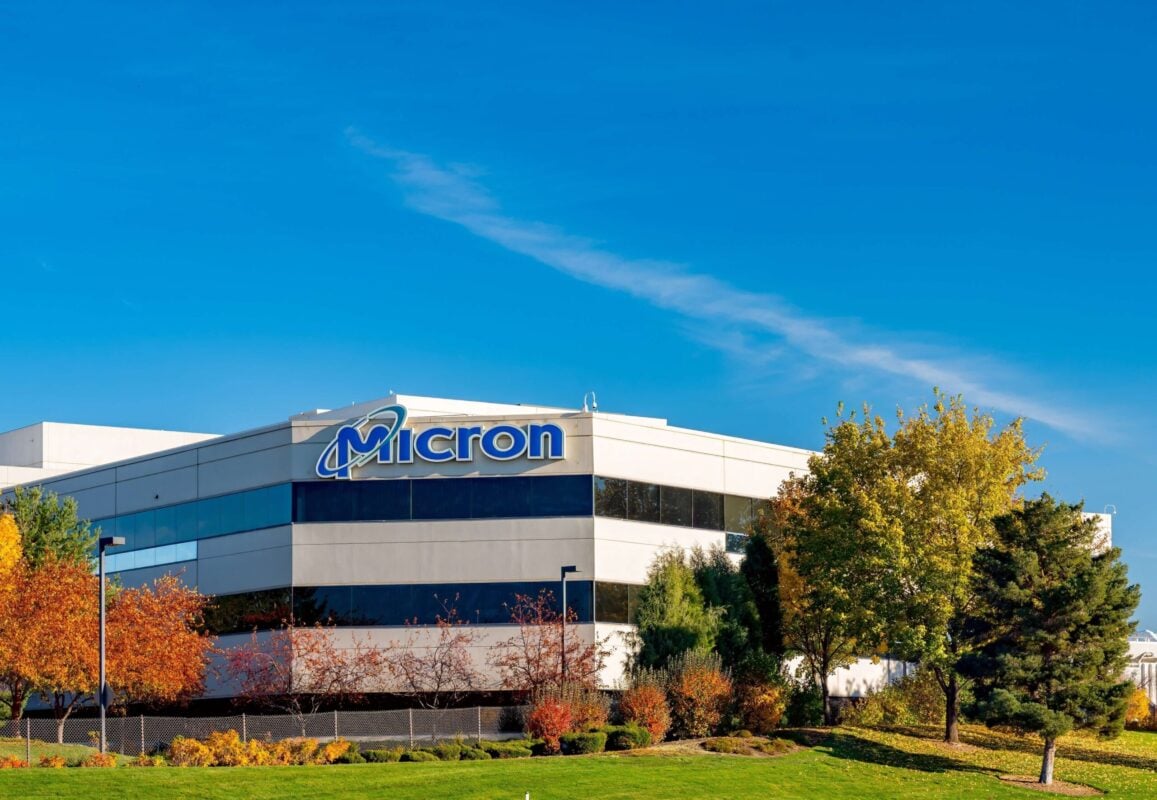
Key Highlights
- On May 26, Micron momentarily surpassed a $1 trillion valuation following UBS’s price target upgrade to $1,625 — the most bullish forecast among 46 Wall Street analysts tracking the company.
- Shares of MU soared 17.4% that session and have climbed more than 220% in 2024 alone, with gains exceeding 830% over a 12-month period.
- Second-quarter fiscal results showed revenue jumping nearly threefold to $23.86 billion, while adjusted earnings per share of $12.20 significantly surpassed the $9.19 consensus forecast.
- The semiconductor manufacturer has completely sold its 2026 allocation of HBM (high-bandwidth memory) products, and is currently manufacturing next-generation HBM4 modules for Nvidia’s Vera Rubin architecture.
- The analyst community rates the stock a “Strong Buy,” pointing to constrained AI memory availability that may extend into 2027.
Micron achieved an unexpected breakthrough on May 26 when its valuation briefly exceeded $1 trillion. Shares rocketed 17.4% to close at $881.60, after touching an intraday peak representing a 19.3% gain, following UBS’s decision to nearly triple its price objective from $535 to $1,625.
This represents the most optimistic projection among all 46 research firms monitoring the semiconductor company.
The surge represents the culmination of an extraordinary performance period. Year-to-date gains for MU exceed 220%, while the trailing 12-month return surpasses 830%, fueled by exceptional quarterly results, constrained supply conditions, and accelerating artificial intelligence demand for specialized memory solutions.
Financial Performance Driving the Momentum
The company’s second fiscal quarter delivered results that fundamentally altered Wall Street’s narrative around the stock. Revenue expanded nearly threefold on an annual basis, reaching $23.86 billion versus $8.05 billion in the prior-year period. Net income totaled $13.79 billion, translating to $12.07 per share, a dramatic increase from $1.58 billion twelve months earlier.

Adjusted earnings of $12.20 per share substantially exceeded the $9.19 analyst consensus figure. Gross margin expanded to approximately 75%, demonstrating the substantial pricing leverage Micron currently commands in the market.
Adjusted free cash flow reached $6.9 billion during the quarter. The company reported $16.7 billion in cash and marketable securities on its balance sheet.
Looking to Q3, executives provided revenue guidance of $33.5 billion — substantially above the $24.29 billion Wall Street projection at that time — alongside an adjusted EPS forecast of $19.15.
Chief Executive Sanjay Mehrotra noted the company “set new records across revenue, gross margin, EPS, and free cash flow” during Q2, with additional records anticipated in Q3.
What’s Fueling Wall Street Optimism
Following a May 26 meeting with Micron leadership, Mizuho maintained its Outperform rating and $800 price objective. Analyst Vijay Rakesh emphasized that HBM and DRAM requirements driven by AI workloads continue to outpace available supply, with critical customers experiencing shortfalls of 30% to 50% relative to their needs.
Mizuho’s research suggests this supply-demand imbalance may extend well past 2026, noting that HBM4 and HBM4e pricing could increase 70% to 100% during 2027 following anticipated pricing adjustments in Q4 2025.
The company has already allocated its entire 2026 HBM production capacity. Manufacturing of HBM4 products for Nvidia’s Vera Rubin platform is currently underway, supporting analyst confidence in sustained pricing strength.
Beyond Mizuho’s assessment, D.A. Davidson launched coverage with a Buy recommendation and $1,500 target, while Morgan Stanley and KeyBanc have expressed positive views on the stock. Wall Street’s overall rating stands at “Strong Buy,” with the consensus $1,625 target suggesting approximately 76% appreciation potential from current trading levels.
Supporting the demand narrative, Micron recently acquired Powerchip’s Tongluo manufacturing facility in Taiwan for $1.8 billion and announced plans for a second site. Management also increased its fiscal 2026 capital expenditure outlook to above $25 billion.
Not all analysts dismiss potential headwinds. Some caution that incoming capacity additions could pressure memory pricing in 2027 and 2028, and note that Micron remains fundamentally a cyclical enterprise despite the transformative AI tailwind reshaping its business model.
Micron presently trades at approximately 8.4x forward earnings, contrasting with 22x for the S&P 500 and 26x for the Nasdaq 100.
Get 3 Free Stock Ebooks
Discover top-performing stocks in AI, Crypto, and Technology with expert analysis.
- Top 10 AI Stocks - Leading AI companies
- Top 10 Crypto Stocks - Blockchain leaders
- Top 10 Tech Stocks - Tech giants


