



Key Highlights
- Morgan Stanley projects gold will exceed $5,000 per ounce by 2027
- The precious metal reached Morgan Stanley’s fourth-quarter forecast of $4,450 sooner than anticipated
- Treasury Department’s decision to expand liquidity operations caused bond yields to decline, supporting gold prices
- Major central banks like China and Poland continue accumulating gold in their reserves
- Federal Reserve anticipated to maintain current rates throughout 2026, though markets see a 33% probability of a September increase
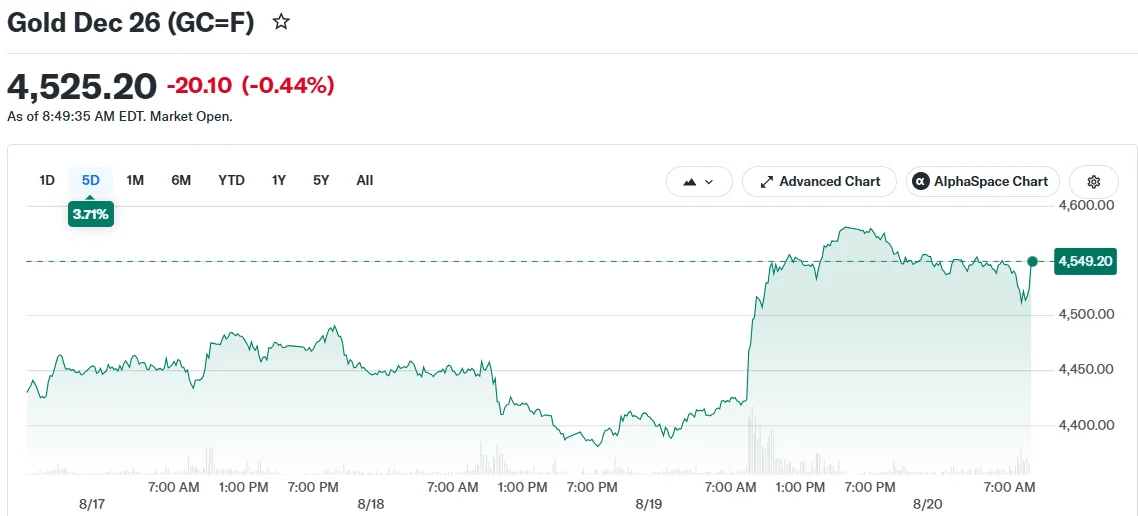
The precious metal market has experienced significant upward momentum throughout 2026. According to Morgan Stanley, gold has already achieved its Q4 price projection of $4,450 per ounce earlier than forecast, with the financial institution now anticipating prices to breach the $5,000 threshold by 2027.
In a research note, analyst Amy Gower indicated that despite the bullish trajectory, market participants should prepare for significant price fluctuations during this upward journey.
Treasury Department’s Move Fuels Price Surge
An unexpected policy shift from the U.S. Treasury Department provided substantial momentum to gold prices recently. Treasury Secretary Scott Bessent announced plans to expand certain liquidity-support mechanisms related to longer-maturity government securities by twofold.
This initiative caused yields on long-dated Treasuries to decline. Lower yields increase gold’s appeal since the opportunity cost of owning a non-interest-bearing asset diminishes.
Simultaneously, the U.S. dollar weakened, trading near its lowest point in three months. Dollar depreciation typically benefits gold valuations as it reduces the cost for international buyers using alternative currencies.

Spot gold reached its peak level since early June before experiencing a correction. By Thursday morning, spot prices had declined approximately 0.8% to $4,487 per ounce amid profit-taking activity. Gold futures held relatively stable around $4,544 per ounce.
Persistent Central Bank Accumulation
Central bank purchasing activity has provided consistent support for gold prices. Morgan Stanley reports that China has accumulated 60 tons of gold year-to-date, representing its largest purchases since 2023. Poland has increased its holdings by 82 tons, elevating total reserves to 632 tons while pursuing a 700-ton objective.
The financial institution notes that monetary authorities have strategically utilized price pullbacks to expand their reserves, establishing effective price support levels.
Regarding investor demand, exchange-traded fund flows have shown improvement. Following outflows totaling 93 tons during May and June, ETFs attracted 70 tons in July and August. Morgan Stanley attributes this turnaround to reduced expectations for Federal Reserve rate increases.
Morgan Stanley’s economic team forecasts the Federal Reserve will maintain its current policy stance throughout 2026. Recent Fed meeting minutes revealed ongoing inflation concerns, with numerous policymakers willing to consider rate increases if price pressures fail to moderate toward the 2% objective.
Market pricing suggests approximately a one-in-three likelihood of a rate increase at September’s policy meeting, based on CME FedWatch data.
U.S. government debt has surpassed $40 trillion for the first time, intensifying questions about the nation’s fiscal sustainability. Morgan Stanley observed that gold has begun diverging from real yields, appreciating even while long-term yields remained unchanged, suggesting fiscal concerns are driving prices beyond traditional yield considerations.
Potential headwinds persist. Forthcoming U.S. inflation reports could alter rate expectations, and short positions on COMEX gold futures have fallen to levels not seen since April 2020, limiting the potential for short-squeeze rallies to propel prices higher.
Get 3 Free Stock Ebooks
Discover top-performing stocks in AI, Crypto, and Technology with expert analysis.
- Top 10 AI Stocks - Leading AI companies
- Top 10 Crypto Stocks - Blockchain leaders
- Top 10 Tech Stocks - Tech giants


