



Key Takeaways
- Investment bank reduces Q3 2026 Brent crude projection by $15 to $75 per barrel
- Daily tanker movements through Strait of Hormuz normalize to 30-40 vessels
- Analysts forecast 4.8 million barrel per day oversupply by 2027
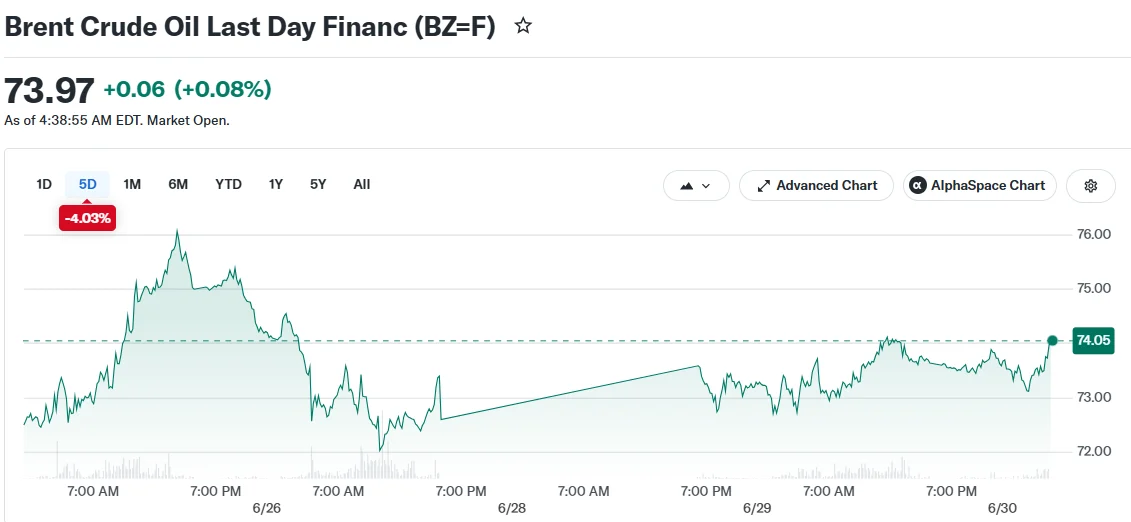
- Brent prices plummet from April high of $126 to below $74
- Crude markets face third consecutive monthly drop and worst quarterly showing since early 2020
Major investment firm Morgan Stanley has revised downward its oil price projections following an unexpectedly swift recovery in shipping activity through the Strait of Hormuz. The financial institution slashed its Q3 2026 Dated Brent prediction by $15, establishing a new target of $75 per barrel.
The revision follows a four-month period of disruption that significantly impacted petroleum shipments through this critical maritime chokepoint. The strait serves as an essential corridor for Middle Eastern oil exports.
Shipping Activity Returns to Normal Levels
Morgan Stanley researchers documented 35 oil and natural gas tankers departing the Persian Gulf via the strait on Thursday. This figure aligns with the typical 30 to 40 vessel range observed before hostilities commenced in February.
This represents the first occasion since the conflict’s outbreak that shipping volumes have returned to standard levels. Tanker operators and their personnel have demonstrated renewed confidence in traversing the waterway, according to the bank’s assessment.
Shipping activity experienced a temporary slowdown over the weekend following attacks on two vessels during renewed fighting. However, the broader pattern indicates sustained recovery.

For the petroleum market to achieve equilibrium in 2027, Hormuz throughput needs only to reach approximately 65% of pre-conflict volumes. This translates to about 11 to 12 million barrels daily, Morgan Stanley estimates.
Market Outlook Shifts from Shortage to Glut
The financial institution currently anticipates a worldwide petroleum oversupply of 4.8 million barrels per day throughout 2027. Prior to the conflict, Morgan Stanley had forecast a more modest surplus ranging from 2 million to 3 million barrels daily.
The strait’s temporary closure had momentarily transformed that projected surplus into a substantial deficit. With export operations resuming, market conditions are reverting toward excess supply.
Robust American oil production and sluggish Chinese consumption are compounding oversupply concerns. Morgan Stanley identified these dual factors as persistent downward pressures on pricing.
The bank additionally reduced its Q4 2026 projection to $75 per barrel from a previous $80 estimate. For 2027’s first six months, it now anticipates Brent at $75 per barrel, declining to $70 during the latter half.
This represents Morgan Stanley’s second forecast adjustment since the United States and Iran reached an accord to suspend hostilities and reopen the strait earlier this month.
Brent futures had surged beyond $126 per barrel in April amid peak conflict tensions. Those substantial gains have now completely evaporated.
The most actively traded September Brent contract settled at $73.91 per barrel Monday. Prices continued their descent Tuesday, with August Brent futures declining 0.9% to $72.47 per barrel.
US West Texas Intermediate crude for August delivery dropped 0.5% to $70.24 per barrel. Crude is currently positioned for its third straight monthly decline.
This would represent the poorest quarterly performance for petroleum markets since early 2020. Iranian and American negotiation teams were anticipated to convene in Doha this week, though Iran announced Monday that no session had been arranged.
Weekend missile exchanges between both parties challenged the provisional ceasefire that concluded the four-month conflict.
Get 3 Free Stock Ebooks
Discover top-performing stocks in AI, Crypto, and Technology with expert analysis.
- Top 10 AI Stocks - Leading AI companies
- Top 10 Crypto Stocks - Blockchain leaders
- Top 10 Tech Stocks - Tech giants


