


Executive Summary
- Nestlé shares have plummeted approximately 41% from their early 2022 peak, erasing around $177 billion in shareholder value during a challenging period.
- CEO Philipp Navratil is eliminating 16,000 positions globally and concentrating resources on coffee, pet care, snacks, and nutrition — aiming for 3%–4% organic expansion in 2025.
- Q1 2026 real internal growth (RIG) increased 1.2% compared to the prior year, triggering a 5.9% daily gain — the strongest rally since October 2025.
- The company negotiated with Spanish unions to trim planned workforce reductions by 20%, lowering cuts from 301 to no more than 242 jobs.
- Shareholder activists want Nestlé to divest its ~$47 billion L’Oréal position for share repurchases, while GLP-1 medications and geopolitical tensions present ongoing challenges.
Nestlé (NESN) shares have declined roughly 41% from their early 2022 highs, a painful downturn that erased approximately $177 billion in market capitalization. The Swiss consumer goods powerhouse has cycled through three chief executives in just over a year, confronted failed acquisition attempts, and reported consecutive quarters of underwhelming revenue performance.
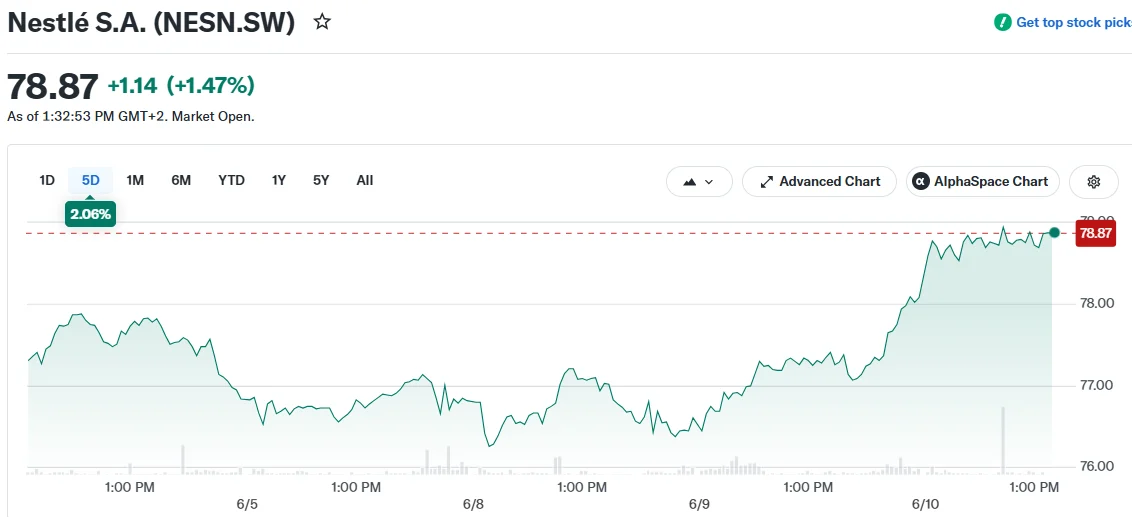
Philipp Navratil, who assumed the CEO role in September 2025, now shoulders responsibility for executing the recovery. His approach has been decisive.
Navratil unveiled plans to eliminate 16,000 positions worldwide — approximately 6% of total headcount — anticipating the reorganization will generate around CHF3 billion ($3.8 billion) in savings through 2027. The workforce reduction initiative is actively progressing throughout European operations.
This week in Spain, Nestlé finalized an arrangement with labor organizations to decrease the targeted job eliminations to a ceiling of 242 roles, down from the originally proposed 301. That represents a 20% decrease. The agreement encompasses severance provisions, a resource pool for displaced workers, and mechanisms for internal reassignment.
The reductions affect various Nestlé facilities throughout Spain, including the Girona production site — Europe’s largest instant coffee manufacturing center and the third-largest globally for the company.

Volume Metrics Begin Improving
Beyond workforce adjustments, Navratil is reshaping Nestlé’s brand portfolio. He’s divesting slower-performing segments like San Pellegrino and portions of the Häagen-Dazs franchise, while intensifying investment in coffee, pet care, snacking, and nutrition categories.
His primary performance indicator is RIG — real internal growth — which tracks unit volume expansion independent of pricing actions. During the first quarter of 2026, RIG climbed 1.2% year-over-year across the majority of business units. The announcement triggered a 5.9% single-day share price increase, marking the strongest performance since October 2025.
The equity currently trades near 18 times projected earnings, below its five-year historical average of 23 times.
Navratil’s inaugural acquisition as CEO was revealed earlier this month: a complete acquisition of ready-to-drink nutrition brand yfood Labs, which generated approximately €150 million in revenue during 2025 while maintaining double-digit expansion rates.
Material Risk Factors Under Scrutiny
The transformation narrative faces meaningful obstacles.
Nestlé maintains roughly a 20% ownership position in L’Oréal, currently valued near $47 billion. Certain shareholders, including Christopher Rossbach of J. Stern from Barron’s Roundtable, are advocating for liquidation of the stake to fund share buyback programs. CFO Anna Manz has resisted this suggestion, characterizing the investment as “a very high-performing investment.”
GLP-1 weight-management pharmaceuticals represent another consideration, as certain patients demonstrate reduced overall food consumption. Navratil has countered by emphasizing that Nestlé markets nutrition solutions, not merely caloric products.
Geopolitical instability also warrants attention. Continued friction surrounding the Strait of Hormuz could elevate commodity input expenses, constraining Nestlé’s pricing flexibility — the identical challenge that eroded market position during 2022 and 2023 when the company implemented price increases of 8.2% and 7.5%, respectively.
Nestlé is pursuing organic revenue growth of 3% to 4% for the current year. Analysts view this objective as ambitious. Projected annual free cash flow is expected to reach CHF12.9 billion by 2030, advancing from CHF9.2 billion currently.
The corporation has raised its dividend payment annually since 1996. During the most recent period it distributed CHF3.10 per share, representing a yield of 3.94%.
Get 3 Free Stock Ebooks
Discover top-performing stocks in AI, Crypto, and Technology with expert analysis.
- Top 10 AI Stocks - Leading AI companies
- Top 10 Crypto Stocks - Blockchain leaders
- Top 10 Tech Stocks - Tech giants


